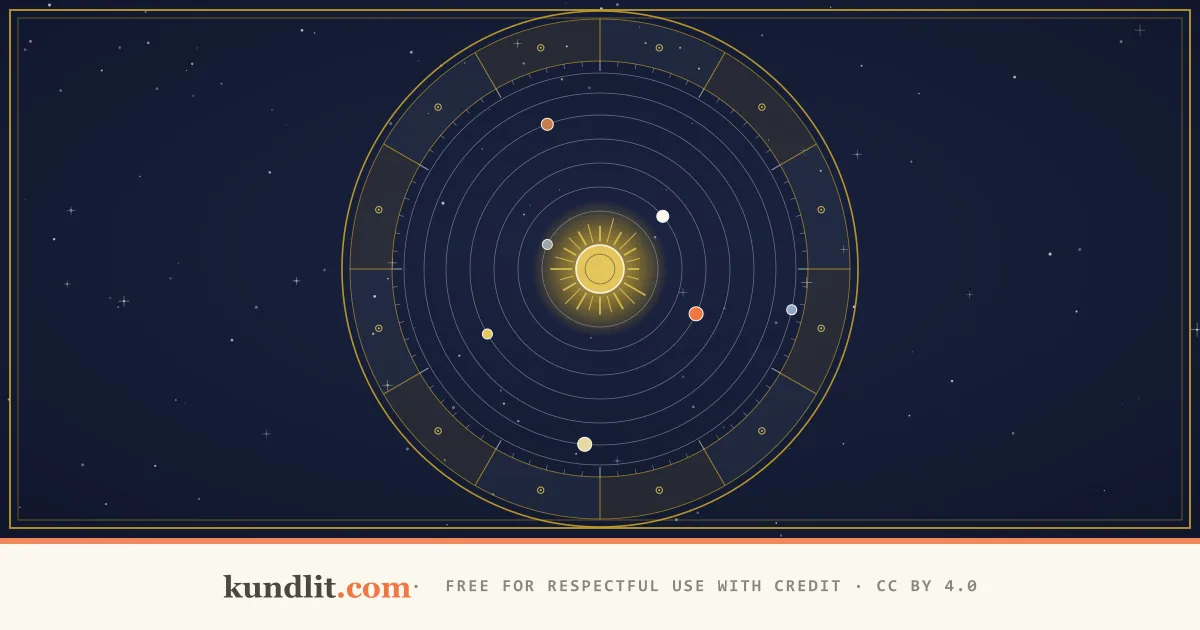

Western astrology is the horoscopic tradition that works in the tropical zodiac — the band of signs measured from the vernal equinox, the moment each year when the Sun crosses the celestial equator and day and night are equal. The wheel has twelve signs, twelve houses, and five main aspects — conjunction, sextile, square, trine and opposition — the “Ptolemaic” aspects named for Claudius Ptolemy's Tetrabiblos, the 2nd-century handbook that codified how they were read.
On this site every western chart is computed with the Swiss Ephemeris in the tropical zodiac. The default traditional mode follows the whole-sign framework of the Hellenistic astrologers — the system Vettius Valens worked in — with the seven classical planets, and cites the claims it renders to Ptolemy, Valens and William Lilly. A modern mode offers Placidus houses, the ten-planet set that includes Uranus, Neptune and Pluto, and the full aspect grid. All twenty free western calculators are listed below.
The single most important fact about western astrology is where it starts measuring. The tropical zodiac is anchored to the seasons (the equinoxes and solstices); the Vedic (sidereal) zodiac is anchored to the fixed stars. Because the equinoxes drift against the stars — about one degree every 72 years — the two zodiacs currently sit roughly 24 degrees apart. A planet at 15° Aries in the tropical zodiac sits around 21° Pisces sidereal. That is why your Vedic sun sign is often one sign behind your western one, and why the same birth time can produce two different charts.
| What | Western (Tropical) | Vedic (Sidereal) |
|---|---|---|
| Zodiac | Tropical — measured from the vernal equinox | Sidereal — measured against the fixed stars (Lahiri ayanamsa) |
| House system | Whole-sign (traditional) or Placidus/Equal (modern) | Whole-sign |
| Timing techniques | Transits, annual profections, zodiacal releasing, solar returns | Vimshottari dasha, gochar (transits), yogas |
| What it foregrounds | Aspects, houses, psychological profile | Dashas, yogas, nakshatras |
Neither system is “wrong”: they read the same sky from different reference points, and each is a complete tradition with its own timing techniques. If you want the full worked comparison — including why your “big three” can change between systems — our post Your Big Three vs Your Vedic Three goes through it in depth. Both systems are available on this site: the Janam Kundali is the Vedic side, this page is the western side.
Your birth chart calculator computes the same sky twice, in the two modes western astrologers actually use.
Traditional mode is the Hellenistic chart: whole-sign houses and the seven classical planets (no Uranus, Neptune or Pluto), with every judgement it renders — dignities, sect, condition — cited to the classical sources: Ptolemy, Valens, Lilly. It is the default here because it is the most historically defensible and the least ambiguous: a planet is in a house, or it is not.
Modern mode switches to Placidus houses and adds the three outer planets, so your chart shows ten planets and the full grid of Ptolemaic aspects. This is the mode behind most popular horoscopes today. Both modes use the same Swiss Ephemeris calculation and the same tropical zodiac — only the interpretive framework changes.
One honest technical note: Placidus houses are undefined at latitudes above 66 degrees north or south, where some degrees of the ecliptic never rise. If your birthplace is inside a polar circle, modern mode will tell you so rather than fake a chart — the traditional whole-sign mode is the honest option for polar births.
Twenty free calculators, grouped by what they answer. All computed with the Swiss Ephemeris in the tropical zodiac, all free, no signup.
New to reading tropical charts? Start with these in-depth guides:
Two quick tools to go with them: the Western Moon Sign Calculator and the Rising Sign Calculator.
Western astrology's working picture is the wheel: the twelve zodiac signs as a ring, the planets placed around it, and the whole arrangement anchored to the ascendant — the sign rising on the eastern horizon at the moment of birth.

The computation is deterministic astronomy: given a birth time and place, the Swiss Ephemeris returns the same planet positions every time. The interpretation is a different matter — astrology describes tendencies and patterns of temperament, not fixed outcomes. We state the positions precisely and the interpretations honestly, as tradition-based readings rather than predictions you can bank on.
Three practical differences. First, the zodiac: western uses the tropical zodiac measured from the vernal equinox, Vedic uses the sidereal zodiac measured against the fixed stars — currently about 24 degrees apart, which shifts most planets one sign back in Vedic. Second, house systems: whole-sign or Placidus in western, whole-sign in Vedic. Third, timing: western relies on transits, profections, zodiacal releasing and solar returns; Vedic uses Vimshottari dasha periods and gochar, plus yogas and nakshatras that western astrology does not foreground.
Neither is better — they are different traditions asking different questions. If you grew up with horoscope columns and sun signs, the tropical system will feel familiar. If you want the Indian tradition with its dasha timing and nakshatras, Vedic is the one. Both are available on this site: the western calculators on this page, and the Janam Kundali for the Vedic chart.
The houses divide the sky into twelve areas of life, starting from the ascendant: self, money, communication, home, creativity, work and health, relationships, transformation, philosophy, career, community and the unconscious. Each planet lands in a house as well as a sign, which is why two people with the same sun sign can read very differently. Our Houses in Astrology guide walks through all twelve.
Your rising sign (ascendant) is the sign that was rising on the eastern horizon at your exact birth time and place. It changes roughly every two hours, so it needs a precise birth time. Enter yours in the Rising Sign Calculator and you will get the sign, its degree and the house layout of your chart.
Yes. The Birth Chart Calculator is completely free, with no signup — you get the full chart in both traditional and modern modes: your planets, houses and dignities, with the aspect grid in modern mode.
One thing we will be plain about: this site is built on the Vedic (sidereal) tradition, and that is the tradition of our paid readings. The western layer exists alongside it as a complete, free, well-computed tropical toolkit — the two traditions are kept cleanly separate, never blended into one chart.
The Vedic counterpart of this page is the Janam Kundali, where the same birth details are charted against the fixed stars (Lahiri ayanamsa) with Vedic house and dasha frameworks. If you come from a western-astrology background and want a professional reading, the paid Birth Chart Reading is an honest option — with one thing made explicit: it is a Vedic sidereal reading, prepared in the classical Indian tradition, not a tropical one. Your planets will appear in the sidereal signs, and the analysis works through dashas and yogas. We would rather you know exactly what you are buying than dress a Vedic reading up as tropical.
Start with the free Birth Chart Calculator to see your tropical chart in both modes, or order the paid Birth Chart Reading for the full written Vedic analysis.