

Your Big Three vs Your Vedic Three: Sun, Moon and Rising in Two Zodiacs
- big-three
- sun-moon-rising
- tropical-vs-sidereal
- western-astrology
- vedic-astrology
Read with context
- Sources and context stay close to the text
- Interpretations are presented as guidance
If you have read astrology content on almost any Western site, your "big three" are your Sun sign, your Moon sign, and your rising sign — the three placements treated as the core of a personality reading.
In Vedic astrology the same trio exists. It is called the Surya rashi (Sun sign), the Chandra rashi (Moon sign), and the lagna (rising sign, or ascendant). The difference is the zodiac in which those positions are measured: Vedic astrology uses the sidereal zodiac, fixed to the background stars, while Western astrology uses the tropical zodiac, fixed to the seasons. Because the two frames are offset by roughly 24 degrees today, two — and sometimes all three — of your signs usually shift when you look yourself up in the other system.
Neither system is wrong. They read the same sky from two different starting points. This guide explains what the big three mean in each system, why the signs shift, and how to choose which one to use.
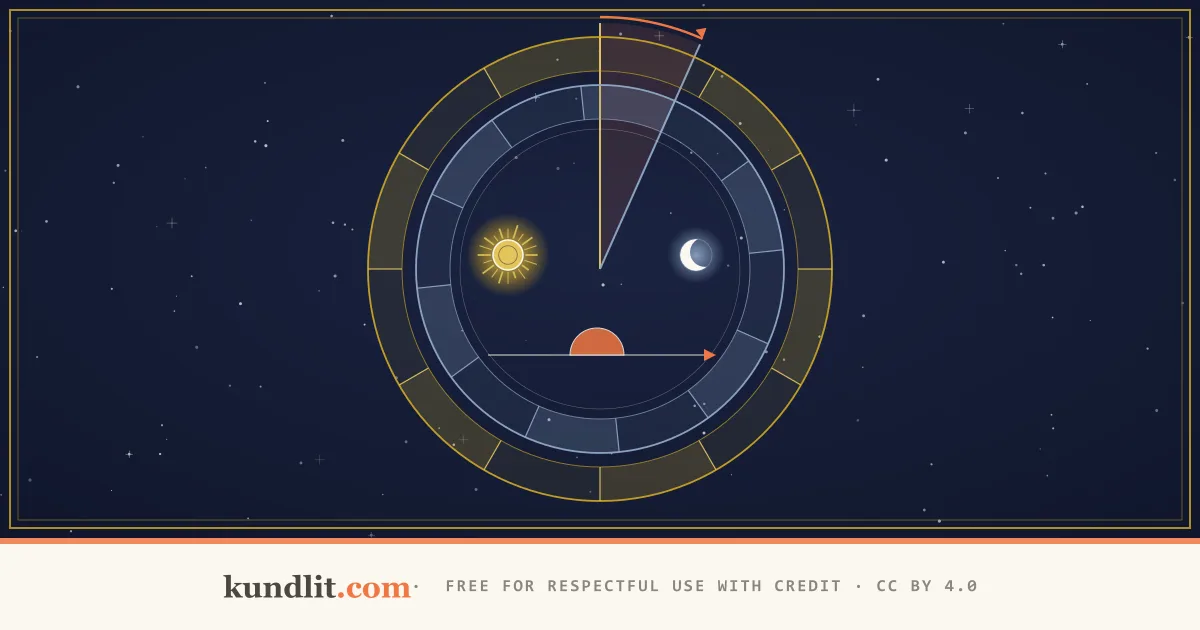
The tropical and sidereal zodiacs drawn as two rings, offset by the roughly 24 degree ayanamsa — the whole disagreement in one picture. Image by kundlit.com, CC BY 4.0 — free to reuse with credit.
What the big three are (Western astrology)
In modern Western practice the big three are the three placements an astrologer reaches for first, in this order:
- Sun sign — your core identity, ego, and conscious will. It is what you are "supposed to be" when someone asks what sign you are. See Sun Sign Calculator.
- Moon sign — your emotional nature, instincts, and inner world. It shows how you react underneath the surface. See Western Moon Sign Calculator.
- Rising sign (ascendant) — your outer personality and how others first perceive you. It is the sign that was rising on the eastern horizon at your birth. See Rising Sign Calculator.
The three work as a stack: the Sun is the engine, the Moon is the weather, and the rising sign is the paint job. If you want all three at once, the Big Three Calculator does the whole stack in one go.
The Vedic three
Vedic astrology reads the same three positions, under their own names and in the sidereal zodiac. The emphasis, though, is distributed differently.
- Lagna (ascendant) — the anchor of the entire chart; every house is counted from it. The classical texts are explicit about its weight: Saravali (Ch. 5) records the teaching — credited there to Chudamani Acharya — that the strength of the ascendant equals that of its lord, so the rising sign and its ruler carry the whole reading. See Lagna Calculator.
- Chandra rashi (Moon sign) — where the Vedic emphasis on the Moon comes from. Saravali (Ch. 4, slokas 1-2) assigns the Moon as the significator of the mind, and a Vedic chart traditionally names a person by their Moon sign rather than their Sun sign. That is why two people born on the same day can be "different signs" in Vedic practice — their Moons differ. See Rashi Calculator.
- Surya rashi (Sun sign) — the significator of the soul. Hora Sara opens its first chapter calling the Sun "the soul of the Universe." See Janam Kundali for the full chart with all three positions.
Notice what differs beyond the zodiac itself: Western practice puts the Sun on top; Vedic practice puts the Moon and the lagna on top. Same planets, different frame.
Why your signs change: tropical vs sidereal, and the ayanamsa
This is astronomy, not scripture, so it can be stated plainly. The tropical and sidereal zodiacs coincided roughly 2,000 years ago. Since then, the slow wobble of Earth's axis — the precession of the equinoxes — has shifted the tropical frame backward against the stars by about 1 degree every ~72 years. The accumulated gap between the two frames is called the ayanamsa, and it stands at about 24 degrees today.
The result is a simple subtraction. Every planet's sidereal position is its tropical position minus roughly 24 degrees.
A worked example makes it concrete:
Someone with the Sun at 10 degrees of tropical Aries has it at about 16 degrees of sidereal Pisces: subtract ~24 degrees from the tropical longitude (10 minus 24 equals -14), and since -14 degrees means moving backward into the previous sign, add 30 to get 16 degrees of Pisces.
Check the arithmetic yourself: 10 minus 24 is -14, and -14 plus 30 is 16 — 16 degrees into the sign before Aries, which is Pisces. The subtraction crosses a sign boundary whenever a placement sits in the first roughly 24 degrees of its tropical sign — about four times in five. So the Moon usually lands in a different sign sidereally, and the rising sign usually shifts too.
On this site, the Vedic tools use the Lahiri ayanamsa, the standard adopted by Indian panchangs, while the western tools use the tropical zodiac via the Swiss Ephemeris. Both are legitimate; they are simply two different zero points on the same wheel.
Which one should you use?
The honest answer is: use the system whose tradition you want to work in. If you want the seasonal, psychological reading popular in the West, work tropical. If you want the classical Indian reading — dashas, transits against the fixed stars, the Moon-first chart — work sidereal.
There is no gatekeeping in either direction. On this site the western tools are labelled tropical and the Vedic tools are labelled sidereal, and each calculator links its counterpart. The Western Astrology hub collects all the tropical tools in one place.
Just do not mix frames mid-reading — interpreting a sidereal Moon through a tropical Moon-sign column will simply be wrong. Pick one zero point and stay consistent.
FAQ
Why is my moon sign different in Vedic astrology?
Because the Moon's sidereal position is its tropical position minus about 24 degrees. Subtracting the ayanamsa can move a placement back one sign at most — and for about four birth charts in five, the Moon does cross that boundary. So the Moon sign you know from Western astrology is usually not the Chandra rashi the Vedic chart names you by.
Can my rising sign change between systems?
Yes. Like every placement, the ascendant sits about 24 degrees earlier in the sidereal frame, so it changes sign whenever it rises in the first roughly 24 degrees of its tropical sign — about four charts in five. And because the ascendant moves through roughly a degree every four minutes of clock time, a precise birth time matters even more in Vedic practice.
Is sidereal more accurate than tropical?
Neither system is "more accurate" — they answer different questions. The tropical zodiac measures from the equinox, so it tracks the seasonal cycle, which is why its Sun-sign system reads strongly in psychological and seasonal terms. The sidereal zodiac measures against the fixed stars, so it tracks the sky the classical Indian texts described, which is why it reads strongly in karmic and timing terms. Both describe the same sky; they just index it differently.
Do all three signs always change?
No. A placement more than 24 degrees into a tropical sign stays in the same sign sidereally — only its degree changes. A Sun at 28 degrees of tropical Leo, for instance, lands at about 4 degrees of sidereal Leo. A placement shifts sign only when it sits in the first roughly 24 degrees of its tropical sign — which is about four times in five, and the same odds apply independently to the Sun, the Moon and the rising sign. Two or three of them changing is typical; all three keeping their signs happens, but it is rare.
Big Three at a glance
| Placement | Tropical (Western) frame | Sidereal (Vedic) frame |
|---|---|---|
| Zodiac zero point | Spring equinox (seasonal) | Fixed background stars |
| Sun | Sun sign — core identity, conscious self | Surya rashi — the soul significator, vitality |
| Moon | Emotional nature, instincts | Chandra rashi — the mind; often the name-sign |
| Rising sign | Outer personality, first impressions | Lagna — anchor of the chart, equal in strength to its lord |
| Typical emphasis | Sun first | Moon and lagna first |
| How a person is named | By Sun sign | By Moon sign |
About the image on this page
The cover illustration on this page is an original Kundlit graphic released under the Creative Commons Attribution 4.0 licence. You are free to reuse it anywhere, provided you credit kundlit.com — the caption above the image carries the licence notice as well.
Sources
- Saravali (Kalyana Varma; R. Santhanam's translation) — the Moon as significator of the mind (Ch. 4, slokas 1-2) and the strength of the lagna as equal to that of its lord, a view Saravali credits to Chudamani Acharya (Ch. 5).
- Hora Sara (Prithuyasas) — the Sun as the soul of the Universe, stated in the opening chapter.
- The ayanamsa figures on this page — the ~24 degree offset, the ~1 degree per ~72 years precession rate, and the rough 2,000-year coincidence of the two zodiacs — are astronomy. No scriptural citation is given or implied for them.
The fastest way to see your two trios side by side is to run the numbers. The free Big Three Calculator shows your tropical Sun, Moon, and rising signs, and the Janam Kundali builds the full sidereal chart with your lagna and Chandra rashi. For a deeper interpretation, the paid Kundali Analysis is a complete classical reading.