

How to read your Janam Kundali, step by step
- janam-kundali
- birth-chart
- how-to
- vedic-astrology
- basics
Read with context
- Sources and context stay close to the text
- Interpretations are presented as guidance
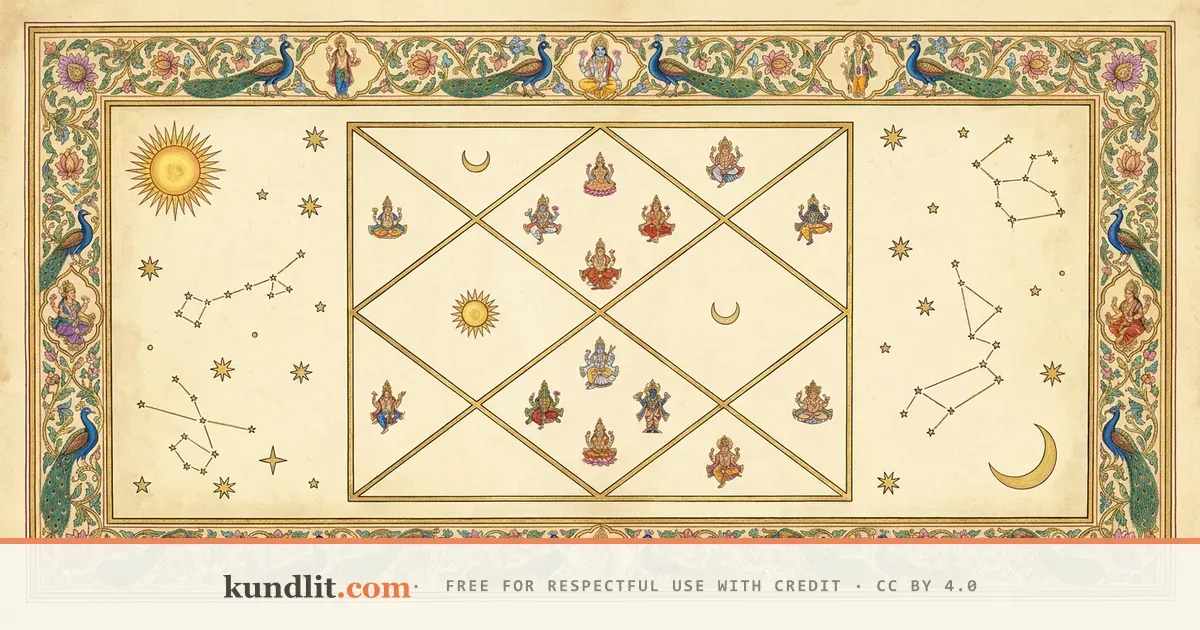
A janam kundali is a map of the sky at the exact minute you were born, drawn from where you were born. Learning to read it is not mystical. It is a skill with a fixed grammar: a handful of symbols, arranged in a fixed grid, that you read in a fixed order.
This guide walks through that order the way a classical reading is built up — Lagna first, then the houses, then the grahas, then the dasha clock that tells you when. By the end you will be able to look at your own chart and understand what it is actually saying, instead of waiting for someone to tell you to be afraid.
You will need your accurate birth date, time, and place, and a chart generated from them. Birth time matters most: a difference of a few minutes can move your Lagna into the next sign and change the whole reading.
First, what the chart actually is
The kundali freezes two things forever: the twelve houses (the framework of life areas, called bhavas) and the position of the nine grahas (the planets) within them at your birth. The houses never move. The planets in the sky kept moving the instant after you were born — but your chart holds that one frame for life.
In a North Indian chart the houses are fixed diamonds and the signs rotate through them; in a South Indian chart the signs are fixed boxes and the houses rotate. Either way you are reading the same three things: which sign rises, where the houses fall, and which grahas sit where.
A chart is descriptive, not a sentence handed down. It describes the conditions you started with. What you do inside them stays yours.
Step 1 — Find your Lagna (the rising sign)
The Lagna, or ascendant, is the sign that was rising on the eastern horizon at your birth. It is the single most important reference point in the whole chart. The classical texts treat the Lagna as the seat of the body, vitality, and the overall direction of life — every other house is counted from it. Brihat Parashara Hora Shastra, the foundational text of this system, opens its analysis of a horoscope from the Lagna for exactly this reason.
Find the house marked as the 1st. The sign sitting there is your Lagna. Whichever planet rules that sign becomes your Lagna lord, and where that lord sits — strong or weak, well-placed or troubled — colours the entire reading. So your first two questions are always: what is my Lagna, and where is its lord?
Step 2 — Learn the twelve houses
The twelve houses are the fixed grammar of the chart. Their meanings do not change; only the signs and planets inside them do. The classical significations (drawn from the Bhava chapters of Brihat Parashara Hora Shastra and echoed in Phaladeepika) are:
- 1st house — the self, body, temperament, overall life
- 2nd house — wealth, family, speech, what you accumulate
- 3rd house — siblings, courage, effort, communication
- 4th house — mother, home, property, inner peace
- 5th house — children, intelligence, creativity, past merit
- 6th house — health, debts, obstacles, daily work, adversaries
- 7th house — marriage, partnership, business relationships
- 8th house — longevity, upheaval, inheritance, hidden things
- 9th house — fortune, dharma, higher learning, father, the guru
- 10th house — career, status, public action
- 11th house — gains, income, networks, fulfilled desires
- 12th house — expenses, loss, foreign lands, sleep, liberation
When a question brings you to your chart, go straight to the house that owns it: the 7th for partnership, the 10th for career, the 6th for health and obstacles, the 2nd and 11th for money.
Step 3 — Place the nine grahas
The nine grahas are the Sun (Surya), Moon (Chandra), Mars (Mangala), Mercury (Budha), Jupiter (Guru), Venus (Shukra), Saturn (Shani), and the two lunar nodes Rahu and Ketu. Each carries a core significance:
- Sun — soul, vitality, authority, the father
- Moon — the mind and emotions (manas); in Jyotish the Moon is so central that much of a reading is judged from it, not just from the Lagna
- Mars — energy, drive, courage, conflict
- Mercury — intellect, speech, analysis
- Jupiter — wisdom, growth, expansion, grace
- Venus — love, comfort, art, relationship
- Saturn — discipline, time, limit, labour, consequence
- Rahu and Ketu — the karmic axis: craving and over-reach (Rahu), detachment and the unfinished (Ketu)
Note where each graha sits — which house and which sign. A planet in its own sign or exalted is strong and gives its results cleanly; a planet debilitated or hemmed in by malefics struggles to. This is dignity, and it is why the same planet can be a blessing in one chart and a strain in another.
You also need the aspects (drishti). Every planet aspects the 7th house from itself; Saturn additionally aspects the 3rd and 10th, Mars the 4th and 8th, and Jupiter the 5th and 9th. An aspect lets a planet influence a house it does not sit in — which is why you can never read a house in isolation.
Step 4 — Read the combinations
Now you combine the three layers: planet + sign + house. A graha expresses its nature (planet), through a particular style (sign), in a particular life area (house). Jupiter in the 10th house brings growth and grace to career; Saturn in the 7th brings duty, delay, and durability to partnership.
Repeating combinations form yogas — recognised patterns that, taken together, point to a leaning. A raja yoga (a combination linking a trine and an angle, described at length in Brihat Parashara Hora Shastra) points toward status and success; a daridra or kemadruma pattern points to struggle. Hold these lightly: a single yoga is rarely the whole story, and the texts themselves warn that one combination can cancel or modify another. Read the whole chart before you weigh any one part.
Step 5 — Read the dasha clock for timing
A chart shows what is possible. The dasha system shows when. The most widely used is the Vimshottari dasha, a 120-year cycle of planetary periods keyed to the nakshatra (lunar mansion) your Moon occupied at birth — its calculation from the Moon's nakshatra is set out directly in Brihat Parashara Hora Shastra. The major period running (mahadasha), with its sub-period (antardasha), tells you which planet's themes are loud in your life right now.
This is what separates an honest reading from a vague one. Instead of "you will be successful," a careful reading says "this support exists, and your Jupiter period from these years is when it is most likely to mature." Timing is the difference between a horoscope and a fortune cookie.
A chart shows the soil and the season. It does not show what you decide to plant, or how you tend it.
Where reading honestly stops
A janam kundali will not give you a date of death, a guaranteed salary figure, or a yes-or-no on a person you have not met. Any reading that promises those is selling certainty the chart cannot back. The honest answer to "will this definitely happen?" is almost always "this is supported, and here is when the pressure builds."
It also cannot override your effort. A supportive period rewards work; it does not replace it. A difficult period asks for patience; it does not forbid progress. And if a word like Sade Sati or Mangal dosha appears, treat it as a chapter heading, not a curse — every chart has hard chapters and easy ones.
Putting it together
Read in this order and a kundali stops being intimidating: Lagna → houses → grahas and their dignity and aspects → combinations → dasha. Start with the Lagna and the Moon to set the stage, then go to the house tied to your question, see what supports and what pressures it, and use the dasha as the calendar.
If you want to go deeper without learning the whole system yourself, our Kundali Analysis reads your chart this way end to end, and the Deep Kundali Dive-In extends it across the divisional charts and dashas. Curious where the numbers in your birth date point first? The free numerology tool is an easy starting place. A janam kundali, read in order, is just a fair picture of the conditions you started with — and a clear one, once you know the grammar.