

Birth Chart Analysis: How to Actually Read a Birth Chart, Step by Step
- birth-chart-analysis
- birth-chart
- how-to-read
- western-astrology
- vedic-astrology
Read with context
- Sources and context stay close to the text
- Interpretations are presented as guidance
A birth chart analysis is the process of taking the snapshot of the sky at your birth and turning it into a readable picture of temperament, life areas, and timing. Done properly, it follows a fixed order: first the planet positions, then how strong or weak each planet is (dignity), then which houses they occupy, then how they interact (aspects), and finally when their themes activate (timing).
The good news: the first and most error-prone layer — the raw computation — is freely available on this site in both major systems. You can generate your Western birth chart and your Vedic janam kundali at no cost — both computed from a real Swiss Ephemeris engine, and the Western chart's traditional mode cites its classical rules to their sources. What a free computation does not do is weigh one factor against another — that weighing is the actual analysis, and this guide shows you the order in which a careful analyst does it.
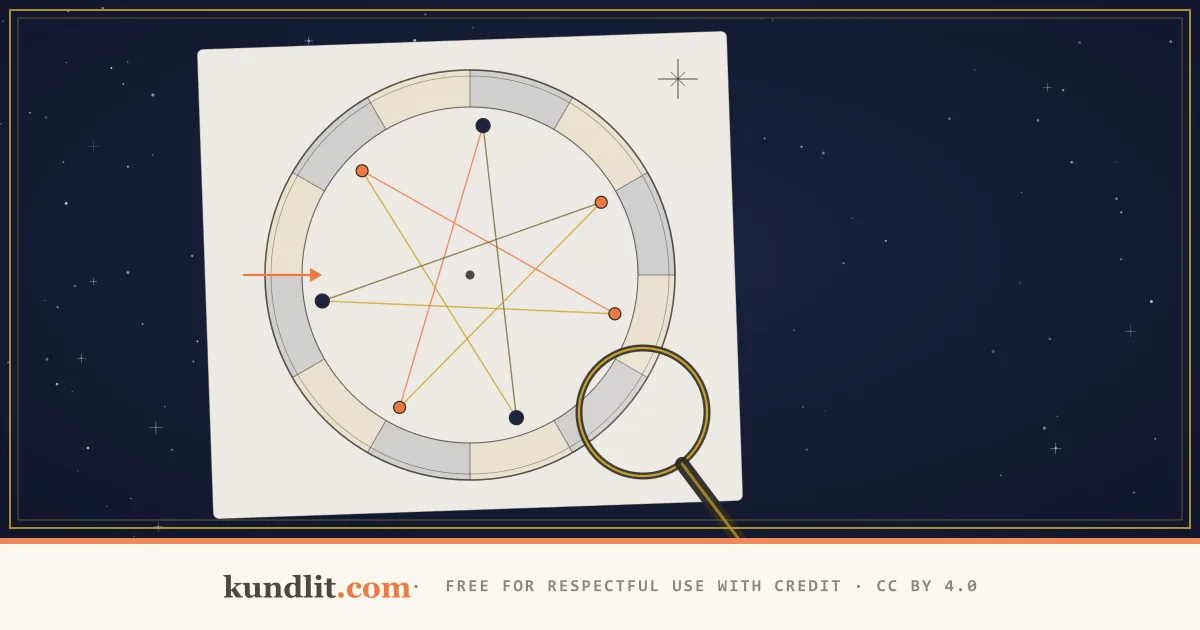
The work of analysis: a chart wheel with its aspect web, and a lens over it. The computation is the easy part — the weighing is the craft. Image by kundlit.com, CC BY 4.0 — free to reuse with credit.
How to read a birth chart: the step-by-step order
The order below is not a preference. It is the order in which every other reading decision depends on the previous one.
Start from the ascendant (lagna). The ascendant is the chart's foundation. It determines which sign occupies which house, and therefore what every planet is doing to your life rather than just in the sky. The classical texts make this plain: Saravali (Chapter 5) records — crediting the teaching to Chudamani Acharya — that "the ascendant's strength equals that of its lord," meaning the chart is only as robust as the rising sign and the planet ruling it. Your first two questions are always: what is my ascendant, and where is its lord?
The Moon — the mind. In the Kalapurusha scheme of Saravali (Chapter 4, slokas 1–2), the Sun is described as the soul of the zodiac personified and the Moon as the mind. This is a critical Vedic distinction: the Moon, not the Sun, carries the emotional processing of the chart. Its sign, its house, and especially its nakshatra (lunar mansion) tell you how the person takes in and reacts to experience — which is why Vedic timing keys everything to the Moon.
The Sun — the self. Hora Sara opens with "the Sun, the soul of the Universe" (Adhyaya 1, sloka 1). The Sun's sign, house, and aspects describe the core identity and the direction the person grows toward. In Vedic analysis the Sun also rules authority, the father, and vitality; in Western analysis it is the sun sign most people already know — the natural bridge between what you have heard about yourself and what the chart actually shows.
Then check dignity. Every planet has signs where it operates cleanly (own sign, exaltation) and signs where it struggles (debilitation). Saravali's planetary-strength doctrine treats this as fundamental: an exalted Jupiter and a debilitated Jupiter in the same house are not the same Jupiter. At the same time, note where each house lord sits — the ruler of a house colours everything that house contains. This is the layer that distinguishes a real reading from a list of placements.
Then aspects. Planets influence houses they do not sit in. Western astrology charts these as angular relationships (conjunction, opposition, trine, square, sextile); Vedic astrology uses a specific scheme in which every planet aspects the 7th house from itself and some add further aspects. You cannot read any house in isolation until you have asked which planets are looking at it.
Finally, timing. A chart shows what is possible; timing shows when. Vedic analysis uses the dasha system — most commonly Vimshottari, a 120-year cycle of planetary periods running from the Moon's nakshatra — while Western analysis uses profections and transits. Both answer the same question: which planet's themes are loud in this person's life right now?
Western analysis vs Vedic analysis
Both systems draw the same twelve signs and the same sky, and both ultimately trace back to Hellenistic practice. They differ in what they foreground:
- Western astrology foregrounds the aspects between planets, the house system (most commonly Placidus), and planetary dignities — the five essential dignities of domicile, exaltation, triplicity, term, and face. It works in the tropical zodiac, measured from the equinoxes. Its strength is the dynamic web of planetary relationships: how the parts of the personality talk to each other.
- Vedic astrology foregrounds dashas (the timing clock), yogas (recognised combination patterns), nakshatras (the 27 lunar mansions), and the divisional charts — the harmonic sub-charts used for specific life areas like marriage, career, and children. It works in the sidereal zodiac with the Lahiri ayanamsa, measured from the fixed stars. Its strength is structure and timing: what kind of life, in what sequence.
The zodiac difference is the single biggest source of beginner confusion — why "my sun sign changed" between the two systems. It is explained in full in our post on the Big Three in Western vs Vedic astrology. The practical takeaway: neither system is wrong — they measure from different reference points, and each reads the same sky for different purposes.
What the free calculators give you
- Birth Chart Calculator — a Western chart in two modes. The traditional mode uses whole-sign houses — the oldest house system, the one Vettius Valens' Anthology works in — with the seven classical planets, and cites every judgement it renders to its classical source. The modern mode switches to Placidus houses, adds Uranus, Neptune and Pluto, and computes the full aspect grid; it is computed, not cited.
- Janam Kundali — the full Vedic kundali: the nine grahas, the twelve bhavas, the ascendant and its lord, and the Vimshottari dasha timeline showing which period is running now and what comes next.
One honest caveat. A computed chart is accurate where computation is the whole job — planetary longitudes to the minute, house cusps, aspect angles, dasha dates. In the traditional mode, the classical rules behind the judgements are cited so you can verify them against their sources. What free tools do not do is weigh factors against each other: deciding whether a strong 10th house outweighs a troubled 7th, or whether a debilitated planet is rescued by its dispositor, is a judgement call. That weighting is the part a human analyst — or a paid reading — actually does.
When to get a human analysis
Computers are better at arithmetic; people are better at judgement. If you want the weighing layer done for you, both offerings on this site are Vedic readings in plain, modern language:
- Birth Chart Reading — a Vedic sidereal reading written for readers who grew up with Western astrology: it explains how your tropical chart maps to the sidereal one, then reads the ascendant and its ruler, all nine classical planets with their dignities, the notable yogas, and the dasha timeline — in plain English, no Sanskrit assumed.
- Deep Kundali reading — the complete study: every house, the divisional charts, two dasha systems cross-checked, a multi-year forecast, and a live consultation so nothing stays abstract.
If you want to learn the Vedic system yourself instead, our step-by-step guide to reading your janam kundali covers the Lagna, the twelve houses, the nine grahas, and the dasha clock in detail — the two posts together give you the grammar and the analysis order.
FAQ
Is a free birth chart analysis accurate? For the computation layer, yes. Planetary positions, house placements, aspect angles, and dasha dates are mathematical facts about a given birth moment, and these tools calculate them to the minute from a real ephemeris. What they are not is a judgement — no free chart can tell you that one placement "matters more" than another in your specific life. Accuracy of computation is free; accuracy of interpretation is the skill.
What should a birth chart analysis include? A complete analysis covers five layers in order: planet positions, planetary dignity (strength and condition), house placements, aspects between planets, and a timing layer. If a reading stops at "you have Jupiter in the 7th house" without the dignity, the aspects, and the timing, it has given you a caption, not an analysis.
Western or Vedic — which should I get? It depends on the question. Western analysis is strongest on personality dynamics and the relationships between the parts of yourself — the aspect web. Vedic is strongest on structure, sequence, and timing — the dasha clock. Many people read both, starting with whichever vocabulary they already understand.
Can I analyze my own birth chart? Yes, with two honest qualifications. The computation is completely learnable — the order in this article, plus the house significations and the planet meanings, gets you a long way, and our janam kundali guide is a solid free curriculum. What takes years is the weighing: knowing when a rule applies, when two rules cancel each other, and when a textbook combination says nothing about the actual person. Self-analysis is a skill you build; it is not a substitute for the judgement of a careful analyst when the question is important.
Birth chart analysis at a glance
- Order matters: ascendant first, then Moon, then Sun, then dignity, then aspects, then timing.
- Positions are facts — free, computable, verifiable against the source texts.
- Dignity is condition: the same planet is not the same planet in its own sign and in its debilitation.
- Aspects connect the chart: no house can be read in isolation.
- Timing is the layer that separates a horoscope from a fortune cookie — dashas in Vedic, profections and transits in Western.
- Free tools compute; human analysts weigh. Both have a place, and neither should pretend to be the other.
About the image on this page
The cover illustration is an original composition made for kundlit.com — a birth chart wheel on parchment with its planets, aspect lines and ascendant marker, and a magnifying lens over the wheel. It is released under the Creative Commons Attribution 4.0 (CC BY 4.0) license: free to share and adapt for any purpose, including commercial use, with credit to kundlit.com.
Sources
- Hora Sara (Prithuyasas) — the Sun as the soul, and the effects of planetary placement in the bhavas.
- Saravali (Kalyana Varma, translated by R. Santhanam) — the Moon as the mind, the Kalapurusha scheme, and planetary strength.
- Ptolemy's Tetrabiblos and Vettius Valens' Anthology — the foundations of Western house doctrine, aspects, and dignities.
If you want your chart computed now, the Birth Chart Calculator and Janam Kundali are free, cited, and take less than a minute. If you want the weighing layer done properly — in plain language, without fear-selling — the Birth Chart Reading and Deep Kundali reading are written by our resident astrologer and grounded in the same classical sources listed above.