
Birth Chart Reading (Vedic)
Your natal chart, read the Vedic way — the same depth as our Kundali Analysis, in language built for a Western reader.

Dr. Rao
PhD, Astrology
Prepared by Dr. Rao
- 100,000+ kundalis read in his lifetime
- 40+ years of experience
Reviewed by Dr. L. Nageshwwar Rao, PhD (Astrology), Consulting Astrologer · Last reviewed 2026-07-17 · How we compute this
A clear, grounded experience
- Format and scope are stated clearly
- Methods and sources are easy to inspect
- No guaranteed outcomes or required remedies
Prepared reading PDF, delivered within 4-7 days of payment.
What your report looks like
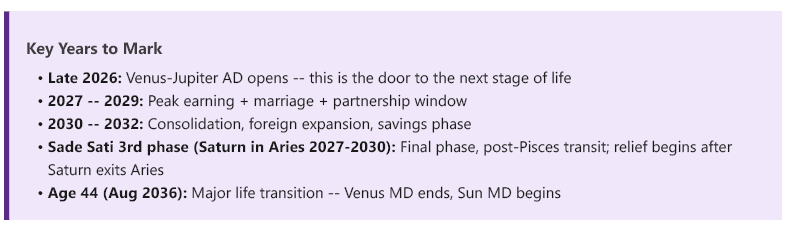
These are real sections from reports we have delivered — names and birth data redacted. Your report is written fresh from your own chart.
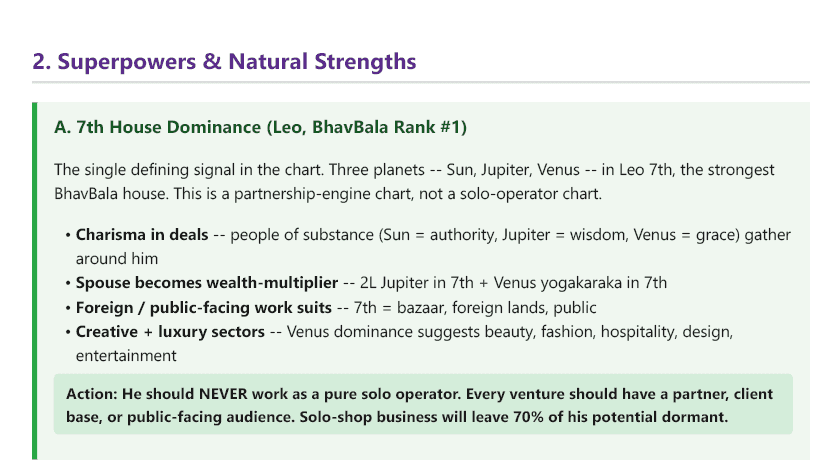
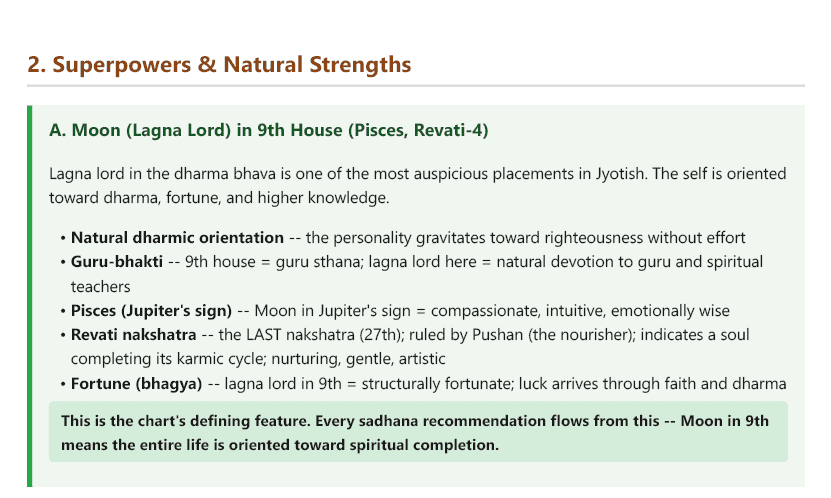
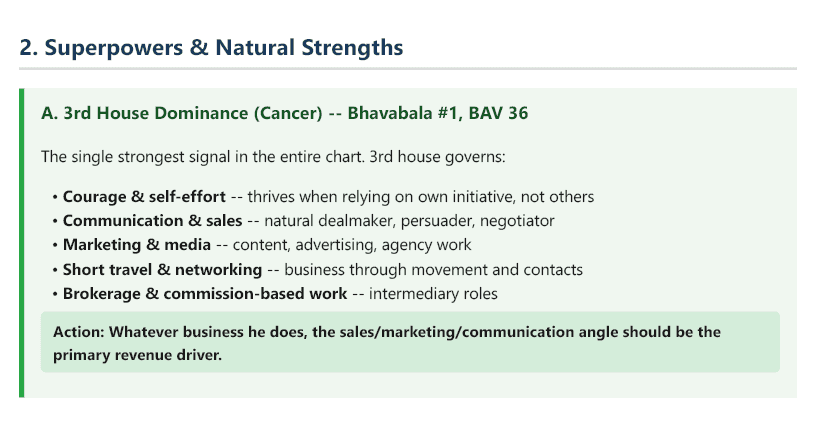
Drawn from the classical corpus
- बृहत्पाराशरहोराशास्त्रBrihat Parashara Hora Shastra — on grahas, bhavas & dashas
- फलदीपिकाPhaladeepika (Mantreswara) — on yogas & results
- सारावलीSaravali (Kalyana Varma) — on planetary effects
The reading
This is a full Vedic (sidereal) birth chart reading, written for someone coming from a Western astrology background. It is the same fulfilment as our Kundali Analysis — the identical depth, the identical hand-checked shastric method — simply presented in the vocabulary you already know: natal chart, houses, planetary placements, and the major life periods explained without assuming you speak Sanskrit.
If you have read your Co-Star or CafeAstrology chart and felt it was generic, this is the contrast: a real natal analysis where every statement is grounded in a planet's house rulership, its dignity (exalted, debilitated, in its own sign), and the aspects acting on it — read by a human against classical texts, not auto-generated.
We are transparent about one thing up front, because most Western readers ask it: Vedic astrology uses the sidereal zodiac, not the tropical one your Western chart uses. That means your sign placements here will often differ from your familiar Western chart by roughly one sign. We explain exactly why and why we read it this way — no sleight of hand. Our honesty policy applies here as everywhere: a placement that looks dramatic but is neutralised is reported as neutralised, a quiet life-period is called quiet, and where the chart genuinely doesn't speak to your question, we say so.
What you'll actually uncover
Read against the classics
- Each of the twelve houses is read from its ruler, its occupants and the aspects on it — the dignity of a planet (exalted, own sign, debilitated, combust) deciding how it actually behaves, not its placement alone. [Brihat Parashara Hora Shastra][Phaladeepika]
- Your core nature is read from the Ascendant (lagna) and its lord against the classical phala for that rising sign, rather than from a Western sun-sign assumption. [Brihat Jataka]
- Notable combinations (yogas) are graded honestly as genuinely strong, partial, or technically present but neutralised — and the dasha periods are read by what each ruling planet signifies in your chart, not by reputation. [Phaladeepika][Brihat Parashara Hora Shastra]
What's included
Your natal chart — cast in the sidereal (Vedic) zodiac
A full reading of the birth chart: the rising sign (Ascendant / Lagna) and its ruler, and the sign, house and condition of all nine classical planets — the Sun, Moon, Mercury, Venus, Mars, Jupiter, Saturn, and the lunar nodes Rahu and Ketu. For each planet we note its dignity — exalted, in its own sign, friendly, debilitated, combust (too close to the Sun) or retrograde — because dignity, not just placement, decides how a planet actually behaves.
House-by-house reading — all 12 houses
A walk through every house of life as Vedic astrology divides it: self and vitality (1st), wealth and family (2nd), effort and siblings (3rd), home and inner peace (4th), children and creativity (5th), health and daily work (6th), marriage and partnership (7th), transformation and the hidden (8th), fortune, beliefs and the father (9th), career and public standing (10th), gains and community (11th), and loss, retreat and the spiritual (12th). Each house is read from its ruler, its occupants and the aspects on it — so you see why, not just what.
Planetary periods (dasha) — explained for a Western reader
Western astrology times life mainly through transits; Vedic astrology adds a second, powerful timing layer most Western readers have never seen: the dasha system, which divides your life into multi-year chapters each "ruled" by one planet. We lay out the chapter you are in now and the ones coming over the next decade, and explain in plain terms what each ruling planet means for your chart — so the timeline reads as a story, not a table of Sanskrit terms.
Key strengths and challenges (yogas and doshas, in plain English)
The notable combinations in your chart — the Vedic equivalent of "stelliums" or strong configurations (called yogas), and the difficulty-patterns Western readers may have heard described dramatically online (the doshas). Each is explained simply and graded honestly: genuinely strong, partial, or technically present but neutralised. No fear-selling.
Sidereal vs tropical — the honest explanation
A clear, non-defensive section on why your placements here differ from your Western chart: the two zodiacs, the precession of the equinoxes, the ayanamsa correction, and why the Vedic tradition reads against the fixed stars. We explain it so you can hold both charts without confusion — and decide for yourself.
What makes a Vedic reading different
A short orientation on what Vedic astrology offers that a tropical reading typically doesn't: whole-sign houses, planetary dignities, the dasha timing system, divisional charts, and a remedial tradition. So you understand the kind of insight you're getting and where it complements (rather than contradicts) what you already know.
Two follow-up questions
After you receive the report, you may ask two follow-up questions by message or email, and we will answer them to clarify anything in your reading.
At a glance
Best suited for
- US-based and diaspora readers curious about Vedic astrology but more fluent in Western terms
- Anyone who has used Co-Star, CafeAstrology, The Pattern or similar and wants something with real depth and a human behind it
- Western-astrology readers who keep hearing their "Vedic sign is different" and want it explained properly
- People who want a single trustworthy natal reading without needing to learn Jyotish vocabulary first
- Readers comparing free tropical calculators against an authentic sidereal analysis
How it works
- You place the order and complete the intake; we confirm the birth data and your time zone.
- We cast and verify your sidereal natal chart and the supporting Navamsa (the Vedic chart that tests the promises of the main chart).
- We read all twelve houses, map your dasha periods for the decade, and assess the key strengths and challenges — prepared by Dr. L. Nageshwwar Rao and grounded in classical texts.
- PDF delivered to your email within 4-7 days.
What we'll ask you
- What life area is most on your mind?
- Anything specific you want answered? (optional)
- Your Western sun sign, if you know it (optional)
Frequently asked
- Why is my Vedic sign different from my Western sign?
- The two systems use different zodiacs. Western (tropical) astrology measures from the equinox; Vedic (sidereal) measures against the fixed stars, which have drifted by about 24 degrees over the centuries. The result is that most placements shift by roughly one sign. We explain the full reasoning in the report so you can hold both charts comfortably.
- Is this different from the Kundali Analysis, or just renamed?
- It is the same depth and the same method — we've simply written it in Western vocabulary so a reader new to Jyotish isn't lost in Sanskrit. If you're already comfortable with Vedic terms, order the Kundali Analysis instead; you'll get the identical analysis.
- I've only ever used apps like Co-Star — will I understand this?
- Yes. We assume no prior Vedic knowledge and define every term as it appears. The difference you'll feel is that this is read and reasoned by a person against classical texts, not generated, and we tell you honestly where the chart is quiet.
- What's not included?
- This is the same fulfilment as the Kundali Analysis; it does not add the D10, D60, Jaimini, Ashtakavarga or a live call — those belong to the Deep Kundali Dive-In.
- We read in the sidereal (Vedic) zodiac. We will explain how it relates to your tropical chart, but we do not produce a tropical reading.
- We do not sell gemstones, crystals or any remedial items; remedial direction is independent.
- Jyotish guidance is not a substitute for medical, legal, financial or mental-health advice.
- Birth-time-sensitive details depend on the accuracy of the time you provide.
Your data
- HTTPS in transit; passwords stored as one-way hashes; Razorpay handles card and UPI credential entry, while we retain transaction and verified webhook records including amount, currency, payment/order references, status, and the instrument's last four digits.
- Payments are processed by Razorpay only (INR settlement); Razorpay handles card and UPI credential entry; we do not store card numbers, UPI PINs or CVVs, but we retain transaction and webhook records.
- GST tax invoice emailed after payment.
Related readings
A registered business: DATCRAZY LLP · GSTIN 22AASFD4221E1ZU · 105, MM Silver Plaza, G.E. Road, Raipur, Chhattisgarh - 492001