

Houses in Astrology: All 12 Houses Explained — and the One Everybody Reads Wrong
- houses-in-astrology
- birth-chart
- western-astrology
- bhava
- twelve-houses
Read with context
- Sources and context stay close to the text
- Interpretations are presented as guidance
An astrology house is a slice of the sky anchored to the horizon at the exact moment and place of your birth. The zodiac signs answer "how" — the style and quality of a thing. The houses answer "where" — which department of life it happens in. A planet in your 7th house is a partnership story; the same planet in your 10th is a career story. Same sky, different shelf.
This guide walks all twelve houses one by one, giving each its Western meaning and its Vedic bhava (house) meaning, and anchoring the claims in the classical texts where a clear reference exists — chiefly Hora Sara and Saravali. Where a meaning is shared tradition and no single text in our corpus owns the point, we say so plainly instead of dressing it up.
One correction up front, because it is the house everybody reads wrong: the 8th. Pop astrology turns it into a literal death house — "the 8th house indicates death" — and too many readings then spend the evening managing panic. The classical texts treat the eighth quite differently: its working use is longevity (ayus) — how long and how well a life runs — and what you receive from others. Hora Sara, the classical digest written by Prithuyasas, son of Varahamihira, devotes a whole chapter (its Ayurdaya, span-of-life, chapter) to computing longevity, and the eighth house runs through those rules again and again — as the thing being measured, not as a sentence hanging over every chart that touches it. That honest reading is the spirit of this article: no fear-selling, no fluff.
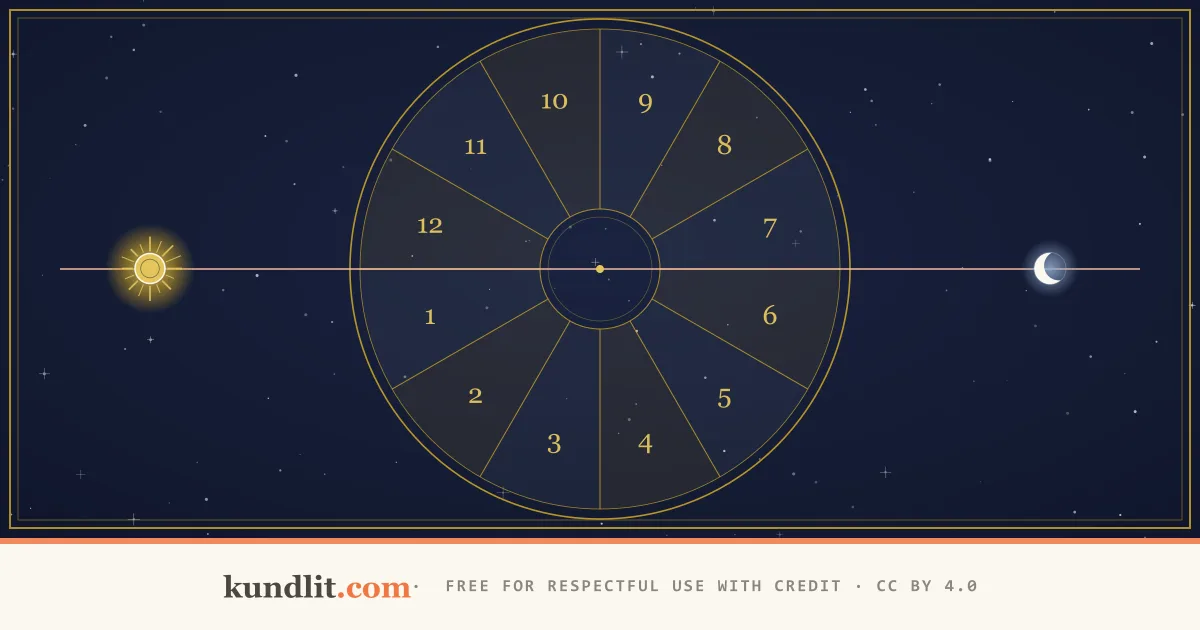
The twelve houses, numbered counterclockwise from the ascendant on the eastern horizon — house 1 just below the rising Sun, house 10 at the top of the sky. Image by kundlit.com, CC BY 4.0 — free to reuse with credit.
What a house actually is
Two different maps are drawn on the same sky. The first is the zodiac: twelve equal bands of the ecliptic, each roughly thirty degrees wide, and they move slowly. The Sun's sign changes about once a month; the whole zodiac barely shifts in a day.
The second map is the houses, and it is anchored to your birth place and birth time. Imagine the eastern horizon at the moment of birth: the point rising on it is the Ascendant, and it is the cusp of the 1st house. The other eleven houses follow from there, around and across the sky, and the entire wheel turns with the Earth once a day.
| Signs | Houses | |
|---|---|---|
| Answers | How | Where |
| Anchored to | The ecliptic | Your birth horizon |
| Move | About 1 degree per day | About 1 degree per 4 minutes |
That last row is why birth time matters far more than birth date. Because the wheel of houses rotates once in twenty-four hours, each house boundary moves roughly one degree every four minutes — a few minutes' error can push your Ascendant into the next sign entirely and reshuffle which sign rules every house. The signs themselves barely move in a day. A chart cast without a birth time is a chart without houses, which is why every serious calculator, including ours, insists on the time. If your rising sign is a mystery, the rising sign calculator solves that first.
The 12 houses, one by one
Each house below gets the Western reading, the Vedic bhava reading, and — where the corpus supports it — the classical anchor. The Sanskrit house-names are kept because they are the tradition's own vocabulary.
1st House (Ascendant / Lagna) — the self
Western astrology: self, appearance, personality — how the world first meets you. Vedic astrology: Tanu bhava, the body and constitution. The Lagna is the reference point of the whole chart: every other house is counted from it, and Saravali records the teaching — credited there to Chudamani Acharya — that the ascendant's strength equals that of its lord: if the ruler is strong, the foundation of the reading is strong. This is also the house to revisit in the big-three comparison in our Big Three vs. Vedic Three article.
2nd House — money, values, speech
Western astrology: money, values, possessions. Vedic astrology: Dhana bhava — wealth, family, speech. The traditions agree closely here, and the classical vocabulary says it all: Hora Sara's list of house synonyms calls the 2nd Vitta (wealth), Kutumba bhavana (the house of family) and Vaksthana (the house of speech).
3rd House — communication and courage
Western astrology: communication, siblings, short trips. Vedic astrology: Sahaja bhava — siblings, courage, short journeys. Hora Sara's synonym list names the 3rd Duschikya, Sahaja and Vikrama — valour. In both traditions the 3rd is the house of effort and nerve: the small daily motions that build a life.
4th House — home and mother
Western astrology: home, mother, roots, the private foundation beneath the public self. Vedic astrology: Sukha bhava — happiness, home, mother, vehicles. Hora Sara gives the 4th a warm cluster of names: Hibuka, Sukha (happiness), Vesma (home), Vari (water) and Bandhu (relative). It is the emotional bedrock of the chart — the "how does this person feel safe" house.
5th House — creativity and children
Western astrology: creativity, children, romance. Vedic astrology: Putra bhava — children, intelligence, and the credit of past merit (purva punya). Shared tradition, no single corpus text of ours states it cleanly, so no book name is attached. It is the house of making things — literally children, but also art, speculation and the playful mind.
6th House — health and daily work
Western astrology: health, service, daily work. Vedic astrology: Ari bhava — enemies, disease, debt, service. Shared tradition, named without a corpus anchor. It is the house of obstacles and of the routines that dissolve them; in the classical grouping it belongs to the "difficult" set, discussed below.
7th House — partnership and marriage
Western astrology: partnership, marriage, open enemies. Vedic astrology: Kalatra bhava — spouse, partnership, desire. The anchor is strong: Hora Sara's house list names the 7th Kalatra (wife), and its synonym slokas give it a whole cluster of alternate names — Jamitra, Astabhavana, Dyuna, Kama and Chitta — all circling relationship and desire. If a question is about a "we," it is a 7th-house question.
8th House — the one everybody reads wrong
Pop astrology: death, taxes, inheritance. Vedic astrology: Randhra bhava — longevity, transformation, hidden things, and what you receive from others. Hora Sara's house list does name the eighth Naidhana — the end — but watch what the text actually does with it: its span-of-life (Ayurdaya) chapter uses the eighth to compute how long a life runs, down to rules like "the lord of the 8th in an angle" adding or removing years. The working question is longevity, not doom. That is a very different thing from literal death: the same house rules the resources that come to you from other people (inheritance, insurance, partner's money, debts, taxes), the hidden transformations of life, and the long game of how long and how well a body holds up. The correction, stated plainly: in working use the eighth is about longevity and what you receive from others. Death is its grossest and least useful reading, and classical practice does not lead with it.
9th House — fortune and philosophy
Western astrology: higher learning, travel, philosophy. Vedic astrology: Dharma bhava — fortune, the guru, righteousness, the father. Shared tradition, no corpus anchor claimed. It is the house of meaning: religion, universities, long journeys, and the sense that events are conspiring in your favour.
10th House — career and public standing
Western astrology: career, public standing, authority. Vedic astrology: Karma bhava — profession, status, action. The anchor is one of the richest in Hora Sara's synonym slokas, which name it Aspada (place), Ajna (command), Karma (profession), Meshurana and Khamadhyastha — situated in the zenith, the sky's highest point. The midheaven, the chart's highest point, is its cusp; the midheaven calculator will show you yours.
11th House — gains and friends
Western astrology: friends, groups, hopes. Vedic astrology: Labha bhava — gains, income, the fulfilment of desires. Hora Sara's house list names it simply Aya — income. It is the house of what comes to you through others and through effort — the payday house, and in classical grouping one of the "houses of increase."
12th House — loss, solitude, liberation
Western astrology: solitude, hidden things, undoing. Vedic astrology: Vyaya bhava — loss, expenditure, foreign lands, liberation (moksha). Hora Sara names it Rippha and Lopasthana — the house of disappearance — and Vyaya, loss. It is the chart's two-faced house: in ordinary life it is the expense account, the hospital, the ashram, the distant country; spiritually it is the last house before the wheel restarts, the place where things dissolve into something larger. Same house, two honest readings.
The Vedic classification layer
Vedic astrology does not treat the twelve houses as a flat list. It groups them into overlapping sets with different behaviours, and the groupings are classical — all four below have text-level support.
- Kendras (angles): 1-4-7-10. Hora Sara defines them, giving them the alternate names Kantaka and Chatushtaya. These are the strongest houses of the chart — a planet in an angle is prominent, visible, and acts loudly.
- Trikonas (trines): the 5th and 9th. Hora Sara designates the 5th and 9th as Trikona. Practice usually counts the lagna alongside them — though Santhanam's note to Saravali points out, honestly, that the classical texts themselves do not designate the ascendant a trine. These are the most auspicious houses: luck, growth, dharma.
- Dusthanas: 6-8-12. Hora Sara's span-of-life chapter states that malefics placed in the 6th, 8th and 12th indicate a shorter life, benefics there the reverse — the classical root of calling them the difficult houses. Notice what the text actually says: the difficulty lives in the malefic placement, not in the person born.
- Upachayas: 3-6-10-11. Hora Sara calls these the houses of increase, and Saravali lists them the same way. Things placed here improve with time — the one class where even a difficult planet can mature into usefulness with age.
- The four aims of life (Purusharthas). The tradition also reads the wheel by the four pursuits: Dharma (righteousness) in 1-5-9, Artha (wealth) in 2-6-10, Kama (desire) in 3-7-11, Moksha (liberation) in 4-8-12 — a classification the later tradition uses so widely that no single text owns it. Every chart is a wheel of these four drives — which is also where Vedic and Western astrology genuinely agree: both read the 10th as career and the 7th as partnership, because both inherited the same sky.
Whole-sign, Placidus, Equal — why house systems disagree
The same birth chart can show different house boundaries in different software. That is not a bug; it is a real, centuries-old disagreement about how to draw the lines, and it deserves one paragraph of honesty.
The oldest system is whole-sign: each house is exactly one full sign, and the Ascendant's sign becomes the entire 1st house. This is the system the Hellenistic astrologers used — Vettius Valens worked in it — and it is what Vedic charts use. Placidus, the modern default in most Western software, divides the day into unequal house spans and fails geometrically near the polar circles (latitudes beyond roughly 66 degrees), where some houses can swallow their neighbours entirely. Equal-house is the simple compromise: twelve equal thirty-degree slices starting from the Ascendant.
Our Birth Chart Calculator offers the traditional whole-sign view and a modern Placidus mode, and it tells you which one you are looking at — a chart you cannot reproduce is a chart you cannot trust. For the broader Western reading of the same wheel, see our Western astrology guide.
FAQ
What do the 12 houses represent?
The twelve houses divide the sky into twelve departments of life, counted from the Ascendant: self (1st), money (2nd), communication and siblings (3rd), home and mother (4th), children and creativity (5th), health and work (6th), marriage and partnership (7th), longevity and inheritance (8th), fortune and philosophy (9th), career (10th), gains and friends (11th), loss and liberation (12th).
Which house is for marriage?
The 7th house. In both Western and Vedic astrology it rules partnership, marriage and open enemies, and Vedic texts give it a cluster of names — Jamitra, Astabhavana, Dyuna, Kama, Chitta — all circling the same idea of relationship and desire. The 5th house colours romance and the 11th the fulfilment of relationship hopes, but the marriage house itself is the 7th.
Which house is for career?
The 10th house, in both traditions. Vedic texts name it Karma (profession), Ajna (command) and Khamadhyastha (the zenith) — the highest point of the chart at birth. Western astrology calls its cusp the Midheaven. The 6th house shows the daily work itself; the 10th shows what the work builds in public.
What is the 8th house really?
Primarily longevity and what you receive from others. The classical texts treat the eighth as the house of the span of life (ayus) — Hora Sara's Ayurdaya chapter computes longevity through it — alongside inheritance, hidden things and transformation. Pop astrology's "literal death" reading is the grossest of its meanings; an honest reading leads with the resources that come to you from others and the long game of the lifespan.
Are houses the same in Vedic and Western astrology?
The meanings of the houses are broadly the same, because both traditions inherited the same sky and much of the same classical literature. The differences are real but smaller: Vedic charts count from the Lagna in whole-sign houses and add a rich classification layer (angles, trines, difficult houses, houses of increase); Western charts more often use unequal house systems like Placidus and read planets as continuous points. The departments of life they describe are recognisably the same twelve.
What is the most important house in a birth chart?
The 1st house. It is the reference point for every other house — the sign on the Ascendant determines which sign rules which area of life — and classical texts tie the whole chart's strength to it. After the 1st, the 7th, 10th and 4th (the angles) carry the most weight, because a planet in an angle acts with the most visibility.
Houses at a glance
- 1st — the self, body, appearance, overall direction (Tanu)
- 2nd — money, values, family, speech (Dhana)
- 3rd — siblings, courage, communication, short journeys (Sahaja)
- 4th — home, mother, roots, happiness (Sukha)
- 5th — children, creativity, intelligence, past merit (Putra)
- 6th — health, service, debt, obstacles (Ari)
- 7th — partnership, marriage, open enemies (Kalatra)
- 8th — longevity, transformation, what you receive from others (Randhra)
- 9th — fortune, higher learning, the guru, the father (Dharma)
- 10th — career, status, public action, the zenith (Karma)
- 11th — gains, income, friends, fulfilled desires (Labha)
- 12th — loss, expenditure, foreign lands, liberation (Vyaya)
About the image on this page
The chart-wheel illustration above is an original composition made for kundlit.com: the twelve houses numbered from the ascendant, with the horizon line and the rising Sun marking the eastern angle. It is released under the Creative Commons BY 4.0 license — free to reuse, including commercially — on one condition: credit kundlit.com with a link to this page.
Sources
- Hora Sara (Prithuyasas, son of Varahamihira) — the house names and synonyms (its first-chapter slokas), the classifications (kendras, trikonas, upachayas), and the span-of-life (Ayurdaya) rules behind the 8th-house and dusthana readings.
- Saravali (Kalyana Varma; Santhanam's translation) — the ascendant-and-its-lord teaching (which it credits to Chudamani Acharya), the upachaya list, and the planetary-strength doctrine.
- Ptolemy's Tetrabiblos and Vettius Valens' Anthology — the Western classical tradition, named here for the history of whole-sign houses and the doctrine that both traditions share.
If you want to see your own twelve houses, run the free Birth Chart Calculator — tropical, with whole-sign or Placidus houses — or the Vedic Janam Kundali, which shows the same twelve bhavas counted from your Lagna. For a full reading of what your houses and planets say together, the paid Kundali Analysis walks your chart end to end in plain language. And once the houses are familiar, the transit chart calculator shows where the planets are today against your birth wheel — houses in motion.