

The 12 Jyotirlingas: names, places, and the stories the Shiva Purana actually tells
- jyotirlinga
- shiva
- somnath
- mahakaleshwar
- kashi-vishwanath
- kedarnath
- sawan
Read with context
- Sources and context stay close to the text
- Interpretations are presented as guidance
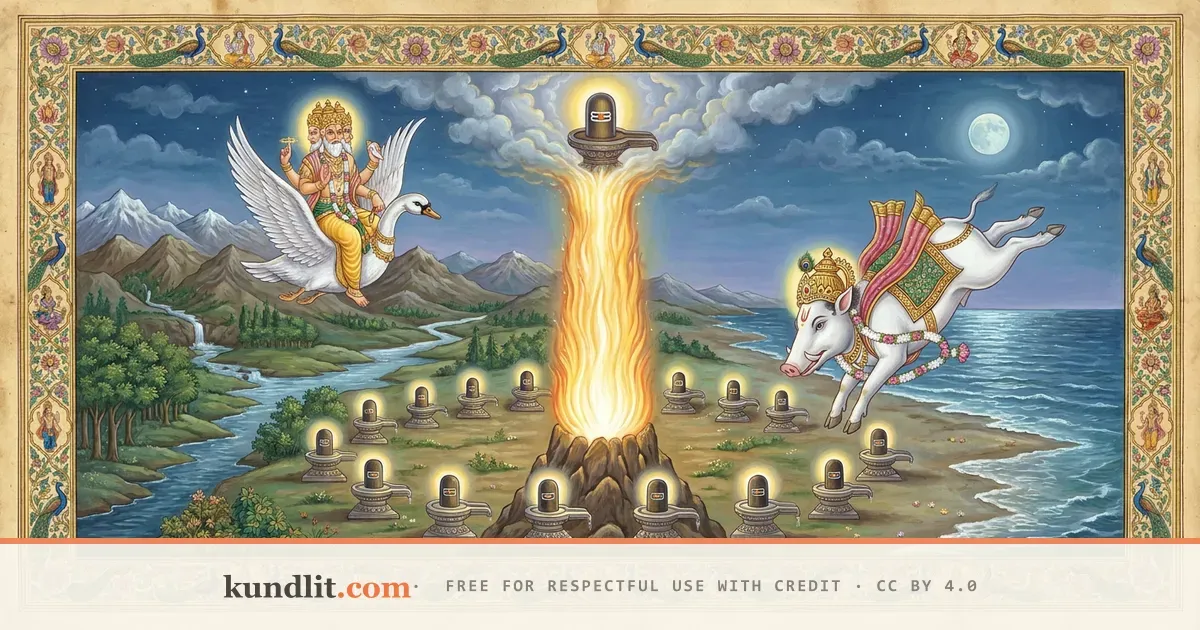
Ask where the 12 jyotirlingas are and you will get a list. Ask why those twelve — why Somnath counts and the lakhs of other shivalingas across India do not — and most lists go quiet. The answer exists, and it is older than any travel guide: the Shiva Purana devotes a whole stretch of its Koti Rudra Samhita to these shrines, telling, one by one, the story of how each linga came to be.
This guide gives you both layers. First the practical one: all twelve names and places, state by state, with the original Sanskrit verse that fixes the list. Then the layer the texts care about: each shrine's origin story — Chandra's curse at Somnath, Ravana's nine severed heads at Vaidyanath, a mother's hundred-and-one clay lingas at Grishneshwar — each cited to the Shiva Purana by samhita and chapter, so you can verify everything. Where the text and today's temple traditions disagree about a location, we say so plainly instead of papering over it.
Every painting in this article was made for this guide following the Purana's own story details, and is free to reuse with credit (CC BY 4.0) — details at the end.
What a jyotirlinga actually is
Jyotih means light; a jyotirlinga is a "linga of light" — a place where, the texts say, Shiva manifested himself as a column of radiance rather than being installed by human hands.
The image comes from one of the most famous scenes in the Shaiva literature. Brahma and Vishnu were disputing which of them was supreme. Between them appeared an endless pillar of light — a flaming linga with no visible top or bottom. Brahma flew upward for ages seeking its summit; Vishnu, as a boar, dove for ages seeking its base. Both failed, and both bowed. From that day, says the text, the worship of Shiva in linga form began. The Shiva Purana tells this in its very first book (Vidyeshvara Samhita, Adhyayas 5–9), and the Linga Purana tells the same story in its 17th chapter.
The twelve jyotirlingas are described as the places where that same self-manifest light stands permanently on earth. The Koti Rudra Samhita opens by saying the lingas of Shiva on earth are beyond counting, and then names the twelve "principal lingas of light" among them (Koti Rudra Samhita, Adhyaya 1).
The 12 jyotirlinga names and places — state-wise list
The canonical list is a four-verse Sanskrit hymn — the Dvadasha Jyotirlinga Smaranam — printed in the Gita Press Rudrashtadhyayi (p. 225) and embedded in the Shiva Purana itself (Koti Rudra Samhita 1.21–24):
सौराष्ट्रे सोमनाथं च श्रीशैले मल्लिकार्जुनम् । उज्जयिन्यां महाकालमोङ्कारममलेश्वरम् ॥ परल्यां वैद्यनाथं च डाकिन्यां भीमशङ्करम् । सेतुबन्धे तु रामेशं नागेशं दारुकावने ॥ वाराणस्यां तु विश्वेशं त्र्यम्बकं गौतमीतटे । हिमालये तु केदारं घुश्मेशं च शिवालये ॥ एतानि ज्योतिर्लिङ्गानि सायं प्रातः पठेन्नरः । सप्तजन्मकृतं पापं स्मरणेन विनश्यति ॥
"Somnath in Saurashtra, Mallikarjuna on Srishaila; Mahakala in Ujjayini, Omkara at Amaleshvara; Vaidyanatha at Parali, Bhimashankara at Dakini; Ramesha at Setubandha, Nagesha in the Daruka forest; Vishvesha in Varanasi, Tryambaka on the bank of the Gautami; Kedara in the Himalaya, and Ghushmesha at Shivalaya. One who recites these jyotirlingas evening and morning — the sins of seven births are destroyed by the remembrance." — Dvadasha Jyotirlinga Smaranam (Rudrashtadhyayi, Gita Press, p. 225; Shiva Purana, Koti Rudra Samhita 1.21–24)
Here is that list mapped to today's temples:
| # | Jyotirlinga | Place in the verse | Temple today | State |
|---|---|---|---|---|
| 1 | Somnath | Saurashtra | Prabhas Patan, Veraval | Gujarat |
| 2 | Mallikarjuna | Srishaila | Srisailam | Andhra Pradesh |
| 3 | Mahakaleshwar | Ujjayini | Ujjain | Madhya Pradesh |
| 4 | Omkareshwar | Omkara / Amaleshvara | Mandhata island, Khandwa | Madhya Pradesh |
| 5 | Kedarnath | Himalaya | Rudraprayag district | Uttarakhand |
| 6 | Bhimashankar | Dakini | Sahyadri hills, Pune district | Maharashtra |
| 7 | Kashi Vishwanath | Varanasi | Varanasi | Uttar Pradesh |
| 8 | Trimbakeshwar | Bank of the Gautami | Trimbak, Nashik district | Maharashtra |
| 9 | Vaidyanath | Parali / Chitabhumi | Deoghar (also claimed at Parli) | Jharkhand / Maharashtra |
| 10 | Nageshwar | Daruka forest | Near Dwarka (also claimed elsewhere) | Gujarat |
| 11 | Rameshwaram | Setubandha | Ramanathaswamy Temple, Rameswaram | Tamil Nadu |
| 12 | Grishneshwar | Shivalaya | Verul (Ellora), near Chhatrapati Sambhajinagar | Maharashtra |
The order above is not arbitrary — it is the order of the verse itself, and pilgrims traditionally follow it, beginning at Somnath. Three of the twelve locations are honestly contested, and the verse itself is part of the reason; we cover that further down.
Now the stories — what the Shiva Purana says happened at each of these places.
1. Somnath — the moon's curse and its cure
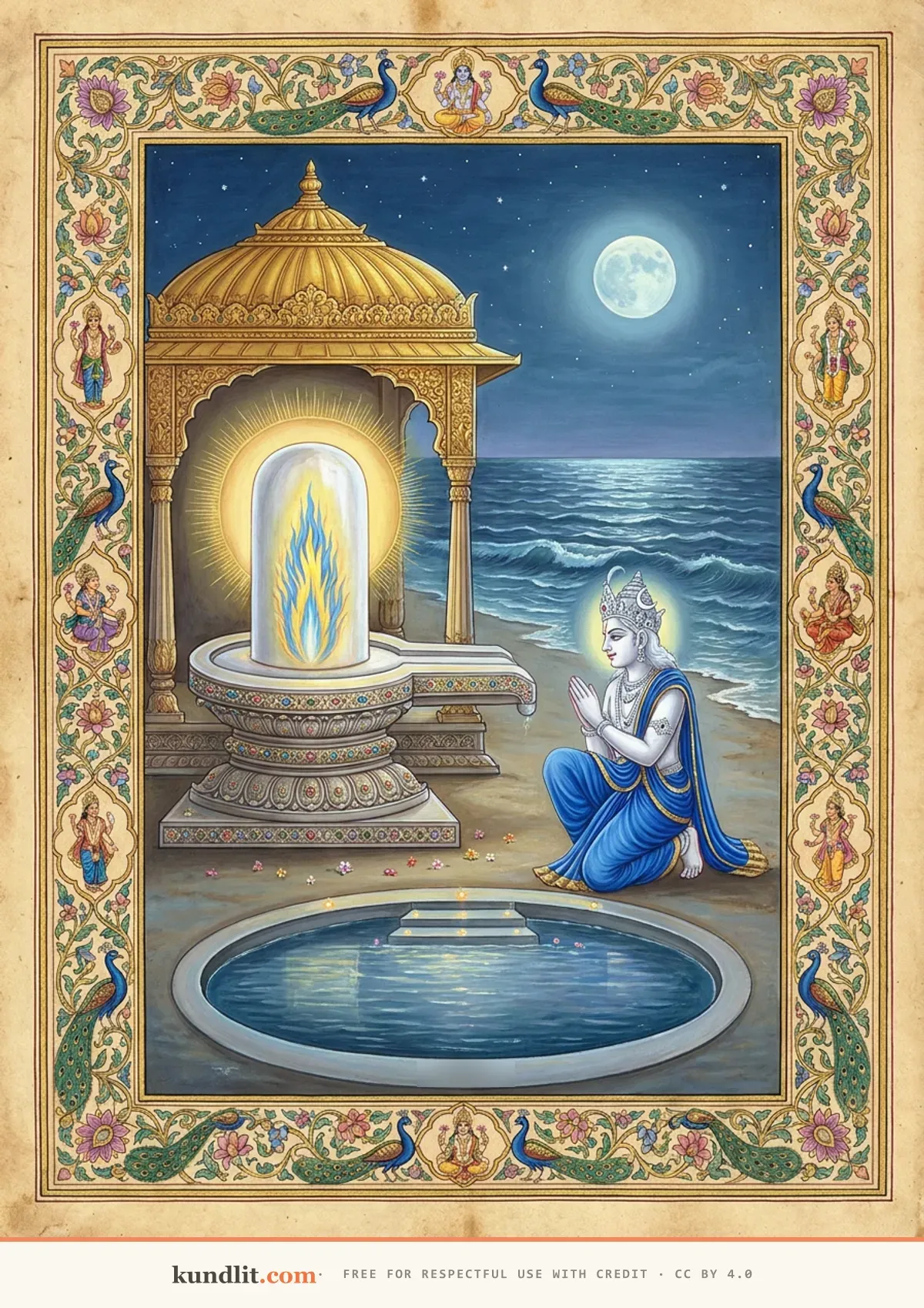
Chandra worships the linga of light at Prabhasa, beside the sea — the scene of Koti Rudra Samhita, Adhyaya 14. Image by kundlit.com, CC BY 4.0 — free to reuse with credit.
Chandra, the moon god, married the twenty-seven daughters of Daksha Prajapati — the twenty-seven nakshatras — but loved only Rohini. The neglected sisters complained; Daksha warned him twice, was ignored, and finally cursed Chandra to waste away with kshaya, the wasting disease. As the moon withered, the world's nights, plants and tides withered with him, and the alarmed gods went to Brahma (Koti Rudra Samhita, Adhyaya 14).
Brahma's remedy: go to Prabhasa on the Saurashtra coast and worship Shiva there. Chandra performed tapasya for six months, repeating Shiva's great healing invocation ten crore times. Shiva appeared and offered the compromise written into the sky ever since: the moon would wane for one fortnight and wax again the next — the curse honoured, the moon saved (KRS 14.39–45). At Chandra's prayer, Shiva remained at Prabhasa permanently as Somnath — "the lord of Soma (the moon)". The same text says the Chandrakund pool there washes away sins, and the Samhita's opening chapter credits Somnath's worship with destroying diseases like consumption and leprosy (KRS 1.6–8).
The temple stands at Prabhas Patan near Veraval in Gujarat — destroyed and rebuilt repeatedly over a thousand years of history, which has only added to its standing as the first shrine of the list.
Full story and temple guide: Somnath Jyotirlinga →
2. Mallikarjuna — the parents who followed their son
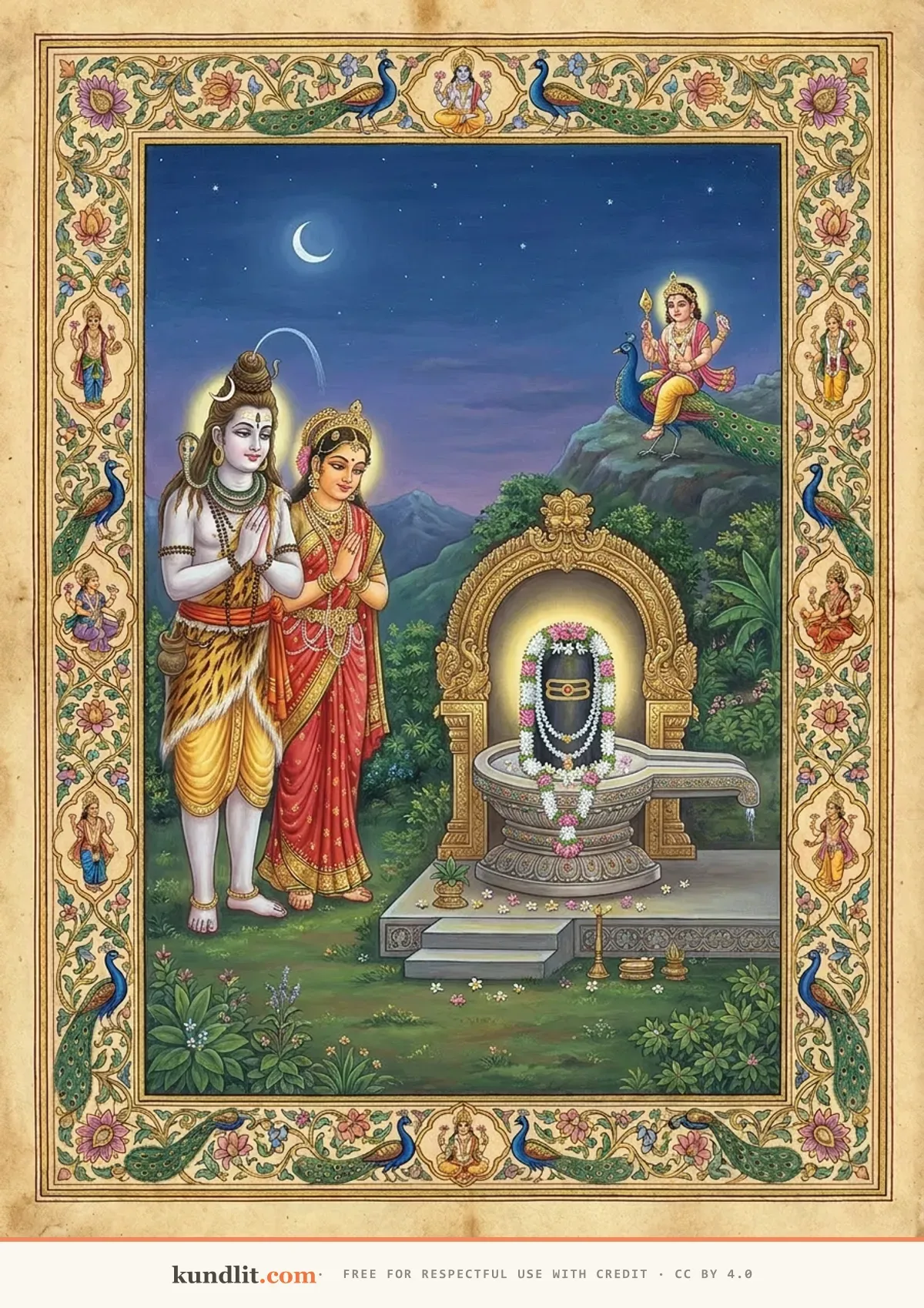
Shiva and Parvati on Srishaila, looking toward their son — the katha of Koti Rudra Samhita, Adhyaya 15. Image by kundlit.com, CC BY 4.0 — free to reuse with credit.
After Ganesha was married first, his brother Kartikeya left Kailasa in hurt pride and withdrew to the Krauncha mountain in the south. Messengers could not bring him back. So the parents went themselves — and the Shiva Purana says that when Kartikeya withdrew further, Shiva and Parvati simply stayed on the mountain to be near him: Shiva visits him on every amavasya (new moon), Parvati on every purnima (full moon) (Koti Rudra Samhita, Adhyaya 15; the background story of Kartikeya's departure is told in Rudra Samhita, Kumara Khanda).
The linga they remained in carries both their names: Mallika is Parvati, Arjuna is Shiva — Mallikarjuna, the one linga that is explicitly the two of them together. The text calls it the second jyotirlinga and promises the sight of it fulfils every wish (KRS 15.19–23). The temple is at Srisailam in Andhra Pradesh, on a hill above the Krishna river — it is also one of the Shakti Pithas, so Devi and Shiva are worshipped side by side.
Full story and temple guide: Mallikarjuna Jyotirlinga →
3. Mahakaleshwar — the lord of time at Ujjain
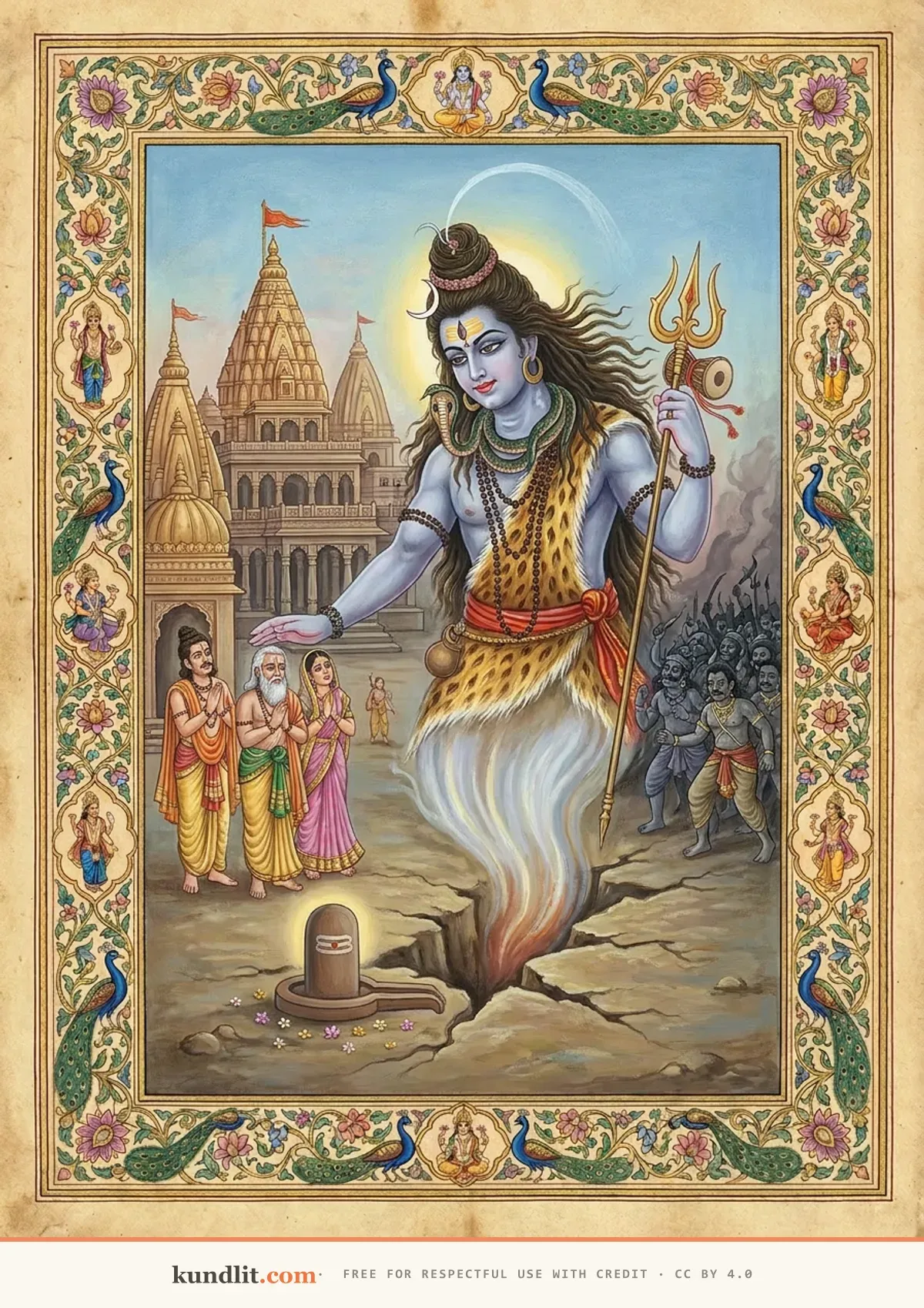
Mahakala bursts from the earth to defend Avantika — Koti Rudra Samhita, Adhyayas 16–17. Image by kundlit.com, CC BY 4.0 — free to reuse with credit.
In the holy city of Avanti (Ujjain) lived a Vedic brahmin, Vedapriya, with four devout sons. A demon named Dushana, "destroyer of Vedic dharma," attacked the city with his army, scattering its rites. As the brothers sat unmoved in worship of their humble earthen linga, the soldiers raised their weapons — and the ground split. Shiva rose from the pit in his immense form as Mahakala, the lord of time, and reduced the demon host to ash with a single roar (Koti Rudra Samhita, Adhyaya 16). At his devotees' prayer he stayed in Ujjain as the Mahakaleshwar jyotirlinga. The following chapter adds the famous local kathas of King Chandrasena and the cowherd boy Shrikara, whose worship of a simple pebble as a linga Shiva honoured in full (KRS, Adhyaya 17).
Mahakaleshwar at Ujjain is the only jyotirlinga that faces south — the direction of death, fitting for the lord of time — and Ujjain's place at the centre of Hindu timekeeping (the city is the classical prime meridian of Indian astronomy) makes "Mahakala" more than a name.
Full story and temple guide: Mahakaleshwar Jyotirlinga →
4. Omkareshwar — the mountain who wanted to grow
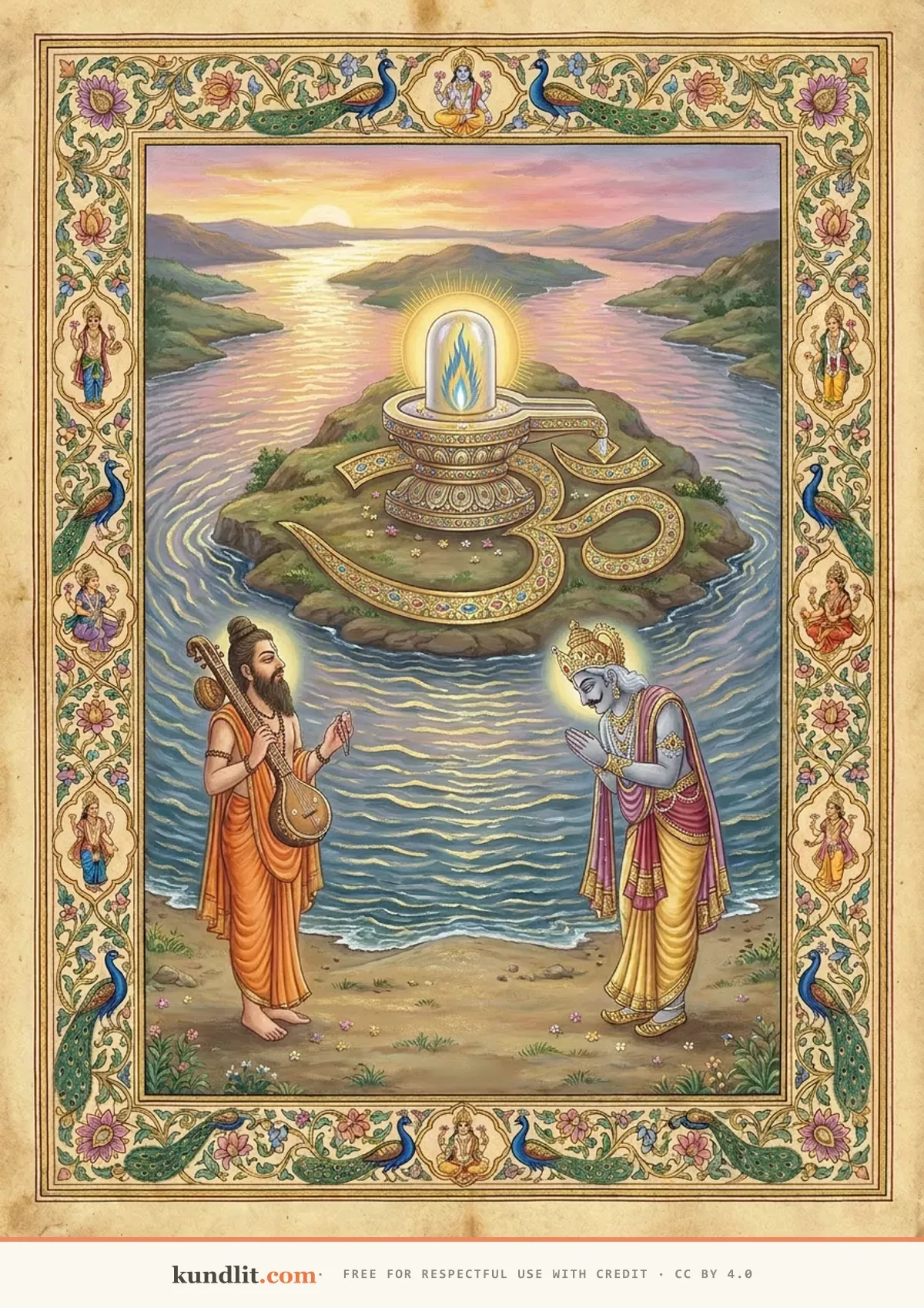
Vindhya worships on the island in the Narmada — Koti Rudra Samhita, Adhyaya 18. Image by kundlit.com, CC BY 4.0 — free to reuse with credit.
The sage Narada, visiting the Vindhya mountain, let slip that Mount Meru stood higher. Stung, Vindhya resolved not to rage but to worship: he made an earthen linga where the Narmada bends around a hill, and worshipped Shiva for six months (Koti Rudra Samhita, Adhyaya 18). Shiva appeared, granted Vindhya his growth — with the condition that he never trouble the world — and, at the gods' request, remained there. The text says he stood in two forms: Omkareshwar on the island, and Amaleshwar (today's Mamleshwar) on the bank — which is why the verse names this station "Omkaram Amaleshvaram" in one breath (KRS 18.19–20; Shatarudra Samhita 42.18–20).
The island, called Mandhata, sits in the Narmada near Khandwa in Madhya Pradesh — and seen from above, the river's loop around the hill is traditionally said to trace the shape of Om itself.
Full story and temple guide: Omkareshwar Jyotirlinga →
5. Kedarnath — the linga of the high Himalaya
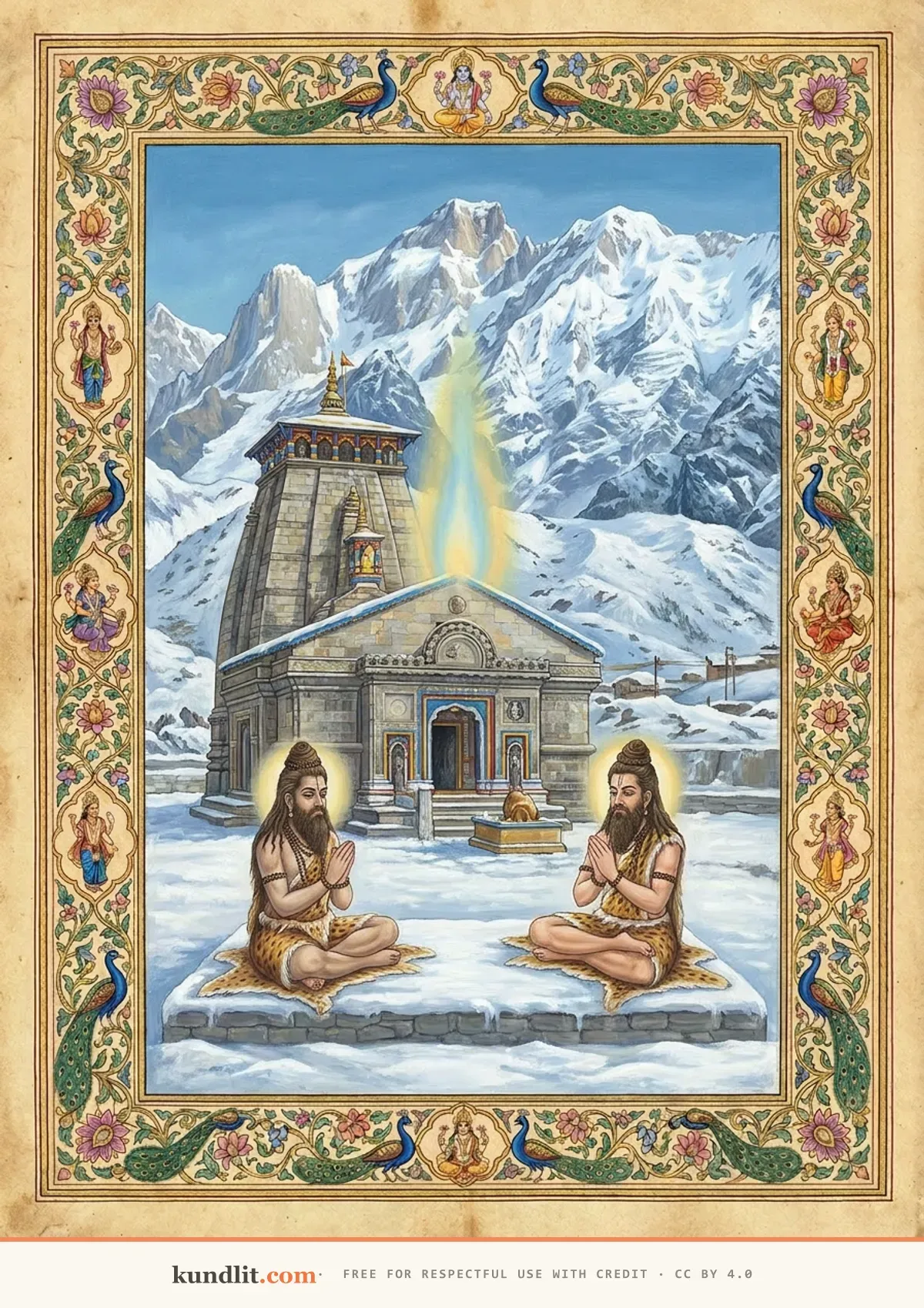
Nara and Narayana do tapas before Kedara in the snow — Koti Rudra Samhita, Adhyaya 19. Image by kundlit.com, CC BY 4.0 — free to reuse with credit.
At Badrikashrama in the Himalaya, the twin sages Nara and Narayana — counted as forms of Vishnu himself — worshipped Shiva daily in an earthen linga. Pleased by ages of this austerity, Shiva offered them a boon, and they asked for the one thing sages ask: that he remain. He did — as Kedareshwar, the jyotirlinga of the Kedara region of the Himalaya, granting protection to all who reach him (Koti Rudra Samhita, Adhyaya 19; Shatarudra Samhita 42.23–24).
Kedarnath in Uttarakhand is the highest and hardest-won of the twelve, open only about six months a year between the snows; the deity spends the winter months at Ukhimath below. The linga here is a natural rock ridge, not a carved form — fitting for a shrine the texts insist was never installed by anyone.
Full story and temple guide: Kedarnath Jyotirlinga →
6. Bhimashankar — the end of Bhima
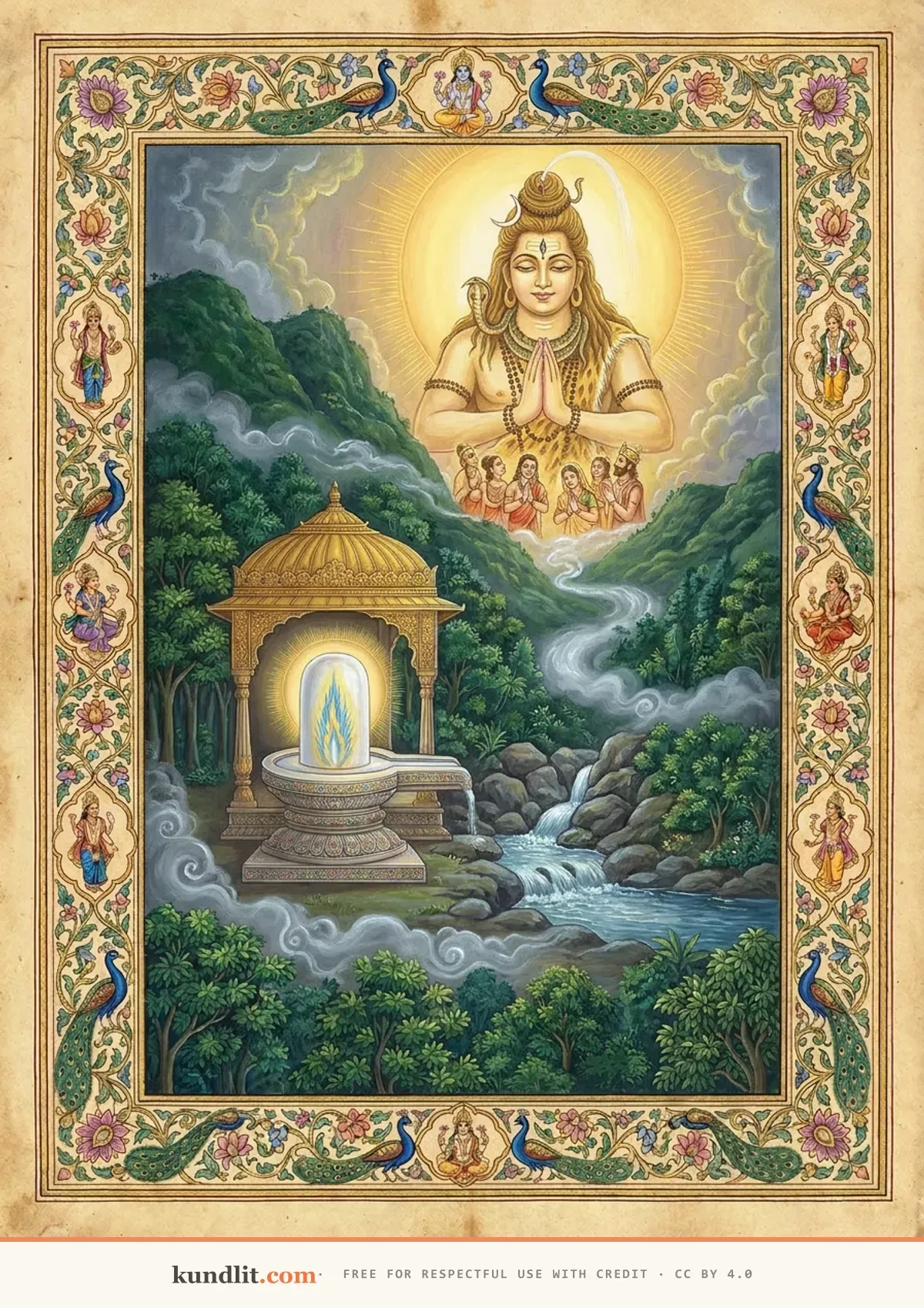
The shrine in the mist at the Bhima's source — the demon Bhima's story is Koti Rudra Samhita, Adhyayas 20–21. Image by kundlit.com, CC BY 4.0 — free to reuse with credit.
Bhima was the son of Kumbhakarna — Ravana's giant brother slain by Rama. Raised by his demoness mother Karkati, he learned of his father's death, won power through tapasya, and turned it on the gods and the devout. His chosen victim was Sudakshina, the devoted king of Kamarupa, whom he threw into prison. There the king worshipped an earthen linga, and when Bhima swung his sword at it, Shiva rose from the linga and burned the demon to ash (Koti Rudra Samhita, Adhyayas 20–21). At the gods' request he remained as Bhimashankar "at Dakini" (Shatarudra Samhita 42.27–29).
The temple stands in the Sahyadri hills of Pune district, Maharashtra, at the source of the river Bhima — the Gita Press edition itself notes this is the shrine glorified by the Marathi sants, from Jnaneshwar onward. Note the geography honestly, though: the same text places the king in Kamarupa — Assam — and Assam has its own Bhimashankar claim. More on this below.
Full story and temple guide: Bhimashankar Jyotirlinga →
7. Kashi Vishwanath — the city Shiva never leaves
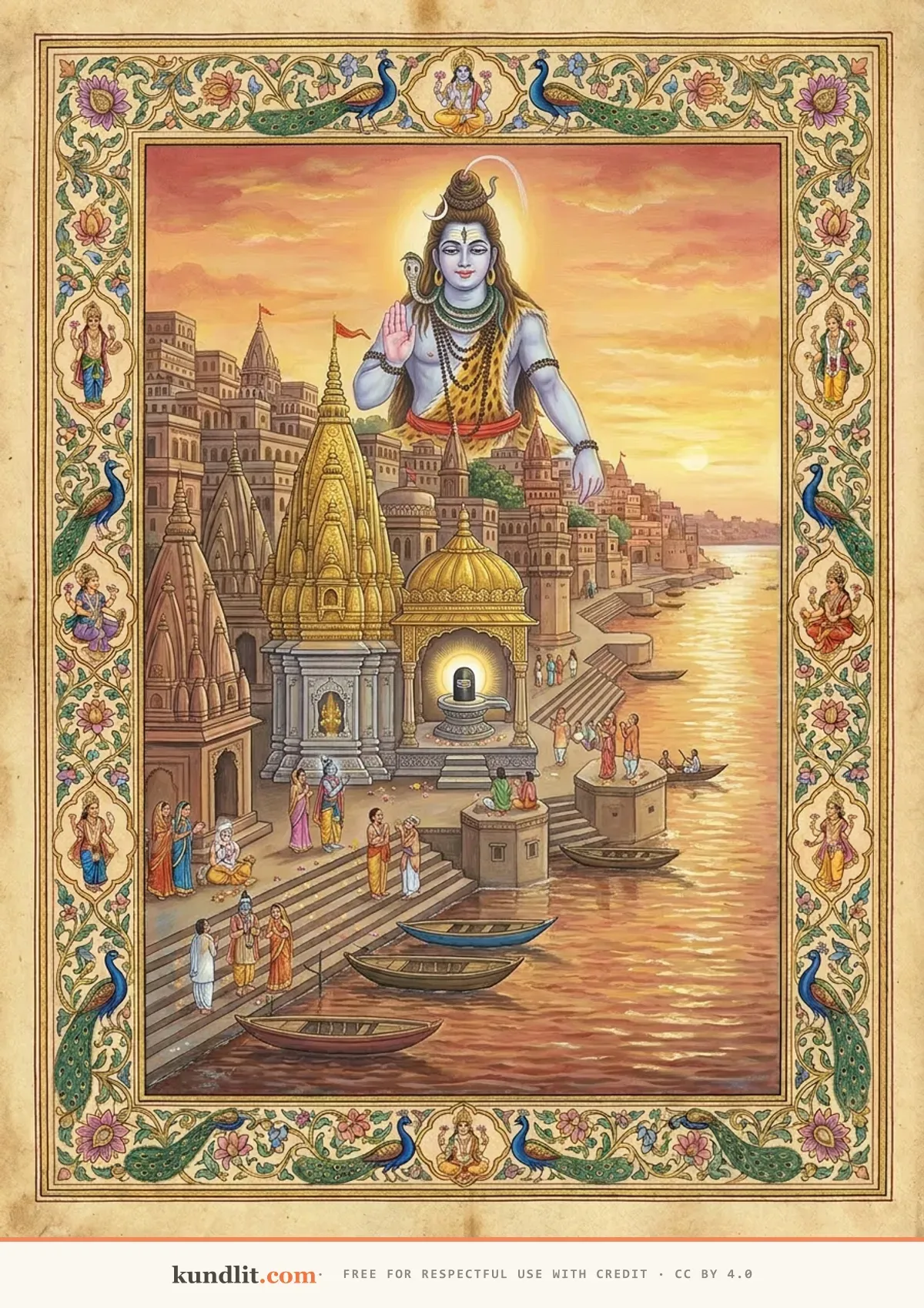
Kashi, the city of light, with its lord at the centre — Koti Rudra Samhita, Adhyayas 22–23. Image by kundlit.com, CC BY 4.0 — free to reuse with credit.
The seventh jyotirlinga needs the least introduction. The Shiva Purana calls Kashi Avimukta — "the never-forsaken" — because Shiva does not leave it even at the dissolution of the universe. The text's chapters on Vishweshwara are less a story than a map of grace: Kashi is called the place where dying itself becomes liberation, and Vishwanath, "lord of all," the form of Shiva worshipped there by gods and sages perpetually (Koti Rudra Samhita, Adhyayas 22–23; Shatarudra Samhita 42.30–33 calls the linga self-manifest in his own city, svayam-siddha).
The temple stands in Varanasi, Uttar Pradesh, a lane's walk above the ghats of the Ganga. Whatever else changes in India, the queue for this darshan does not shorten.
Full story and temple guide: Kashi Vishwanath Jyotirlinga →
8. Trimbakeshwar — Gautama and the descent of the Godavari
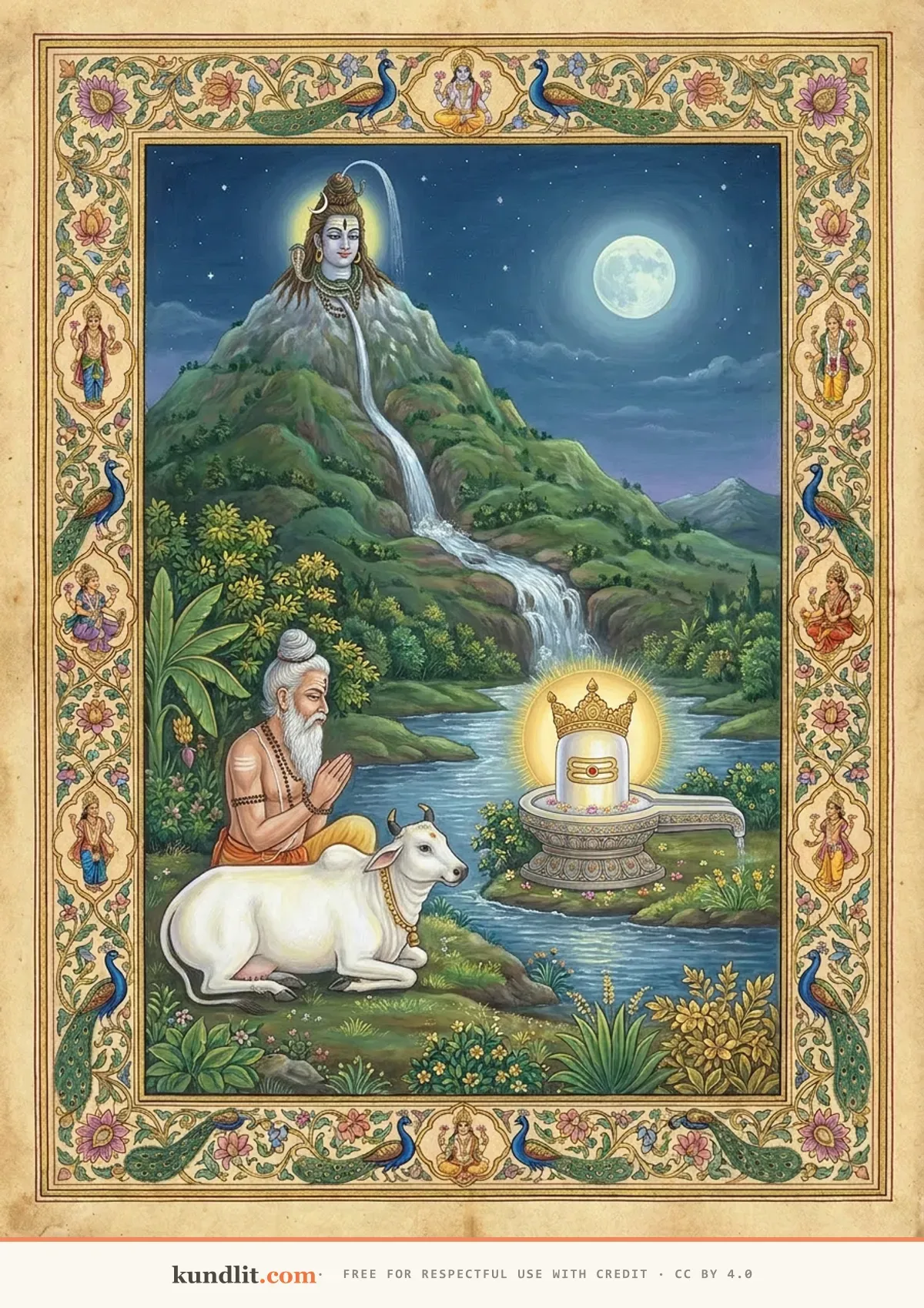
The Gautami descends for Gautama at Brahmagiri — Koti Rudra Samhita, Adhyayas 24–27. Image by kundlit.com, CC BY 4.0 — free to reuse with credit.
The sage Gautama's story is the longest and most human of the twelve. During a great drought, his merit alone kept his ashram fed — and his fellow rishis grew jealous. They had a frail cow sent into his grain field; when Gautama tried to shoo it with a blade of grass, it fell dead, and the rishis who had engineered the scene denounced him as a cow-killer and expelled him (Koti Rudra Samhita, Adhyayas 24–26 tell the full account, including the rishis' plot and Gautama's anguish).
Gautama's answer was not protest but tapasya. He worshipped Shiva on the Brahmagiri mountain and asked, as his purification, that Ganga herself descend there. She did — as the Godavari, also called Gautami after him — and at Gautama's prayer Shiva remained on her bank as Tryambaka, "the three-eyed" (KRS, Adhyaya 27; Shatarudra Samhita 42.34–37). The Shiva Purana frames the jyotirlinga and the river as a single act of grace: where the false accusation fell, a Ganga rose.
The temple is at Trimbak near Nashik, Maharashtra, at the foot of Brahmagiri where the Godavari rises. The linga here is a small natural depression with three faces, honoured as Brahma, Vishnu and Shiva.
Full story and temple guide: Trimbakeshwar Jyotirlinga →
9. Vaidyanath — Ravana's nine heads
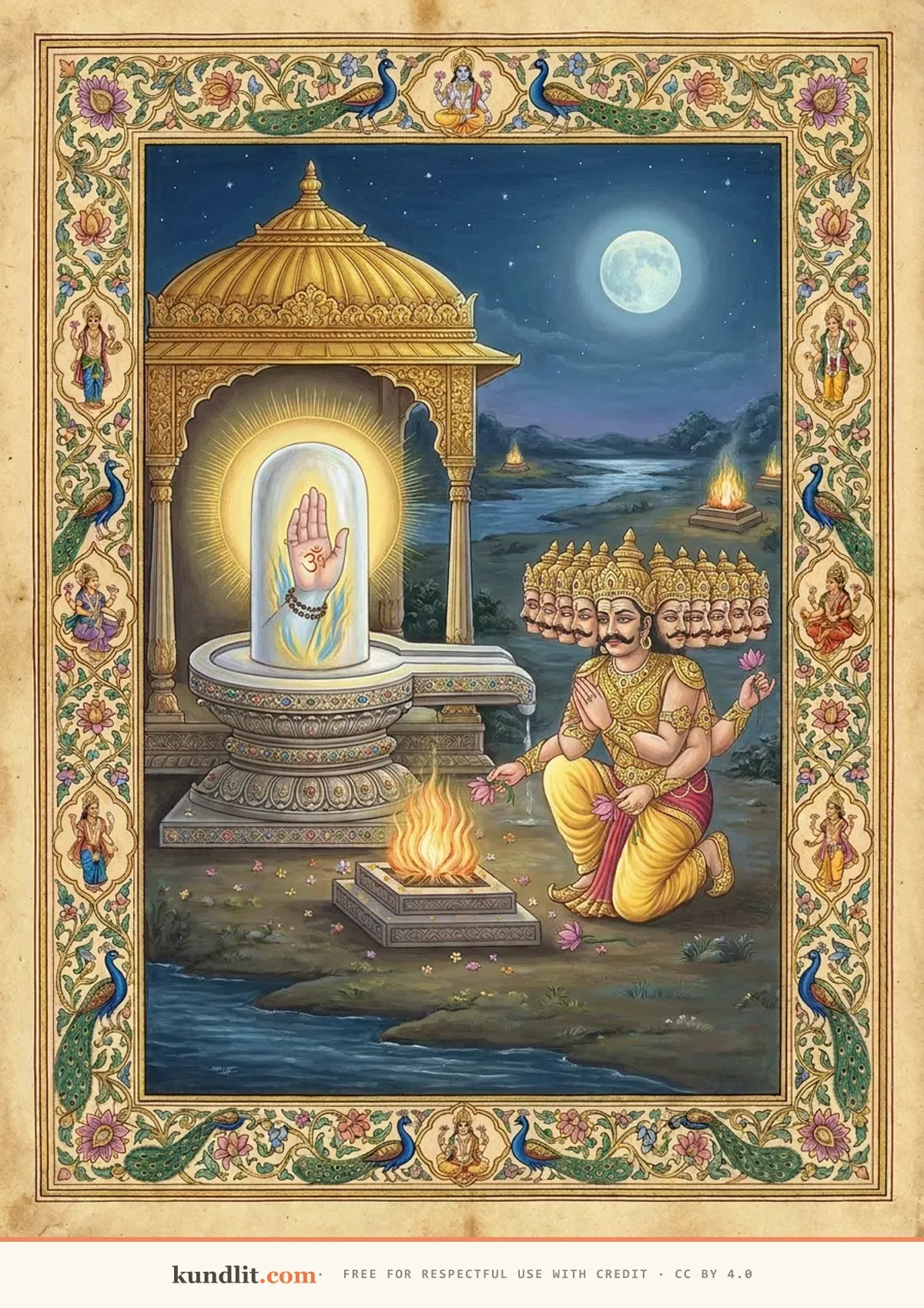
Ravana, the fiercest devotee of the twelve stories — Koti Rudra Samhita, Adhyaya 28. Image by kundlit.com, CC BY 4.0 — free to reuse with credit.
Ravana, king of Lanka, worshipped Shiva with the most extreme tapasya in the whole cycle: fire pits in summer, open ground in the rains, standing in water in winter — and when even that failed to move Shiva, he began cutting off his own heads, one by one, as offerings. When nine were severed and one remained, Shiva appeared, restored all his heads whole and unhurt — acting as the divine vaidya, the healer — and granted him a boon (Koti Rudra Samhita, Adhyaya 28, verses 7–10).
Ravana asked to carry Shiva home to Lanka. Shiva consented through a linga, with one condition: set it down anywhere on the way, and there it stays. The gods, horrified at the thought of an invincible Lanka, intervened; on the journey Ravana was forced to pause, handed the linga to another, and it touched the earth at Chitabhumi — where it stands immovable as Vaidyanath, "the lord who heals" (KRS 28; Shatarudra Samhita 42.38–40).
Today two temples claim the site — Baidyanath Dham at Deoghar in Jharkhand, and Parli Vaijnath in Maharashtra — and the texts themselves split the evidence; see the next section but one.
Full story and temple guide: Vaidyanath Jyotirlinga →
10. Nageshwar — the light in the demon forest
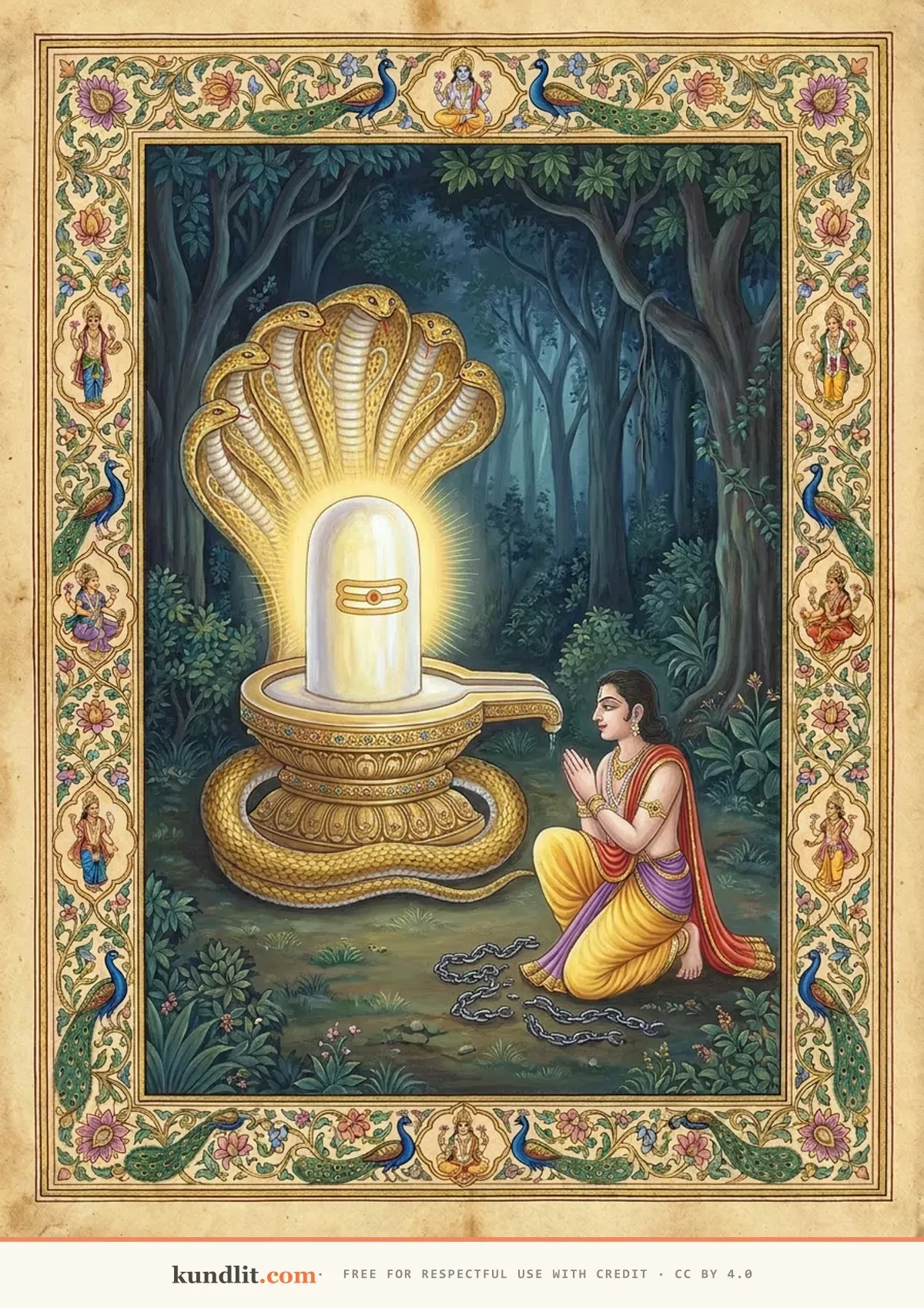
Supriya freed before Nagesha in the Daruka forest — Koti Rudra Samhita, Adhyaya 30. Image by kundlit.com, CC BY 4.0 — free to reuse with credit.
In the Daruka forest by the western sea ruled the demoness Daruka, whose band terrorised the region under the protection of a boon from Parvati. Their captives included Supriya, a merchant leader and steadfast Shiva devotee, who quietly turned the prison into a school of worship. When the demons moved to kill him, Shiva broke out of the earth before the prisoners on a radiant throne, gave Supriya the Pashupata weapon, and the demons were finished (Koti Rudra Samhita, Adhyaya 30 — the chapter also records that Parvati's boon to Daruka was honoured in the resolution, a detail most retellings drop). Shiva remained there as Nageshwar, lord of serpents, with Parvati beside him as Nageshwari (Shatarudra Samhita 42.41–44).
The best-known Nageshwar temple stands near Dwarka in Gujarat; Aundha Nagnath in Maharashtra and Jageshwar in Uttarakhand maintain rival claims to the Daruka forest — covered honestly below.
Full story and temple guide: Nageshwar Jyotirlinga →
11. Rameshwaram — the linga Lord Rama worshipped
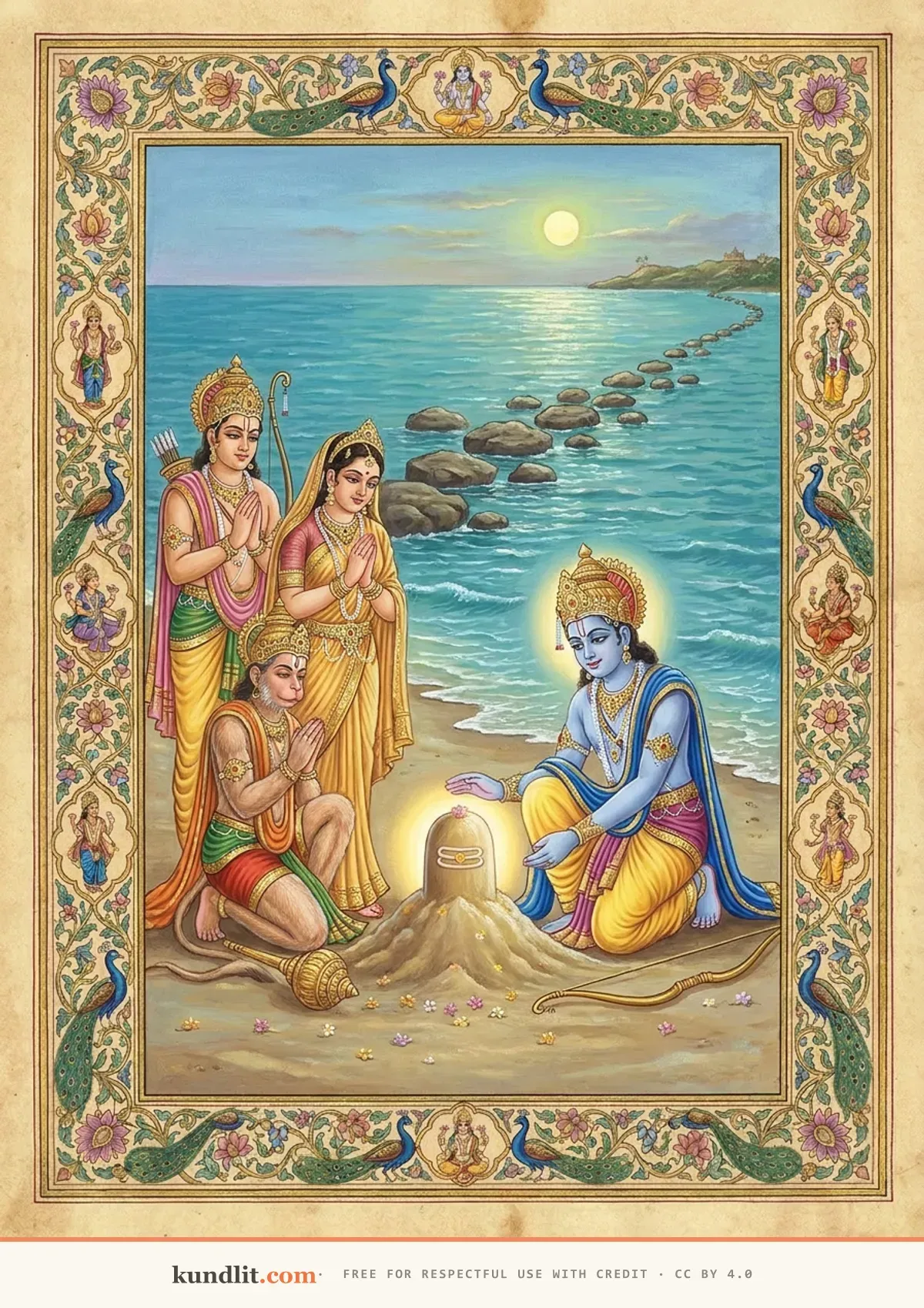
Rama worships Shiva at Setubandha before the crossing — Koti Rudra Samhita, Adhyaya 31. Image by kundlit.com, CC BY 4.0 — free to reuse with credit.
Before the army of vanaras crossed to Lanka, Rama camped on the shore of the southern ocean — anxious, the text says plainly, about the sea, about Ravana's strength, about Lanka's walls. There, on that shore at Setubandha (the place of the bridge), he worshipped Shiva in a linga and asked for victory and for Shiva's permanent presence (Koti Rudra Samhita, Adhyaya 31). The linga remained as Rameshwara — "the lord of Rama" — the one jyotirlinga established through the worship of Vishnu's own avatar, making it equally beloved to Shaivas and Vaishnavas. The Samhita promises that bathing the linga here with Ganga water grants liberation (KRS 31.50–51).
The Ramanathaswamy temple on Rameswaram island, Tamil Nadu, marks the spot — famous for the longest temple corridors in India and the twenty-two sacred wells where pilgrims bathe before darshan.
Full story and temple guide: Rameshwaram Jyotirlinga →
12. Grishneshwar — a mother's hundred and one lingas
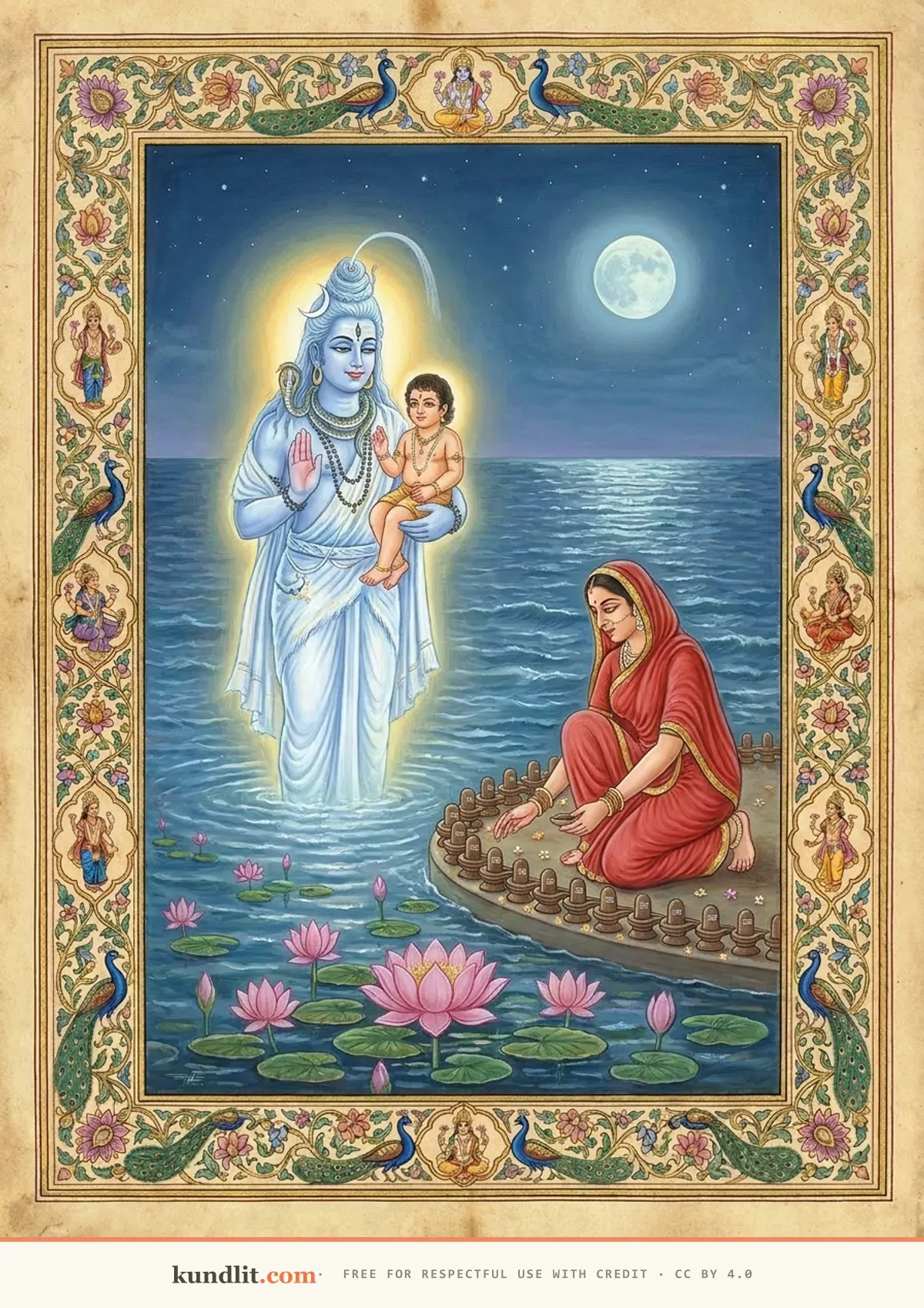
Ghushma's faith rewarded at the pond — Koti Rudra Samhita, Adhyayas 32–33. Image by kundlit.com, CC BY 4.0 — free to reuse with credit.
Near Devagiri in the south lived the brahmin Sudharma and his wife Sudeha, childless; at Sudeha's own urging her sister Ghushma became his second wife. Ghushma's daily vrata was to shape a hundred and one earthen lingas, worship them, and immerse them in the nearby pond. A son was born to her — and Sudeha's helpfulness curdled into jealousy until, one night, she killed the young man and threw his body into the very pond of the lingas.
What the text dwells on is Ghushma's response: she rose as usual, completed her full worship without rage or grief, and went to the pond to immerse the day's lingas — where her son rose alive from the water, and Shiva rose with him, furious, ready to destroy Sudeha. Ghushma asked him to forgive her sister. Astonished by both her steadiness and her mercy, Shiva granted her boon: he remains by that pond as Ghushmeshwar (Grishneshwar), the twelfth jyotirlinga, named for the woman whose faith outlasted everything (Koti Rudra Samhita, Adhyayas 32–33; Shatarudra Samhita 42.52–56).
The temple stands at Verul — Ellora — near Chhatrapati Sambhajinagar (Aurangabad), Maharashtra, a short walk from the Ellora caves and their great rock-cut Kailasa temple. The Shatarudra Samhita's note that the linga arose "near Devashaila" matches the Devagiri country exactly.
Full story and temple guide: Grishneshwar Jyotirlinga →
Which locations are actually certain?
An honest list has to admit this: for nine of the twelve, text and temple agree without argument. For three, they don't, and the dispute is centuries old.
- Vaidyanath — the smaranam verse says Paralyam ("at Parali"), which supports Parli Vaijnath in Maharashtra; but the Shiva Purana's own katha says the linga came to rest at Chitabhumi — "the cremation ground" — which is the traditional epithet of Deoghar in Jharkhand (Koti Rudra Samhita 28; Shatarudra Samhita 42.39). The two texts pull in different directions, and both temples maintain full jyotirlinga worship.
- Nageshwar — the verse only says Darukavane, "in the Daruka forest," and never fixes the forest. The katha's "western sea" detail (KRS 30) favours Dwarka in Gujarat, but Aundha Nagnath (Maharashtra) and Jageshwar (Uttarakhand) each hold old traditions.
- Bhimashankar — the verse says Dakinyam, "at Dakini," and the celebrated temple is in the Sahyadris near Pune, source of the river Bhima — the shrine sung by the Marathi sants. Yet the same Purana sets the rescued king in Kamarupa, i.e. Assam (Shatarudra Samhita 42.28), where another Bhimashankar stands.
This is not a flaw to hide. The texts fix the names and the stories beyond doubt; the map underneath has always carried more than one pin in a few places. If your family or sampradaya honours Parli or Aundha, nothing in the Purana stands against you.
Why these twelve matter — in the text's own words
The Shiva Purana does not present the jyotirlingas as tourist circuit but as a standing act of grace. Its claim is concrete: reciting the twelve names every morning and evening destroys the sins of seven births (KRS 1.24, quoted above), and the Shatarudra Samhita closes its list by promising that hearing these twelve stories with attention brings both bhukti and mukti — wellbeing in this world and liberation beyond it (Shatarudra Samhita 42.57–58).
That is also why the smaranam verse — four lines, twelve names — is among the most-recited Sanskrit passages in daily use. You do not need to visit a single shrine to begin; the text's own entry point is simply remembering the names.
If you are planning darshan, the high season is Shravan (Sawan) — roughly mid-July to mid-August — when every jyotirlinga sees its largest crowds, and Mondays above all. Kedarnath is the constraint to plan around: it is open only from around Akshaya Tritiya (April–May) to Bhai Dooj (October–November).
About the images
The twelve paintings in this article were created by kundlit.com for this guide, in the manner of traditional patachitra and Kangra miniature painting. The scene in each follows the shrine's own katha in the Shiva Purana — the figures, settings and story moments come from the chapters cited beside each image, not from imagination. They contain no mantras or yantras.
All of them are released under CC BY 4.0: you are free to use them on your own site, in presentations, posters or print, with credit to kundlit.com (a link where possible). We ask one thing beyond the licence: these are images of worship — use them respectfully.
Sources
- Shiva Purana, Koti Rudra Samhita (Gita Press, Gorakhpur) — Adhyaya 1 (the twelve named, 1.21–24); Adhyaya 14 (Somnath); 15 (Mallikarjuna); 16–17 (Mahakaleshwar); 18 (Omkareshwar–Amaleshwar); 19 (Kedareshwar); 20–21 (Bhimashankar); 22–23 (Kashi Vishweshwar); 24–27 (Trimbakeshwar and the Gautama katha); 28 (Vaidyanath); 30 (Nageshwar); 31 (Rameshwar); 32–33 (Grishneshwar).
- Shiva Purana, Shatarudra Samhita, Adhyaya 42 — the summary of the twelve jyotirlinga avataras.
- Shiva Purana, Vidyeshvara Samhita, Adhyayas 5–9 — the lingodbhava (pillar of light) account; the same episode in Linga Purana, Adhyaya 17.
- Rudrashtadhyayi (Gita Press, Gorakhpur), p. 225 — Dvadasha Jyotirlinga Smaranam.