

Mallikarjuna Jyotirlinga: the shrine where Shiva and Parvati followed their son
- mallikarjuna
- srisailam
- jyotirlinga
- shiva
- parvati
- andhra-pradesh
Read with context
- Sources and context stay close to the text
- Interpretations are presented as guidance
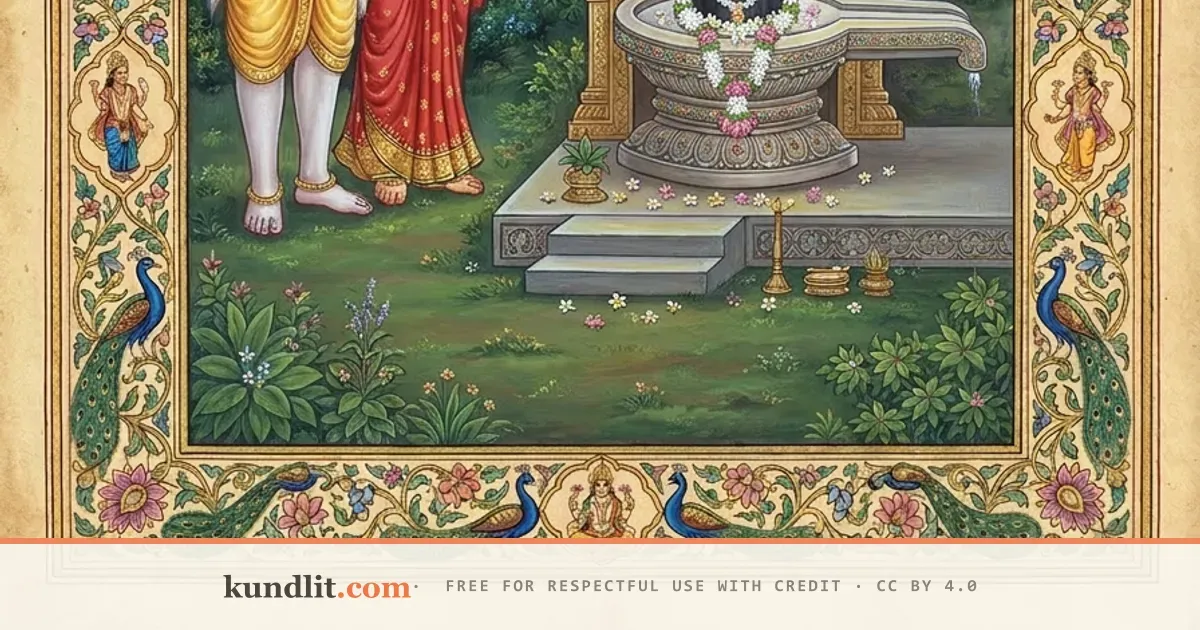
Mallikarjuna at Srisailam, in Andhra Pradesh, is the second of the twelve jyotirlingas — and the only one whose name contains both Shiva and Parvati. Its origin story is not a battle or a curse but something more domestic and more tender: a family quarrel, and parents who would not stop visiting.
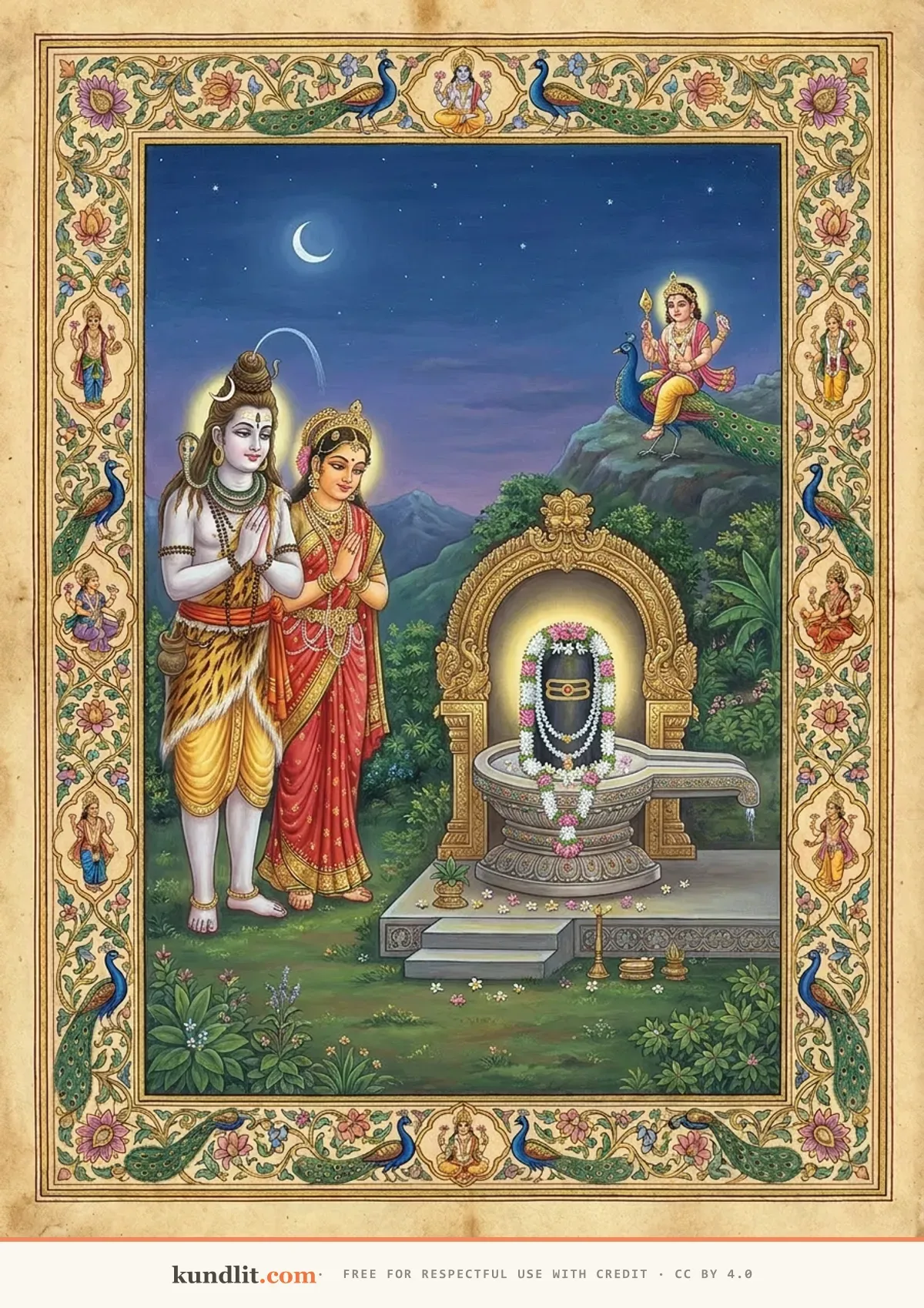
Shiva and Parvati on Srishaila, looking toward their son — Shiva Purana, Koti Rudra Samhita, Adhyaya 15. Image by kundlit.com, CC BY 4.0 — free to reuse with credit.
The story: Kartikeya leaves home
The background is the famous contest between the two sons of Shiva and Parvati. The prize — marriage first — would go to whoever circled the world first. Kartikeya set off on his peacock to actually do it; Ganesha simply walked around his parents and declared them his world. Ganesha was married first. When Kartikeya returned, the Shiva Purana lets him speak with the raw hurt of a son: "You did this without loving me — I cannot stay here even a moment" — and he left Kailasa for the Krauncha mountain in the south (Shiva Purana, Rudra Samhita, Kumara Khanda — the chapter records that the gods and rishis begged him to return, and he withdrew three yojanas further instead).
What turns the family story into a jyotirlinga is what the parents did next. Parvati, unable to bear the separation, said to Shiva: come, we go to him. And they went — not once, but perpetually:
तत्सुखार्थं स्वयं शम्भुर्गतः स्वांशेन पर्वते । मल्लिकार्जुननामासीज्ज्योतिर्लिङ्गं सुखावहम् ॥
"For his happiness Shambhu himself went to the mountain in his own aspect, and became the joy-giving jyotirlinga named Mallikarjuna." — Shiva Purana, Rudra Samhita (Kumara Khanda), 20.32
The Koti Rudra Samhita adds the detail that turned into living practice: Shiva visits his son on every amavasya (new moon), and Parvati on every purnima (full moon) — and from that day the combined form of Mallika (Parvati) and Arjuna (Shiva) stood as one linga, famed through the three worlds (Koti Rudra Samhita, Adhyaya 15, verses 17–19).
What the texts promise here
मल्लिकार्जुनसंज्ञश्चावतारः शङ्करस्य वै । द्वितीयः श्रीगिरौ तात भक्ताभीष्टफलप्रदः ॥
"The avatara of Shankara named Mallikarjuna is the second, on the Sri mountain — the giver of the results his devotees long for." — Shiva Purana, Shatarudra Samhita 42.10
The Koti Rudra Samhita promises that one who sees this linga is freed of all sins and obtains every wish — "his sorrow departs entirely; he does not suffer the womb again" (KRS 15.20–22). The first offering, tradition holds, was the white mallika (jasmine) garland the linga still wears in its iconography.
The temple today
Mallikarjuna stands at Srisailam in the Nallamala hills of Andhra Pradesh, on a plateau above the Krishna river. Two things make it nearly unique among Indian shrines. First, it is both a jyotirlinga and a Shakti Pitha — Devi Bhramaramba's shrine adjoins Mallikarjuna's, so the site carries the highest sanctity of both the Shaiva and Shakta streams, exactly as a linga named for both Shiva and Parvati should. Second, by living tradition the sanctum here is open to all, and pilgrims may touch the linga during abhisheka at appointed times — uncommon among the twelve.
| Position in the twelve | 2nd |
| State | Andhra Pradesh (Srisailam, Nandyal district) |
| Setting | Nallamala hills, above the Krishna river |
| Primary scripture | Shiva Purana, Koti Rudra Samhita, Adhyaya 15 |
| Also in | Rudra Samhita (Kumara Khanda); Shatarudra Samhita 42.10–12 |
| Peak season | Shravan (Sawan), Mahashivratri (the temple's grandest festival), Ugadi |
Continue the yatra
The yatra came from Somnath and continues north to Mahakaleshwar at Ujjain. For all twelve in one place — the Sanskrit verse, the state-wise table, every story — see The 12 Jyotirlingas: names, places and stories.
The painting above was made for this article following the Purana's account, and is free to reuse with credit to kundlit.com under CC BY 4.0.