

Somnath Jyotirlinga: the moon's curse, and why this is the first of the twelve
- somnath
- jyotirlinga
- shiva
- gujarat
- prabhasa
Read with context
- Sources and context stay close to the text
- Interpretations are presented as guidance
Somnath, on the Saurashtra coast of Gujarat, is the first jyotirlinga — first in the verse every list descends from, and first in every traditional yatra of the twelve. Its origin story is one of the oldest "and that is why the moon waxes and wanes" tales in the Sanskrit literature, and the Shiva Purana tells it in full.
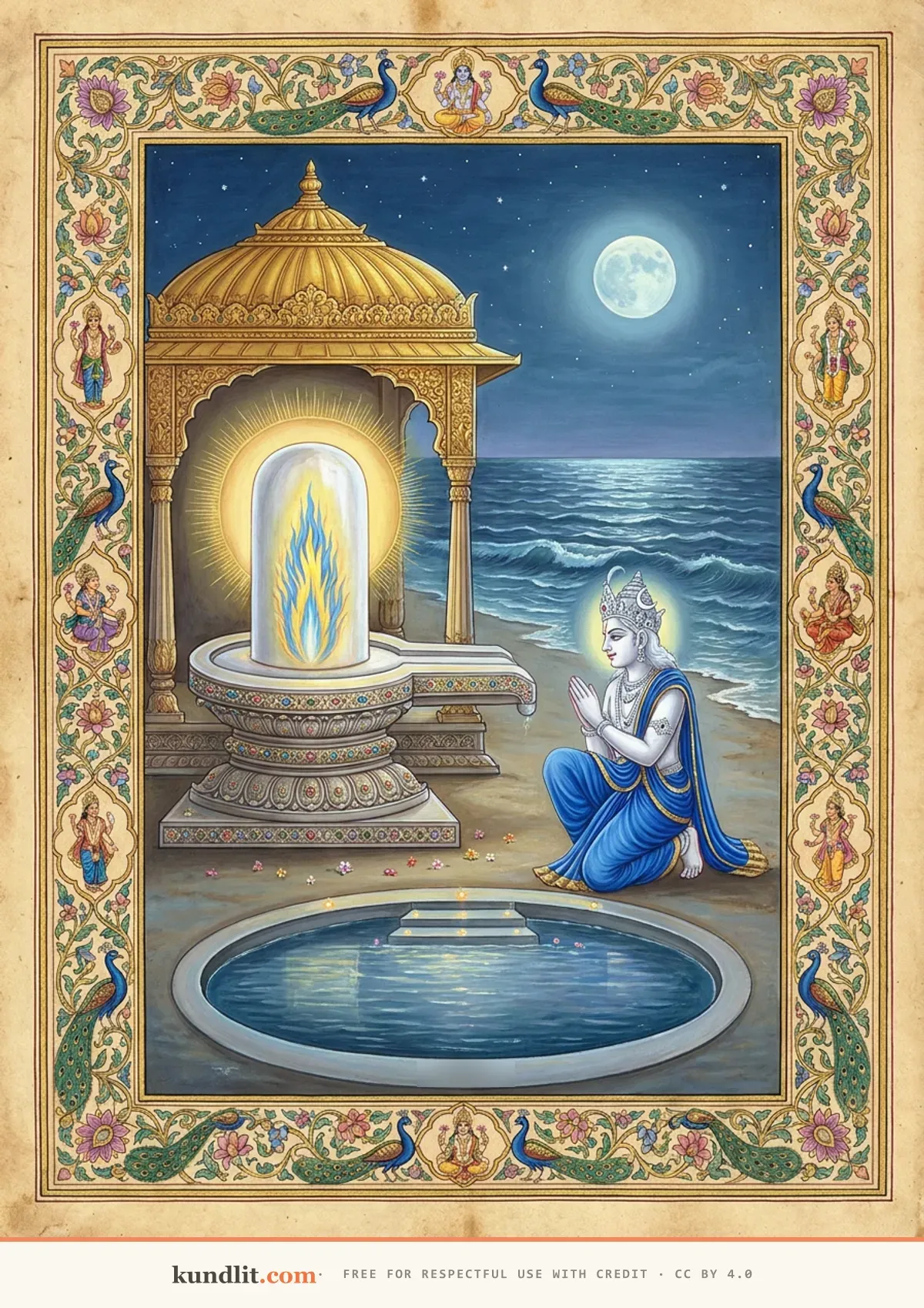
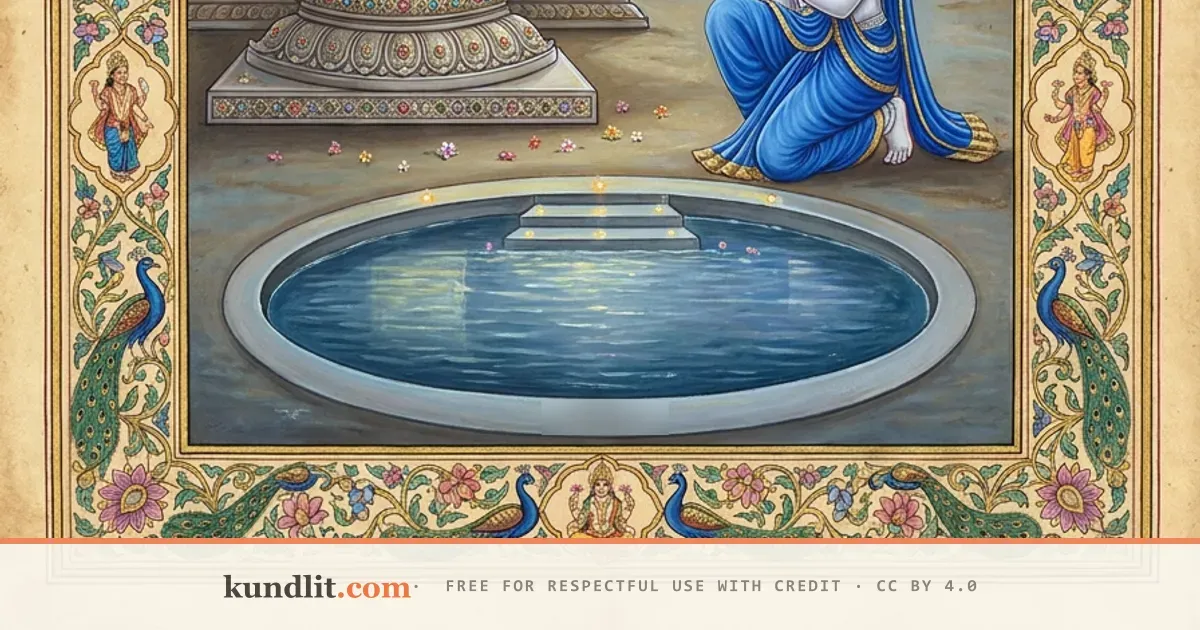
Chandra worships the linga of light at Prabhasa — the scene of Shiva Purana, Koti Rudra Samhita, Adhyaya 14. Image by kundlit.com, CC BY 4.0 — free to reuse with credit.
The story: Daksha's curse on the moon
Chandra, the moon god, married all twenty-seven daughters of Daksha Prajapati — the twenty-seven nakshatras the moon still visits, one each night, on his monthly round of the sky. But he loved only one of them, Rohini. The neglected twenty-six complained to their father. Daksha warned Chandra gently, then warned him again — and the Shiva Purana notes, with a shrug at fate, that Chandra could not listen, "deluded by Shiva's maya by which this whole world is deluded" (Koti Rudra Samhita, Adhyaya 14, verses 13–16).
So Daksha cursed him: be consumed by kshaya — the wasting disease. The moon began to fade, and with him faded everything the moon governs: nights, plants, the minds of living beings. The alarmed gods and rishis went to Brahma, who prescribed the remedy: take Chandra to Prabhasa, on the Saurashtra shore, and let him worship Shiva there with the Mrityunjaya rite — the great invocation of Shiva as the conqueror of death (KRS 14.33–34).
Chandra performed tapasya for six months, completing ten crore repetitions of the invocation. Shiva appeared, pleased, and offered him a boon. Chandra asked simply: stop my wasting away, and forgive me. Shiva's answer is the compromise written across the sky ever since:
पक्षे च क्षीयतां चन्द्र कला ते च दिने दिने । पुनश्च वर्धतां पक्षे सा कला च निरन्तरम् ॥
"O Chandra, let your digits wane day by day for one fortnight — and then let them wax again, fortnight after fortnight, without end." — Shiva Purana, Koti Rudra Samhita 14.45
The curse was honoured, and the moon was saved. At the prayer of Chandra and the gods, Shiva remained at Prabhasa permanently as Somnath — "the lord of Soma," the moon's own name for his rescuer.
What the texts promise here
The Shiva Purana's summary of the twelve gives Somnath a specific character — the healer of wasting:
तत्राद्यः सोमनाथो हि चन्द्रदुःखक्षयंकरः । क्षयकुष्ठादिरोगाणां नाशकः पूजनान्मुने ॥
"The first among them is Somnath, the destroyer of Chandra's sorrow; by his worship, diseases like consumption and leprosy are destroyed." — Shiva Purana, Shatarudra Samhita 42.6
The same passage names the Chandrakund there — the pool where Chandra bathed — as destroying all sins (Shatarudra Samhita 42.8; Koti Rudra Samhita 1.6–8 repeats both claims).
The Skanda Purana, whose Prabhasa Khanda is the most detailed scripture of this region, goes further back: Shiva says he existed at Prabhasa as a sparshalinga — a linga of touch — before anyone knew him there, and that the linga's name changes with each cosmic age; "six Brahmas have passed, and this is the seventh." In the same khanda he calls Prabhasa a mokshadham — a home of liberation — and promises that those who take refuge in Someshwara "do not wander again in this fearsome wheel of the world" (Skanda Purana, Prabhasa Khanda, Gita Press ed.).
The temple today
Somnath stands at Prabhas Patan, near Veraval in the Gir-Somnath district of Gujarat, directly on the Arabian Sea. Its recorded history is itself a lesson in persistence: raided and rebuilt repeatedly across a millennium, the present temple was reconsecrated in 1951. An inscribed arrow-pillar on the seawall — the baan-stambha — marks the famous claim that there is no land in a straight line between Somnath and the south pole.
| Position in the twelve | 1st |
| State | Gujarat (Prabhas Patan, Veraval) |
| Setting | Arabian Sea shore — the ancient Prabhasa kshetra |
| Primary scripture | Shiva Purana, Koti Rudra Samhita, Adhyaya 14 |
| Also in | Skanda Purana, Prabhasa Khanda; Shatarudra Samhita 42.6–9 |
| Peak season | Shravan (Sawan, Jul–Aug), Mahashivratri, Kartik Purnima |
Continue the yatra
Somnath is the first of the twelve. The traditional order continues east to Mallikarjuna at Srisailam. For all twelve shrines, the Sanskrit verse that names them, and a state-wise table, see the complete guide: The 12 Jyotirlingas — names, places and stories.
The painting above was made for this article following the Purana's account, and is free to reuse with credit to kundlit.com under CC BY 4.0.