

Mahakaleshwar Jyotirlinga: why the lord of time faces south at Ujjain
- mahakaleshwar
- mahakal
- ujjain
- jyotirlinga
- shiva
- madhya-pradesh
Read with context
- Sources and context stay close to the text
- Interpretations are presented as guidance
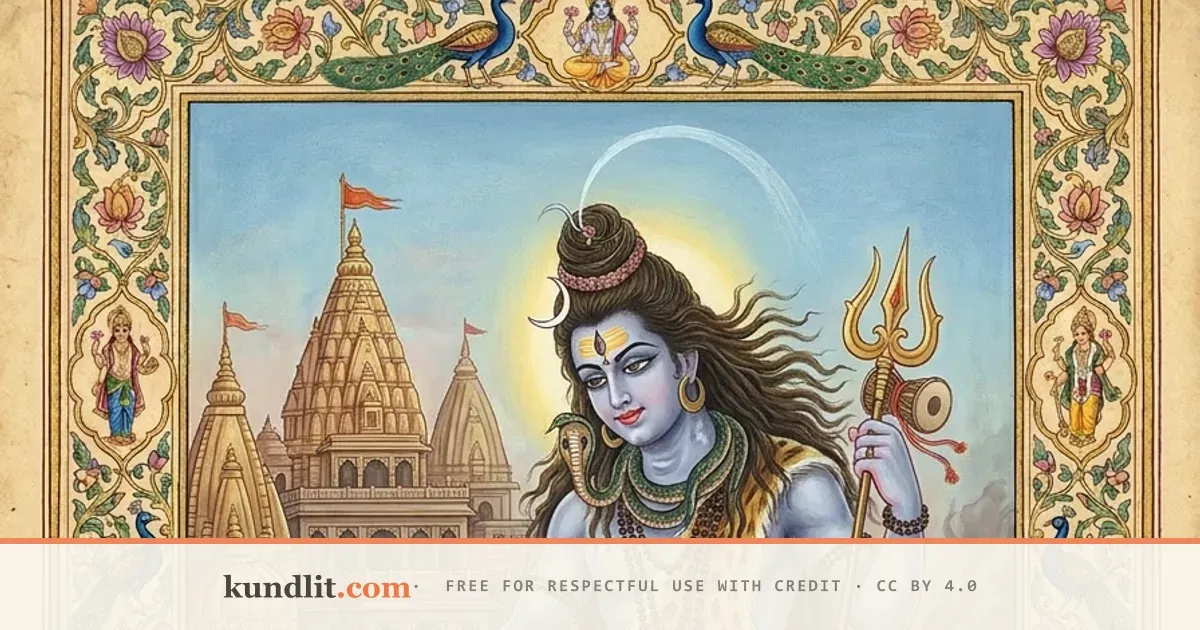
Mahakaleshwar at Ujjain is the third of the twelve jyotirlingas, and the one with the most formidable name: Mahakala, "great time" — the Shiva who consumes everything, including endings themselves. It is the only jyotirlinga that faces south, the direction of death, and the texts treat that as the whole point: at Ujjain, death itself has a master.
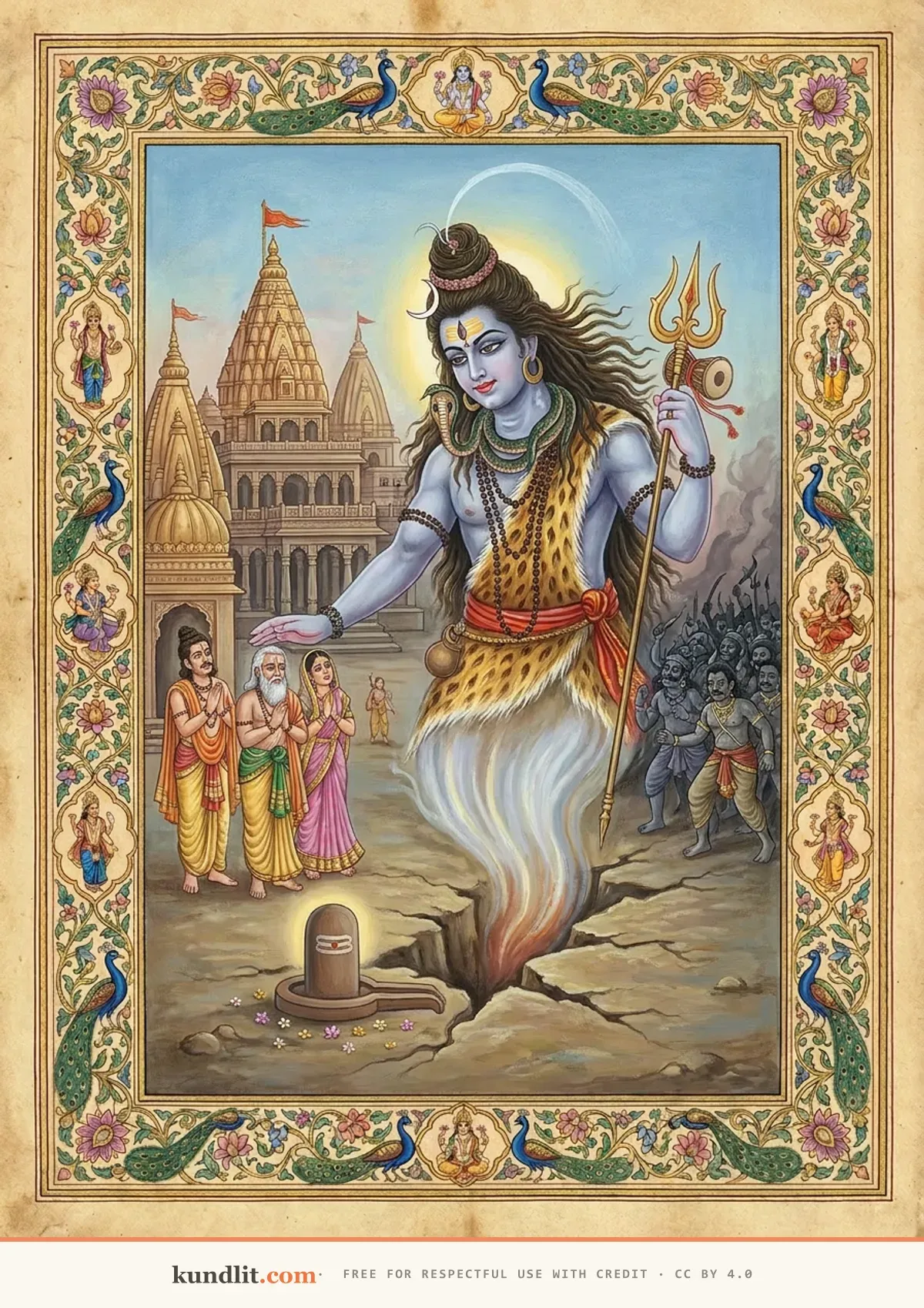
Mahakala bursts from the earth to defend Avantika — Shiva Purana, Koti Rudra Samhita, Adhyaya 16. Image by kundlit.com, CC BY 4.0 — free to reuse with credit.
The story: one roar
In the lovely city of Avanti — Ujjain's older name — lived a Vedic brahmin called Vedapriya, devoted to the daily worship of an earthen (parthiva) linga, and after him his four sons, more devout still. Against them the Purana sets Dushana, a demon from Ratnamala, "destroyer of Vedic dharma, hater of brahmins," who marched on the city to stamp out its rites (Koti Rudra Samhita, Adhyaya 16).
The brothers would not run. As the demon army raised weapons over them, they sat unmoved before the linga in meditation. Then the ground beside the linga split open:
वेदविप्रसुतध्यातो हुङ्कारेणैव स द्रुतम् । भस्मसात्कृतवांस्तं च रत्नमालनिवासिनम् ॥ तं हत्वा स महाकालो ज्योतिर्लिङ्गस्वरूपतः । देवैः स प्रार्थितोऽतिष्ठत्स्वभक्तपरिपालकः ॥
"Meditated upon by the sons of the Veda-brahmin, he reduced that dweller of Ratnamala to ash with a single roar — and having slain him, Mahakala, prayed to by the gods, remained there in the form of a jyotirlinga, the protector of his devotees." — Shiva Purana, Shatarudra Samhita 42.15–16
No weapon, no battle — a hunkara, one syllable of sound, and the army was ash. The next chapter softens the fierce portrait with two famous local stories: King Chandrasena of Ujjain and his Shiva-given jewel, and the cowherd boy Shrikara, who — having nothing else — worshipped an ordinary pebble as a linga, and whose worship Shiva accepted in full (Koti Rudra Samhita, Adhyaya 17).
What the texts promise here
The Shiva Purana promises that seeing and worshipping Mahakala fulfils all desires "and grants the highest destination after" (Shatarudra Samhita 42.17). The Skanda Purana's Avanti Khanda — the scripture of Ujjain — raises the city itself to the same rank: Avanti is the city "where Kali's influence never falls," whose name means the one who protects (avana) from sin; one of its verses makes the most extravagant promise in the whole literature of the twelve: even an insect or a moth that dies in the Mahakala kshetra becomes an attendant of Shiva (Skanda Purana, Avanti Khanda, Gita Press ed.). The same khanda records Ujjain's seven kalpa-names — Svarnashringa, Kushasthali, Avantika, Ujjayini and more — one per cosmic age.
There is also an astronomical layer that is plain history rather than legend: Ujjain sits on the prime meridian of classical Indian astronomy, the zero-line from which the siddhantas counted time. The city of Mahakala — "great time" — was, quite literally, where India set its clock.
The temple today
Mahakaleshwar stands in the old city of Ujjain, Madhya Pradesh, near the Shipra river. Two living traditions define it. The linga is dakshinamukhi — south-facing — unique among the twelve, understood as Mahakala facing down death's own direction. And the day begins with the bhasma aarti, the pre-dawn offering of sacred ash, the temple's most sought-after darshan. Ujjain is also one of the four cities of the Kumbha (Simhastha) cycle, which fills it once every twelve years.
| Position in the twelve | 3rd |
| State | Madhya Pradesh (Ujjain) |
| Setting | Old Ujjain, by the Shipra river |
| Primary scripture | Shiva Purana, Koti Rudra Samhita, Adhyayas 16–17 |
| Also in | Skanda Purana, Avanti Khanda; Shatarudra Samhita 42.13–17 |
| Peak season | Shravan (Sawan — the Mahakal sawari processions), Mahashivratri |
Continue the yatra
The yatra came from Mallikarjuna and continues down the Narmada to Omkareshwar. For all twelve — the Sanskrit verse, the state-wise table, every story — see The 12 Jyotirlingas: names, places and stories.
The painting above was made for this article following the Purana's account, and is free to reuse with credit to kundlit.com under CC BY 4.0.