

Vaidyanath Jyotirlinga: Ravana's nine heads and the lord who heals
- vaidyanath
- baidyanath
- deoghar
- jyotirlinga
- shiva
- ravana
- jharkhand
Read with context
- Sources and context stay close to the text
- Interpretations are presented as guidance
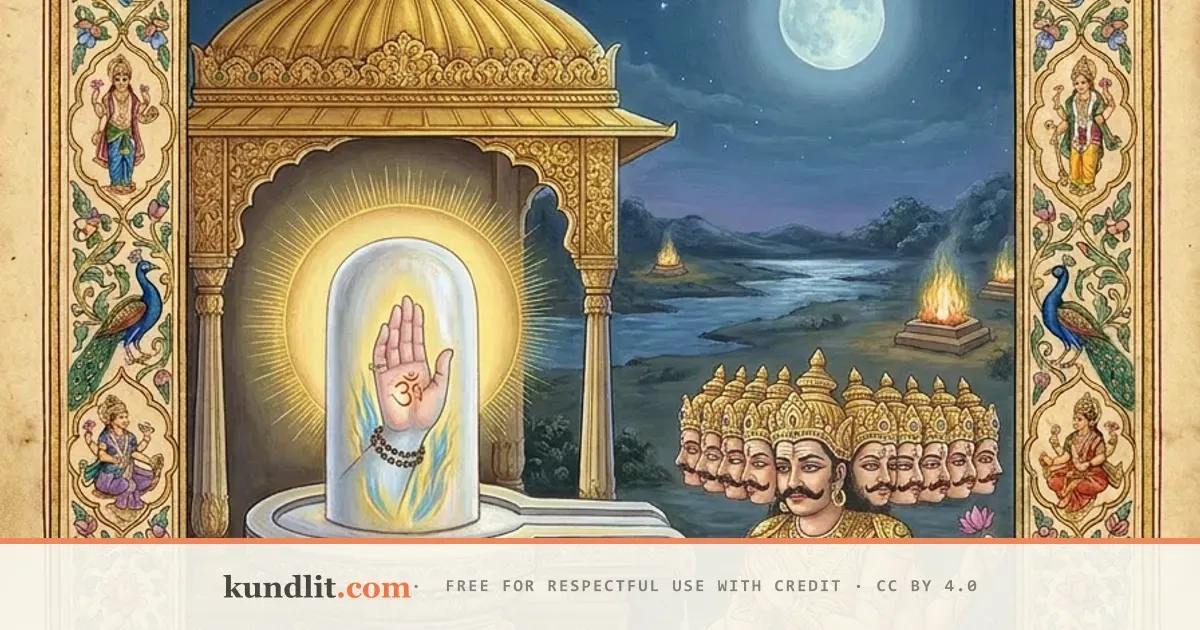
Vaidyanath — Baidyanath in its beloved eastern form — is the ninth of the twelve jyotirlingas, and its katha stars the most unexpected devotee in the whole cycle: Ravana, king of Lanka. The tradition never resolved the paradox, and never wanted to — the villain of the Ramayana is also the most extreme Shiva-bhakta in the literature, and this shrine exists because of him.
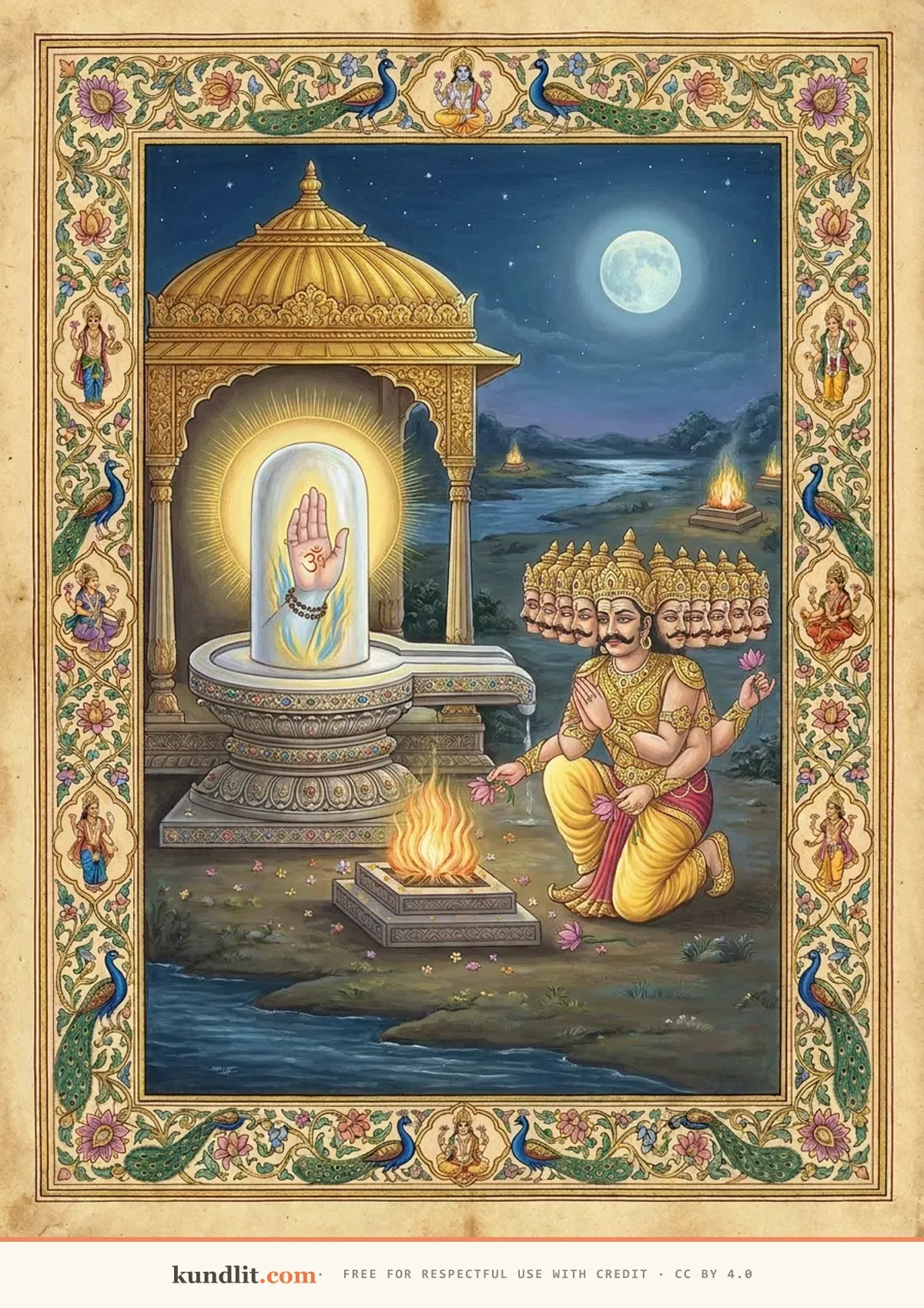
Ravana, the fiercest devotee of the twelve stories — Shiva Purana, Koti Rudra Samhita, Adhyaya 28. Image by kundlit.com, CC BY 4.0 — free to reuse with credit.
The story: nine heads, one boon
Ravana worshipped Shiva on Kailasa and got no answer. So he escalated, in the Purana's own sequence: a fire-pit dug in a tree-filled hollow south of the Himalaya; the five-fire austerity in summer; the open ground in the rains; standing in water through winter. Still nothing — "the supreme lord is hard to win for the wicked-hearted," the text remarks (Koti Rudra Samhita 28.5–6). Then Ravana did the thing that made this katha immortal:
ततः शिरांसि छित्त्वा च पूजनं शंकरस्य वै । प्रारब्धं दैत्यपतिना रावणेन महात्मना ॥ एकैकं च शिरश्छिन्नं विधिना शिवपूजने । एवं सत्क्रमतस्तेन छिन्नानि नव वै यदा ॥ एकस्मिन्नवशिष्टे तु प्रसन्नः शंकरस्तदा । आविर्बभूव तत्रैव संतुष्टो भक्तवत्सलः ॥
"Then the demon-king, the great-souled Ravana, began the worship of Shankara by cutting off his own heads. One by one, with due rite, a head was severed in Shiva's worship — and when in this order nine had been cut and a single one remained, Shankara was pleased, and appeared there, gratified, affectionate to his devotee." — Shiva Purana, Koti Rudra Samhita 28.7–9
Shiva restored all the heads, whole and unhurt — the act of the divine vaidya, the healer, from which the shrine takes its name — and granted a boon (KRS 28.10). Ravana asked to carry Shiva to Lanka. Shiva, "thrown into great perplexity" (the text allows him the feeling), consented through a linga with one condition: set it down anywhere on the way, and there it stays forever (KRS 28.14–15).
The gods could not allow an invincible Lanka. On the journey Ravana was compelled to pause; the linga was handed over, touched the earth at Chitabhumi — "the cremation ground" — and no strength of his could lift it again. There it stands as Vaidyanath, the lord who heals (KRS 28; Shatarudra Samhita 42.38–40 confirms: "the Lord, on the pretext of being carried by Ravana, established himself as a jyotirlinga in Chitabhumi").
Deoghar or Parli? The honest answer
This is the most openly contested location among the twelve, and the texts themselves split the evidence. The smaranam verse recited every morning says परल्यां वैद्यनाथं च — "Vaidyanath at Parali" — which supports Parli Vaijnath in Maharashtra. But the Shiva Purana's own katha and summary say Chitabhumi, the cremation-ground epithet that matches Deoghar in Jharkhand, whose very name means "house of the god" and whose linga is worshipped with the kamana linga (wish-fulfilling) title. Both temples maintain full jyotirlinga worship and centuries of tradition; the great Shravani Mela — below — belongs to Deoghar.
We flag the same honest ambiguity at Bhimashankar and Nageshwar: the names and stories are textually fixed; a few of the pins are not.
The temple today
Baidyanath Dham at Deoghar, Jharkhand, is the centre of one of the largest annual pilgrimages in India: in Shravan (Sawan), lakhs of kanwariyas walk ~105 km from Sultanganj, carrying Ganga water that must not touch the ground — a living echo of the linga that could not be set down — to pour it on the linga. Parli Vaijnath in the Beed district of Maharashtra keeps its own old shrine and tradition.
| Position in the twelve | 9th |
| State | Jharkhand (Deoghar) — with the old rival claim at Parli, Maharashtra |
| Setting | Chitabhumi — the ancient cremation-ground kshetra |
| Primary scripture | Shiva Purana, Koti Rudra Samhita, Adhyaya 28 |
| Also in | Shatarudra Samhita 42.38–40 |
| Peak season | Shravan (Sawan) — the Shravani Mela kanwar yatra — and Mahashivratri |
Continue the yatra
The yatra came from Trimbakeshwar and goes next into the demon forest of the west — Nageshwar. For all twelve — the Sanskrit verse, the state-wise table, every story — see The 12 Jyotirlingas: names, places and stories.
The painting above was made for this article following the Purana's account, and is free to reuse with credit to kundlit.com under CC BY 4.0.