

Trimbakeshwar Jyotirlinga: the false accusation that brought the Godavari down
- trimbakeshwar
- jyotirlinga
- shiva
- godavari
- nashik
- maharashtra
Read with context
- Sources and context stay close to the text
- Interpretations are presented as guidance
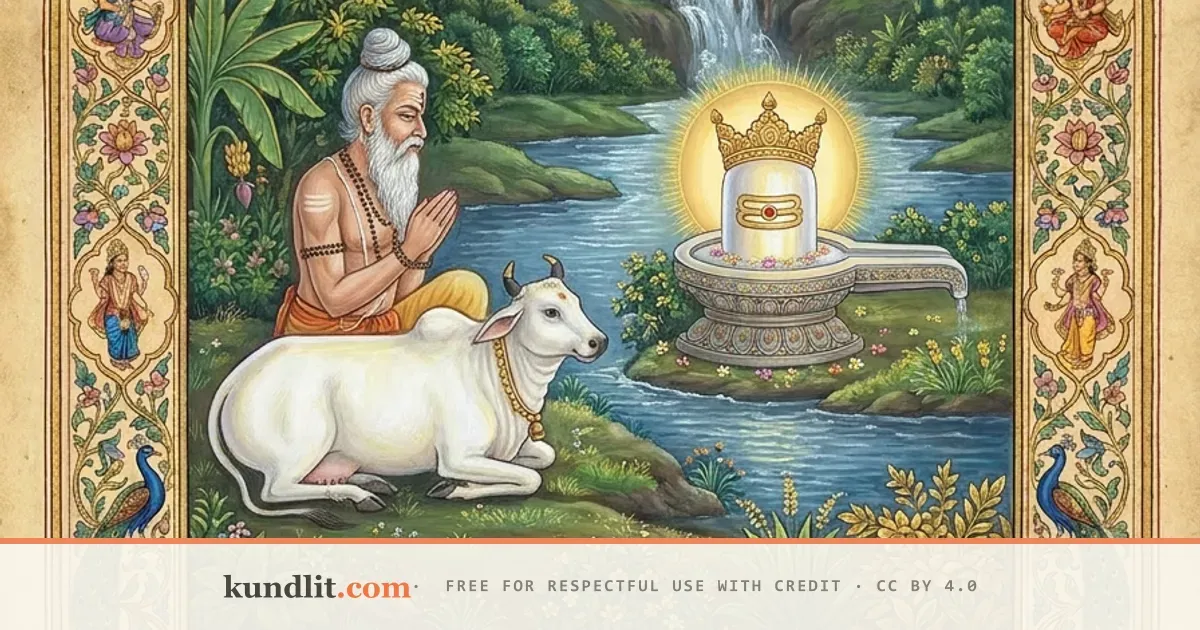
Trimbakeshwar, at the foot of the Brahmagiri mountain near Nashik, is the eighth of the twelve jyotirlingas — and the source of the Godavari, the longest river of peninsular India. The Shiva Purana gives it the longest and most human katha of the twelve: a story about jealousy among the pious, a man framed for the one sin he could not bear, and an answer that turned slander into a river.
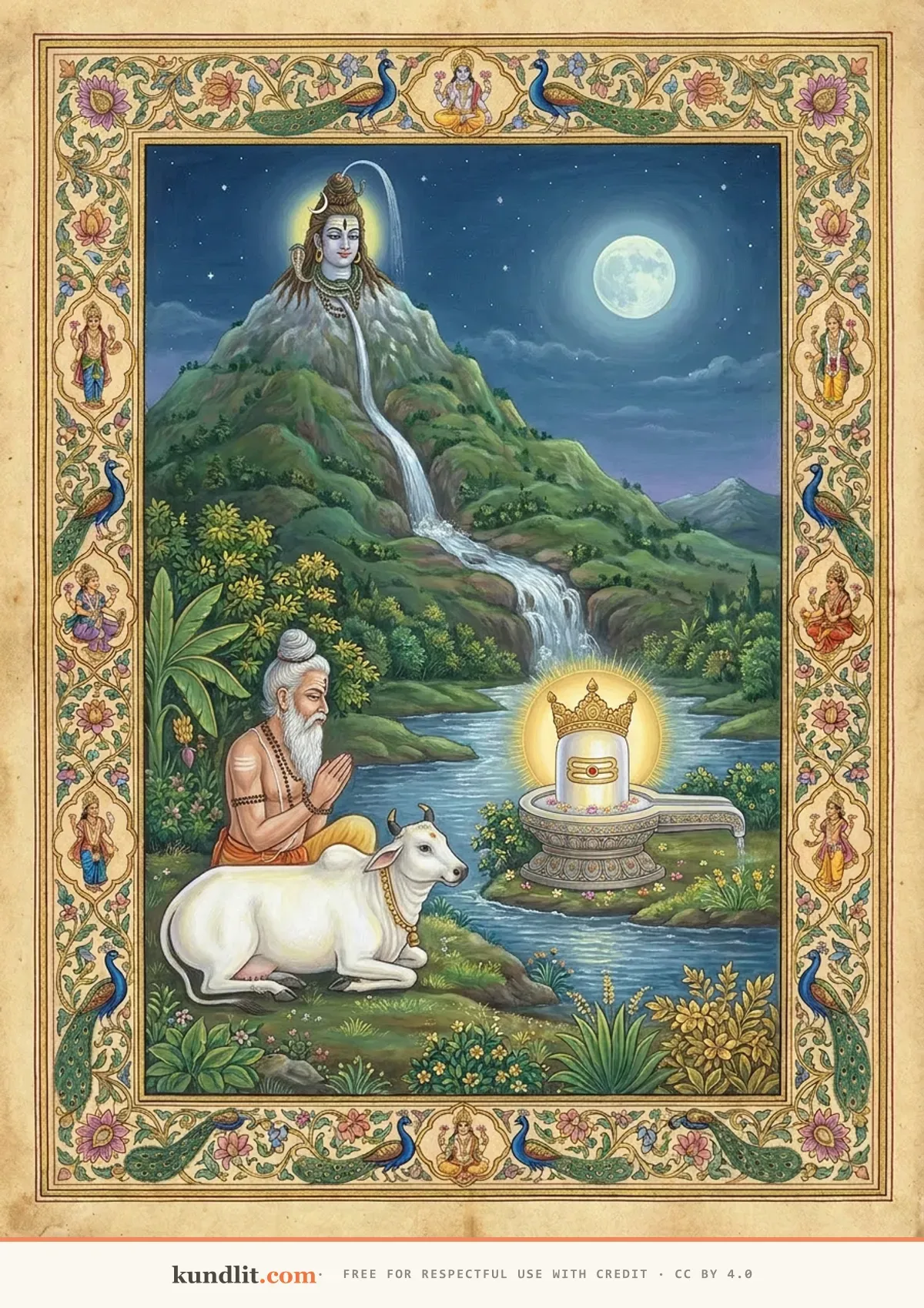
The Gautami descends for Gautama at Brahmagiri — Shiva Purana, Koti Rudra Samhita, Adhyayas 24–27. Image by kundlit.com, CC BY 4.0 — free to reuse with credit.
The story: the framed rishi
During a terrible drought, the sage Gautama's tapas-won merit kept his ashram on Brahmagiri fed when everywhere else starved — grain grew for him on request. The rishis he sheltered repaid him in the oldest coin: envy. The Purana is unsparing about the plot — the jealous rishis engineered it that a frail cow would enter Gautama's grain field; when he lifted a mere blade of grass to shoo it, the cow fell dead (Koti Rudra Samhita, Adhyayas 24–26 carry the full account, including the conspirators' words).
Then came the chorus the plotters had prepared: go-hatya! — cow-slaughter, the sin beyond expiation for a brahmin. "Your face is not fit to be seen," the rishis told him; while you remain, the gods accept nothing from this ashram. Gautama, who had fed them through the famine, was expelled with his wife Ahalya (KRS 26.35–40).
Gautama's answer was not protest. He worshipped Shiva on Brahmagiri and asked, as his purification, for the one thing greater than the accusation: that Ganga herself descend there. The Purana describes the moment with a lovely particular — the stream broke out from the branch of an audumbara (fig) tree on the mountain:
एवं संप्रार्थिता गंगा गौतमेन तदा स्वयम् । ब्रह्मणश्च गिरेर्विप्रा द्रुतं तस्मादवातरत् ॥
"Thus prayed to by Gautama, Ganga herself swiftly descended from the mountain of Brahma." — Shiva Purana, Koti Rudra Samhita 27.3
She is the Godavari, also called Gautami after the man she vindicated. And at Gautama's further prayer, Shiva remained on her bank:
त्र्यम्बकाख्योऽवतारो यः सोऽष्टमो गौतमीतटे । प्रार्थितो गौतमेनाविर्बभूव शशिमौलिनः ॥
"The avatara named Tryambaka is the eighth, on the bank of the Gautami — manifested at Gautama's prayer by the moon-crested lord." — Shiva Purana, Shatarudra Samhita 42.34
Tryambaka means "the three-eyed." Where a false charge fell, a Ganga rose and the three-eyed witness stayed — the tradition reads the whole shrine as a verdict.
What the texts promise here
"By the sight, the touch and the worship of the great lord there, all desires are fulfilled, and thereafter comes liberation" (Shatarudra Samhita 42.36). The descent-point on Brahmagiri is honoured as Gangadwara, "the door of Ganga," which the Purana itself names (KRS 27.6); pilgrims still climb to it from the temple.
The temple today
Trimbakeshwar stands at Trimbak, about 28 km from Nashik, Maharashtra, beneath Brahmagiri. The present temple is an 18th-century work of the Peshwa Balaji Bajirao, in black basalt. The linga here is unlike any other of the twelve: a small depression holding three lingas, honoured as Brahma, Vishnu and Shiva together — the "three-eyed" name made visible. The Kushavarta kund in the town, where the Godavari gathers, is the formal start of the river and a bathing site of the Nashik Kumbha Mela, which turns this small town into one of the largest gatherings on earth every twelve years.
| Position in the twelve | 8th |
| State | Maharashtra (Trimbak, Nashik district) |
| Setting | Foot of Brahmagiri, at the source of the Godavari |
| Primary scripture | Shiva Purana, Koti Rudra Samhita, Adhyayas 24–27 |
| Also in | Shatarudra Samhita 42.34–37 |
| Peak season | Shravan (Sawan), Mahashivratri, Nashik-Trimbak Kumbha (every 12 years) |
Continue the yatra
The yatra came from Kashi Vishwanath and meets its fiercest devotee next at Vaidyanath. For all twelve — the Sanskrit verse, the state-wise table, every story — see The 12 Jyotirlingas: names, places and stories.
The painting above was made for this article following the Purana's account, and is free to reuse with credit to kundlit.com under CC BY 4.0.