

Kashi Vishwanath Jyotirlinga: the city Shiva never leaves
- kashi-vishwanath
- varanasi
- kashi
- jyotirlinga
- shiva
- uttar-pradesh
Read with context
- Sources and context stay close to the text
- Interpretations are presented as guidance
Kashi Vishwanath at Varanasi is the seventh of the twelve jyotirlingas and the one that needs no introduction — yet the texts say things about it that most introductions miss. The other eleven jyotirlingas mark places where Shiva arrived through some katha. Kashi is different: the texts insist Shiva was never anywhere else.
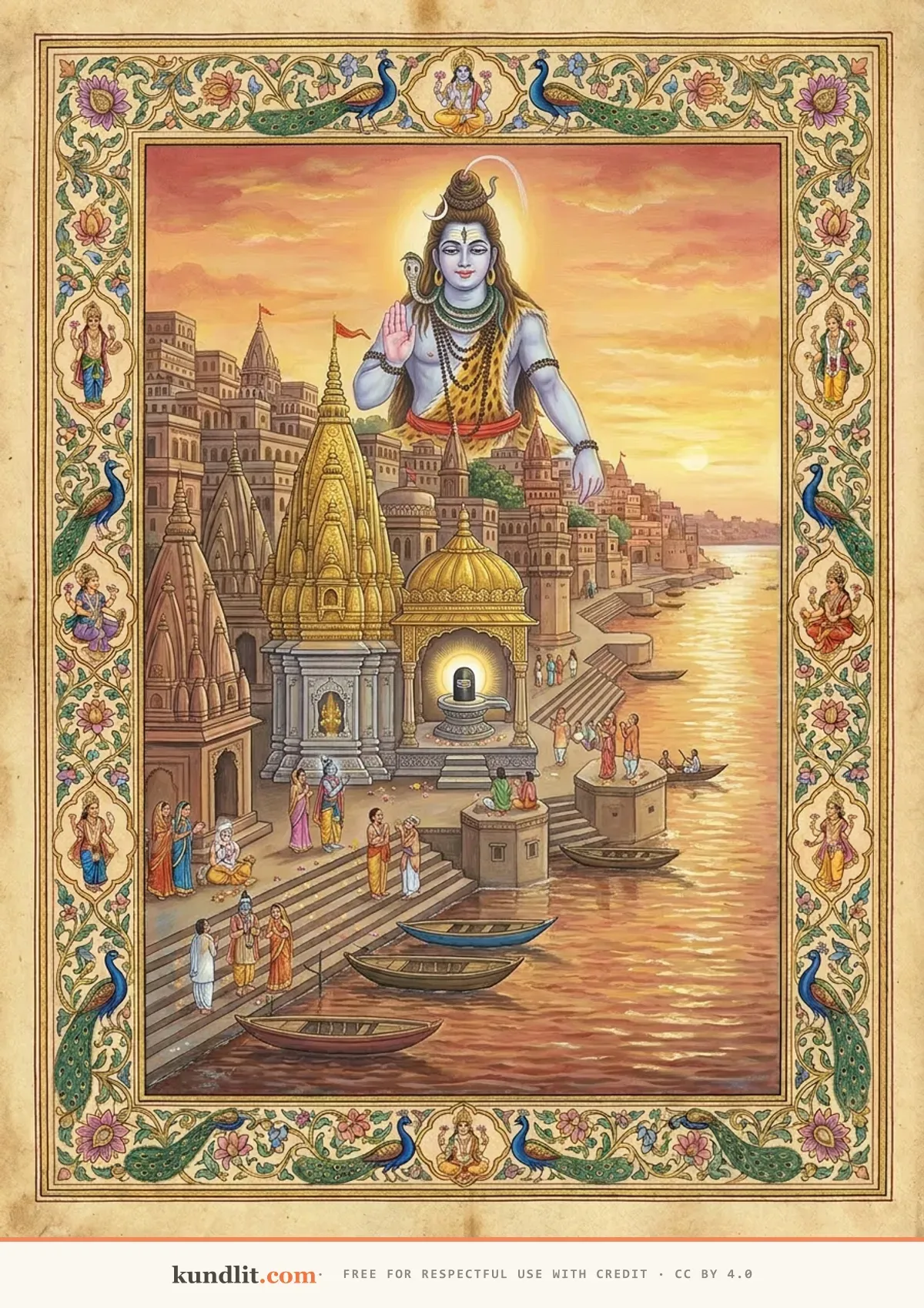
Kashi, the city of light, with its lord at the centre — Shiva Purana, Koti Rudra Samhita, Adhyayas 22–23. Image by kundlit.com, CC BY 4.0 — free to reuse with credit.
Avimukta: the never-forsaken
The Shiva Purana's name for the city is Avimukta — "the un-abandoned" — because Shiva does not leave it even at pralaya, the dissolution of the universe. Its summary of the twelve says of this seventh station:
विश्वेश्वरावतारस्तु काश्यां जातो हि सप्तमः । सर्वब्रह्माण्डरूपश्च भुक्तिमुक्तिप्रदो मुने ॥ ज्योतिर्लिङ्गस्वरूपेण संस्थितस्तत्र मुक्तिदः । स्वयंसिद्धस्वरूपो हि तथा स्वपुरि स प्रभुः ॥
"The seventh avatara, Vishweshwara, arose in Kashi — he whose form is the whole universe, the giver of enjoyment and liberation. He stands there as a jyotirlinga granting moksha, self-manifest in form, the lord in his own city." — Shiva Purana, Shatarudra Samhita 42.30, 42.32
Note the phrase svapuri — "his own city." The other shrines are places Shiva blessed; Kashi is described as his address. And svayam-siddha — self-manifest: no katha of arrival is needed, because there was no arrival.
What dying in Kashi actually means in the texts
The boldest claims come from the Skanda Purana's Kashi Khanda, the largest single scripture of any Indian city. Two of its statements define the tradition:
First, the famous promise about death. At the moment of dying, the Kashi Khanda says, Vishwanath himself comes to the departing soul and gives it the taraka — the "carrier-across" — teaching, by which it becomes of Shiva's own nature. This is the textual root of the belief that to die in Kashi is to be liberated; the text presents it not as automatic magic but as the Lord personally receiving each soul that leaves the body in his city (Skanda Purana, Kashi Khanda, Gita Press ed.).
Second, the city's jurisdiction. In the same khanda Shiva declares that in the five-krosha extent of Avimukta "only my command runs — not Yama's": the god of death has no authority inside Kashi. And in a remarkable line for our purposes, the khanda states that the entire five-krosha kshetra is itself one jyotirlinga named Vishweshwara — the city is the linga (Skanda Purana, Kashi Khanda).
The Shiva Purana adds that those who lovingly repeat the names of Kashi's lord "remain unstained by karmas, and share the state of kaivalya" (Shatarudra Samhita 42.33).
The temple today
The Kashi Vishwanath temple stands in the dense lanes above Dashashwamedh Ghat in Varanasi, Uttar Pradesh. The present structure was raised in 1780 by Ahilyabai Holkar of Indore — restorer, too, of Somnath and Grishneshwar — with the gold of its spires gifted by Maharaja Ranjit Singh in 1835. Since 2021 the Kashi Vishwanath corridor connects the sanctum directly to the Ganga, so the pilgrim's old practice — bathe in the river, carry its water to the linga — is again a single unbroken walk.
| Position in the twelve | 7th |
| State | Uttar Pradesh (Varanasi) |
| Setting | The lanes above the Ganga ghats — the Avimukta kshetra |
| Primary scripture | Shiva Purana, Koti Rudra Samhita, Adhyayas 22–23 |
| Also in | Skanda Purana, Kashi Khanda (the city's own scripture); Shatarudra Samhita 42.30–33 |
| Peak season | Shravan (Sawan), Mahashivratri, Dev Deepawali (Kartik Purnima) |
Continue the yatra
The yatra came from Bhimashankar and goes next to the source of the Godavari — Trimbakeshwar. For all twelve — the Sanskrit verse, the state-wise table, every story — see The 12 Jyotirlingas: names, places and stories.
The painting above was made for this article following the Purana's account, and is free to reuse with credit to kundlit.com under CC BY 4.0.