

Bhimashankar Jyotirlinga: the demon's end at the source of the Bhima
- bhimashankar
- jyotirlinga
- shiva
- sahyadri
- maharashtra
Read with context
- Sources and context stay close to the text
- Interpretations are presented as guidance
Bhimashankar is the sixth of the twelve jyotirlingas, set in the cloud-forest of the Sahyadris above Pune, at the source of the river Bhima. Its katha is the most cinematic of the twelve — a demon with a grudge inherited from the Ramayana, a king praying in prison, and a sword-stroke answered from inside the linga.
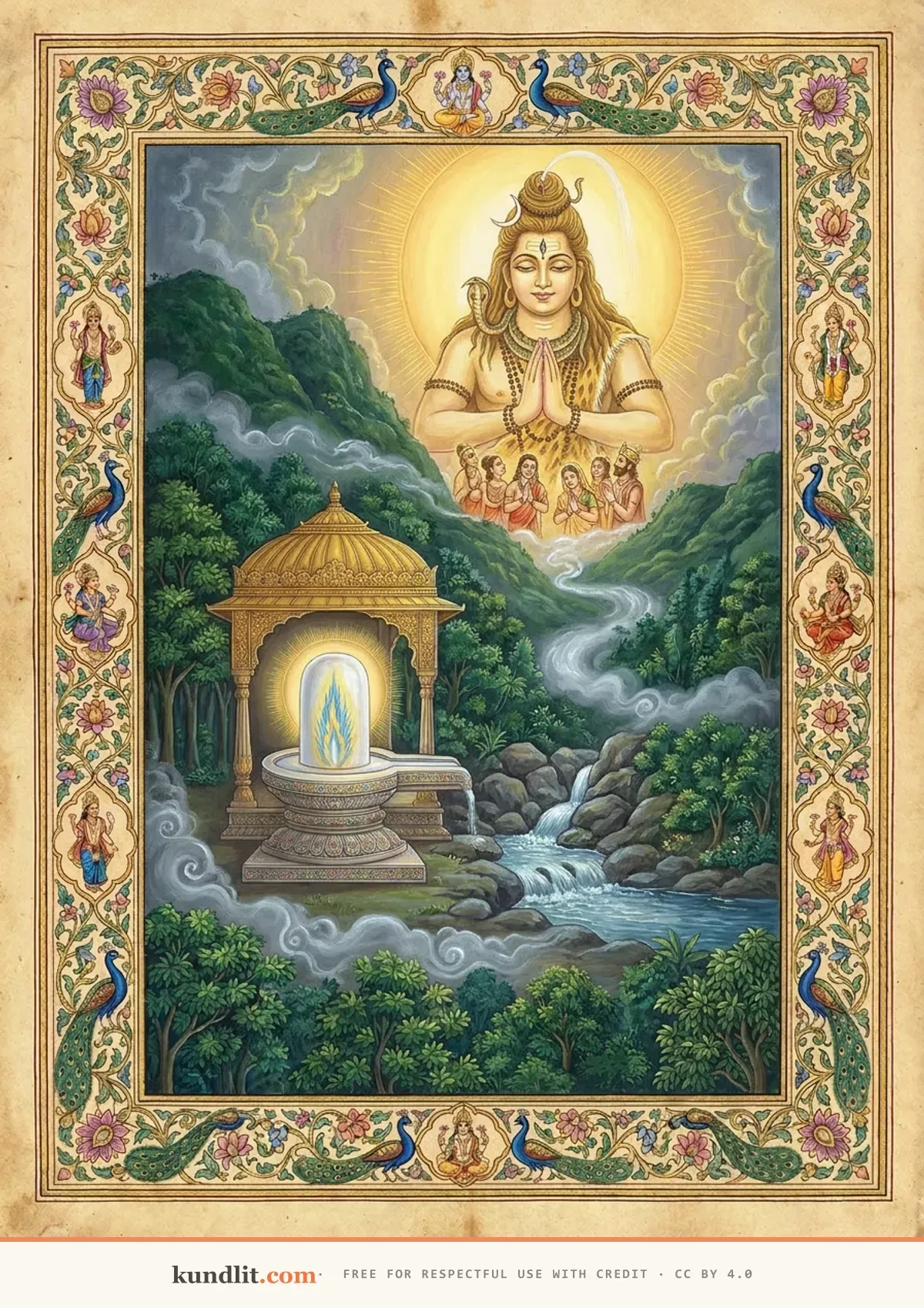
The shrine in the mist at the Bhima's source — Shiva Purana, Koti Rudra Samhita, Adhyayas 20–21. Image by kundlit.com, CC BY 4.0 — free to reuse with credit.
The story: the sword and the linga
Bhima was the son of Kumbhakarna — Ravana's giant brother, slain by Rama — raised by his demoness mother Karkati with no knowledge of his father. When he learned how Kumbhakarna died, his grief hardened into a vow against the gods. He won terrible power through tapasya to Brahma, and turned it on heaven and on the devout alike (Koti Rudra Samhita, Adhyaya 20).
His chosen victim was Sudakshina, the devoted king of Kamarupa, whom he defeated and threw into a dungeon. The king did the one thing left to him: he shaped an earthen linga in his cell and worshipped. Spies reported it; Bhima stormed in and demanded the prisoner worship him instead. The king refused. Bhima raised his sword over the linga — and the stroke never landed:
सुदक्षिणाभिधं भक्तं कामरूपेश्वरं नृपम् । यो ररक्षाद्भुतं हत्वासुरं तं भक्तदुःखदम् ॥ भीमशङ्करनामा स डाकिन्यां संस्थितः स्वयम् । ज्योतिर्लिङ्गस्वरूपेण प्रार्थितस्तेन शङ्करः ॥
"He who protected the devoted king Sudakshina, lord of Kamarupa, wondrously slaying that demon who tormented the devout — that Shankara, named Bhimashankar, prayed to by the king, established himself at Dakini in the form of a jyotirlinga." — Shiva Purana, Shatarudra Samhita 42.28–29
Shiva rose out of the prison linga, burned the demon to ash, and at the freed king's prayer remained "at Dakini" as Bhimashankar — the name carrying both the slain demon's and the Lord's (Koti Rudra Samhita, Adhyaya 21).
Where is Dakini? An honest note
Read the verse closely and you will see the puzzle the tradition has lived with for centuries. The shrine is "at Dakini" — and the celebrated Bhimashankar temple stands in the Sahyadri hills of Pune district, at the source of the river Bhima; the Gita Press edition of the Shiva Purana itself notes that this is the jyotirlinga sung by the Marathi sants from Jnaneshwar onward. Yet the same verse places the rescued king in Kamarupa — Assam — nearly the whole width of India away, and Assam's own Bhimashankar dham near Guwahati claims the katha on that basis.
Both claims are old, and the text genuinely supports each in part. The name, the story and the promise are fixed; the pin on the map carries an ancient ambiguity, exactly as with Vaidyanath and Nageshwar. The mainstream of the twelve-shrine yatra goes to the Sahyadri temple, and nothing in the Purana rebukes a devotee of the other.
The temple today
The Sahyadri Bhimashankar sits at about 1,000 metres in dense Western Ghats forest, Pune district, Maharashtra — since 1984 a wildlife sanctuary, home of the giant Indian squirrel and, in the monsoon, an ocean of mist and moss. The Bhima rises near the shrine and flows southeast to join the Krishna. The temple's Nagara-style shikhara was raised in the 18th century, with the diwan Nana Phadnavis adding its great bell.
| Position in the twelve | 6th |
| State | Maharashtra (Pune district, Sahyadri hills) — with an old rival claim in Assam |
| Setting | Cloud forest at the source of the river Bhima |
| Primary scripture | Shiva Purana, Koti Rudra Samhita, Adhyayas 20–21 |
| Also in | Shatarudra Samhita 42.27–29 |
| Peak season | Shravan (Sawan) — the forest at its greenest — and Mahashivratri |
Continue the yatra
The yatra came from Kedarnath and turns next to the holiest city of all — Kashi Vishwanath at Varanasi. For all twelve — the Sanskrit verse, the state-wise table, every story — see The 12 Jyotirlingas: names, places and stories.
The painting above was made for this article following the Purana's account, and is free to reuse with credit to kundlit.com under CC BY 4.0.