

Kedarnath Jyotirlinga: the linga of the high Himalaya and the sages who asked Shiva to stay
- kedarnath
- jyotirlinga
- shiva
- himalaya
- uttarakhand
- char-dham
Read with context
- Sources and context stay close to the text
- Interpretations are presented as guidance
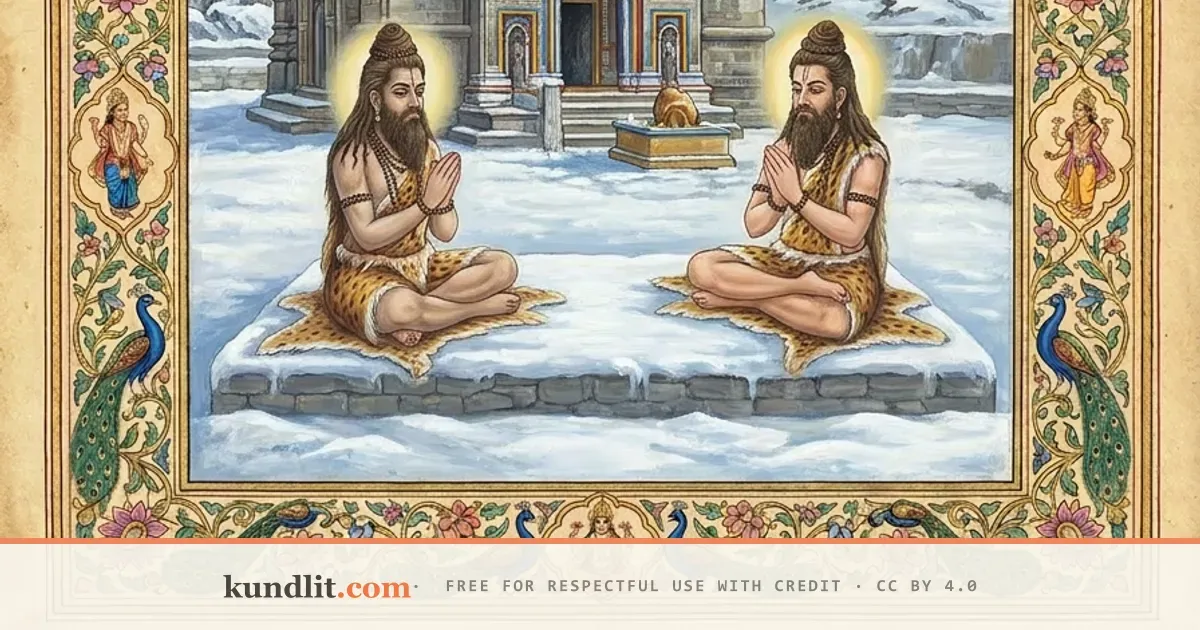
Kedarnath is the fifth of the twelve jyotirlingas and the most remote: a stone shrine at about 3,580 metres in the Garhwal Himalaya of Uttarakhand, reachable only on foot or by pony for the final sixteen kilometres, and open barely half the year between the snows. The texts treat the difficulty as part of the point — this is the linga you earn.
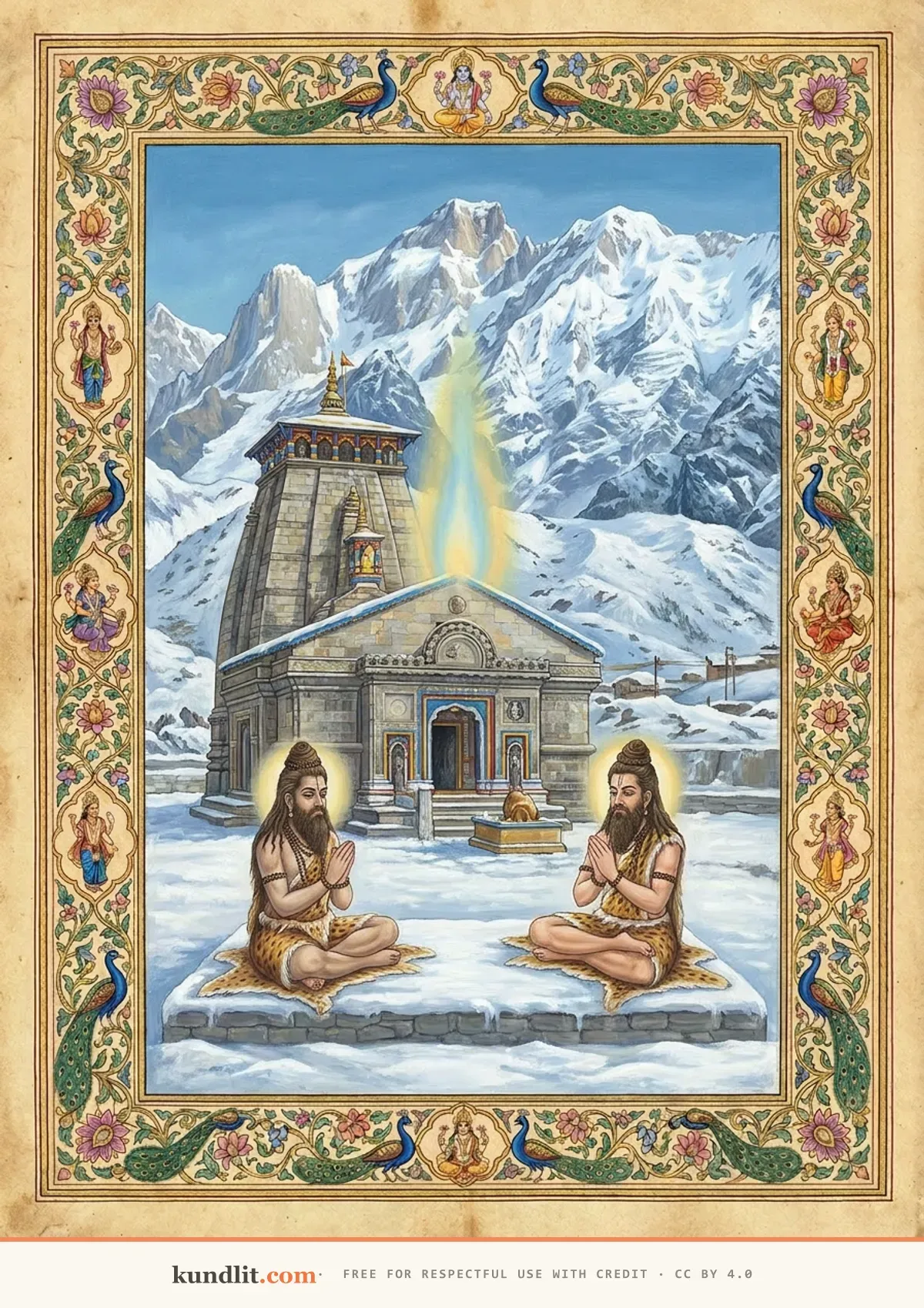
Nara and Narayana perform tapas before Kedara in the snow — Shiva Purana, Koti Rudra Samhita, Adhyaya 19. Image by kundlit.com, CC BY 4.0 — free to reuse with credit.
The story: Vishnu's own austerity
The origin katha here is brief and serene. At Badrikashrama in the Himalaya lived the twin sages Nara and Narayana — whom the tradition counts as forms of Vishnu himself. Their daily practice was the worship of Shiva in an earthen (parthiva) linga, sustained through ages of austerity. Pleased beyond measure, Shiva appeared and offered them any boon — and, being sages, they asked for nothing for themselves. They asked him to stay:
केदारेशोऽवतारस्तु पञ्चमः परमश्शिवः । ज्योतिर्लिङ्गस्वरूपेण केदारे संस्थितः स च ॥ नरनारायणाख्यौ यावतारौ हरेर्मुने । तत्प्रार्थितः शिवस्तत्स्थैः केदारे हिमभूधरे ॥
"The fifth avatara, Kedaresha, is the supreme Shiva himself, established in the form of a jyotirlinga at Kedara. Prayed to by Nara and Narayana, the avataras of Hari, and by those who dwell there, Shiva remained at Kedara in the snow mountain." — Shiva Purana, Shatarudra Samhita 42.23–24
It is worth pausing on what the verse actually says: the jyotirlinga of Kedara exists because Vishnu asked Shiva to remain. The two great streams of the tradition meet here without rivalry — which is why the pilgrimage geography pairs Kedarnath (Shiva) with Badrinath (Vishnu) to this day, two shrines the tradition urges be seen together.
The Purana adds that this Kedara avatara, "though lord of all, is the special master of this Kedara khanda," granting every wish of those who reach him (Shatarudra Samhita 42.25–26). The vast Kedara Khanda of the Skanda Purana is devoted to the sanctity of this same Himalayan region.
What the texts promise here
The Koti Rudra Samhita promises that the sight and worship of Kedareshwar fulfils the devotee's wishes (Adhyaya 19); the Shatarudra summary calls him sarvakamaprada — giver of all desires. Folk tradition adds the Pandava story — that the brothers sought Shiva here after the war, and he eluded them as a buffalo whose hump became the Kedarnath linga; that katha belongs to the later sthala tradition rather than the Shiva Purana's own account, and we flag it as such honestly. What the Purana itself gives Kedarnath is older and simpler: the place where Vishnu's own austerity persuaded Shiva to remain.
The temple today
Kedarnath stands in Rudraprayag district, Uttarakhand, at the head of the Mandakini valley, with the great Kedar dome rising behind it. The linga is a natural rock ridge — conical, unsculpted — fitting for a shrine the texts insist no human hand installed. The temple opens around Akshaya Tritiya (April–May) and closes after Bhai Dooj (October–November); through the winter the deity is worshipped at Ukhimath below. It is at once one of the twelve jyotirlingas, the chief of the Panch Kedar, and a seat of the Uttarakhand Char Dham — no other shrine carries all three.
| Position in the twelve | 5th |
| State | Uttarakhand (Rudraprayag district) |
| Setting | 3,580 m, head of the Mandakini valley, Garhwal Himalaya |
| Primary scripture | Shiva Purana, Koti Rudra Samhita, Adhyaya 19 |
| Also in | Shatarudra Samhita 42.23–26; Skanda Purana, Kedara Khanda (the region's mahatmya) |
| Season | Open ~Akshaya Tritiya to Bhai Dooj only; plan for the 16 km trek from Gaurikund |
Continue the yatra
The yatra came from Omkareshwar and descends next to the misty Sahyadris, to Bhimashankar. For all twelve — the Sanskrit verse, the state-wise table, every story — see The 12 Jyotirlingas: names, places and stories.
The painting above was made for this article following the Purana's account, and is free to reuse with credit to kundlit.com under CC BY 4.0.