

Nageshwar Jyotirlinga: the light in the demon forest
- nageshwar
- jyotirlinga
- shiva
- dwarka
- darukavana
- gujarat
Read with context
- Sources and context stay close to the text
- Interpretations are presented as guidance
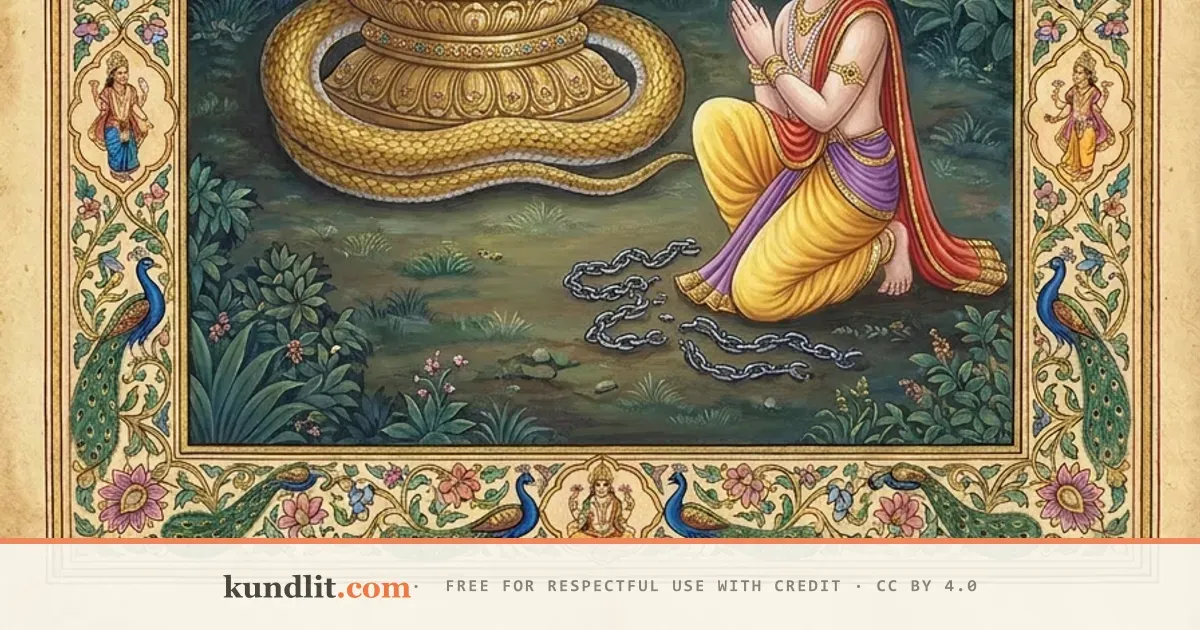
Nageshwar — "lord of serpents" — is the tenth of the twelve jyotirlingas, placed by the verse "in the Daruka forest" near the western sea. Its katha is the cycle's hymn to ordinary courage: the hero is not a god or a king but a merchant who would not stop worshipping, even in a demon's prison.
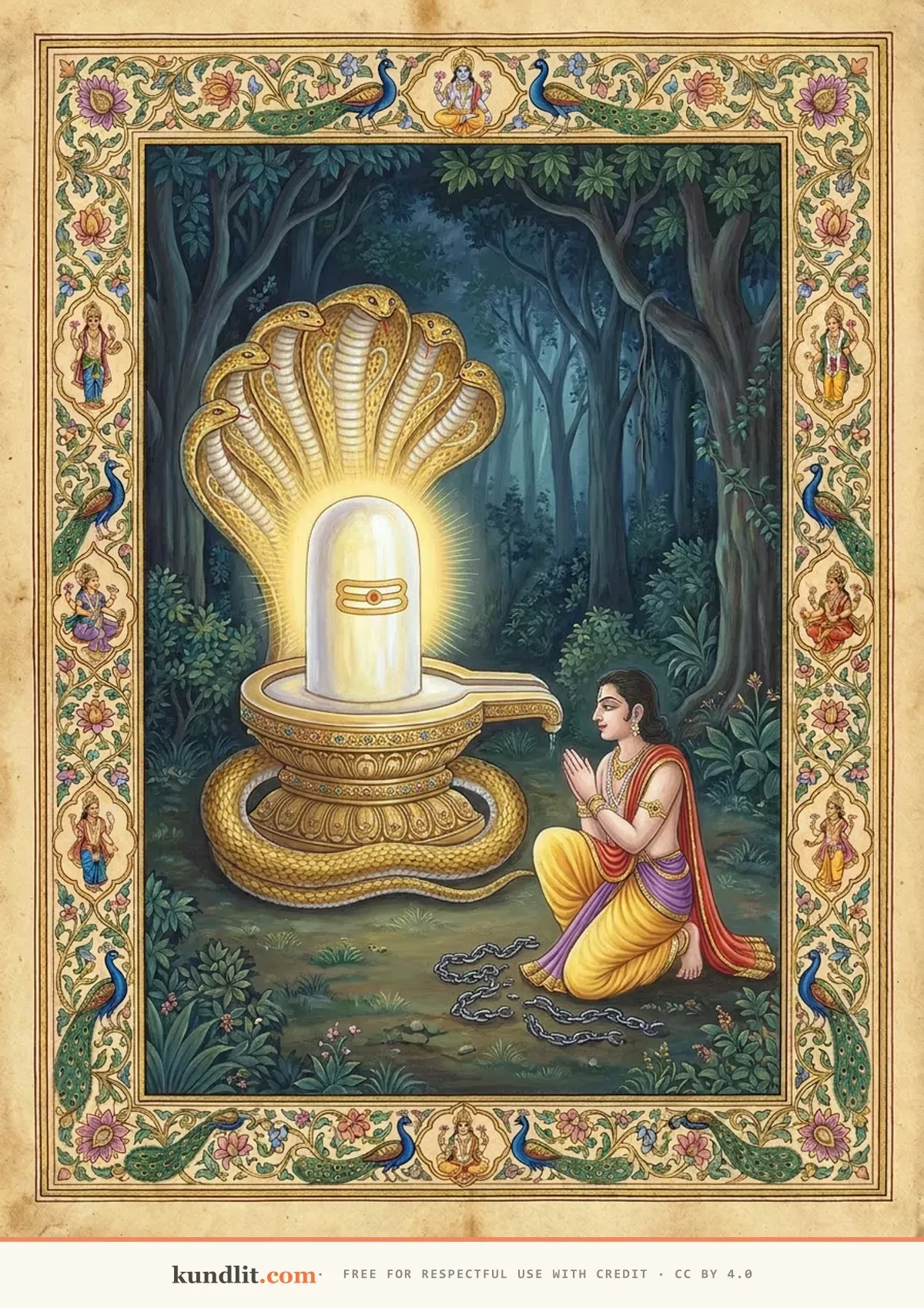
Supriya freed before Nagesha in the Daruka forest — Shiva Purana, Koti Rudra Samhita, Adhyaya 30. Image by kundlit.com, CC BY 4.0 — free to reuse with credit.
The story: worship in prison
By the western sea lay a forest ruled by the demoness Daruka, who held it by a boon she had won from Parvati herself, and whose band — led by her husband Daruk — preyed on travellers and the devout. Among their captives was Supriya, a leader of merchants and a steadfast Shiva-bhakta (Koti Rudra Samhita, Adhyaya 30).
What Supriya did with imprisonment is the heart of the katha: he turned the dungeon into a shrine. He taught his fellow prisoners the worship of Shiva, and the cell filled with it. When the demons discovered it and came to kill him, the earth of the prison answered first — Shiva broke out of it on a radiant throne, gave Supriya the Pashupata weapon, and the demon host was finished (KRS 30; the Purana adds a detail most retellings drop: Parvati's old boon to Daruka was honoured in the resolution rather than simply broken — the text lets the Devi's word and the Lord's protection both stand).
एवं नागेश्वरो देव उत्पन्नो ज्योतिषां पतिः । लिङ्गरूपस्त्रिलोकस्य सर्वकामप्रदः सदा ॥ एतद्यः शृणुयान्नित्यं नागेशोद्भवमादरात् । सर्वान्कामानियाद्धीमान्महापातकनाशनात् ॥
"Thus arose the god Nageshwara, lord of lights, in linga form — ever the giver of all desires to the three worlds. The wise one who daily hears this origin of Nagesha with reverence obtains all wishes, through the destruction of even great sins." — Shiva Purana, Koti Rudra Samhita 30.43–44
Shiva remained there as Nageshwar, with Parvati beside him as Nageshwari (Shatarudra Samhita 42.41–44) — the serpent-lord whose canopy shelters the linga in this shrine's iconography.
Which Daruka forest? An honest note
The verse says only दारुकावने — "in the Darukavana" — and never fixes the forest on a map. Three old traditions claim it:
- Nageshwar near Dwarka, Gujarat — favoured by the katha's own "western sea" setting, and the best-known of the three;
- Aundha Nagnath, Hingoli district, Maharashtra — an ancient Hemadpanthi temple with its own deep tradition;
- Jageshwar, Almora district, Uttarakhand — a deodar-forest complex of over a hundred shrines ("daru" is the deodar itself, runs that claim).
The story, the name and the promise are textually certain; the pin is not — the same honest situation as Vaidyanath and Bhimashankar. The mainstream twelve-shrine yatra goes to Dwarka's Nageshwar; the Purana says nothing against the others.
The temple today
The Gujarat Nageshwar stands on the coastal road between Gokul and Dwarka, in Devbhumi Dwarka district — marked from afar by its 25-metre seated Shiva murti, with the linga in an underground sanctum below. Pilgrims typically pair it with the Dwarkadhish temple and Bet Dwarka, making this the jyotirlinga most often met inside a Krishna pilgrimage — a fitting western mirror of Rameshwaram, the jyotirlinga inside a Rama pilgrimage.
| Position in the twelve | 10th |
| State | Gujarat (near Dwarka) — with old rival claims at Aundha Nagnath (MH) and Jageshwar (UK) |
| Setting | The Darukavana of the katha — coastal forest by the western sea |
| Primary scripture | Shiva Purana, Koti Rudra Samhita, Adhyaya 30 |
| Also in | Shatarudra Samhita 42.41–45 |
| Peak season | Shravan (Sawan), Mahashivratri |
Continue the yatra
The yatra came from Vaidyanath and turns to the far south next — Rameshwaram, the linga Lord Rama himself worshipped. For all twelve — the Sanskrit verse, the state-wise table, every story — see The 12 Jyotirlingas: names, places and stories.
The painting above was made for this article following the Purana's account, and is free to reuse with credit to kundlit.com under CC BY 4.0.