

Rameshwaram Jyotirlinga: the linga Lord Rama worshipped before crossing to Lanka
- rameshwaram
- jyotirlinga
- shiva
- rama
- setubandha
- tamil-nadu
Read with context
- Sources and context stay close to the text
- Interpretations are presented as guidance
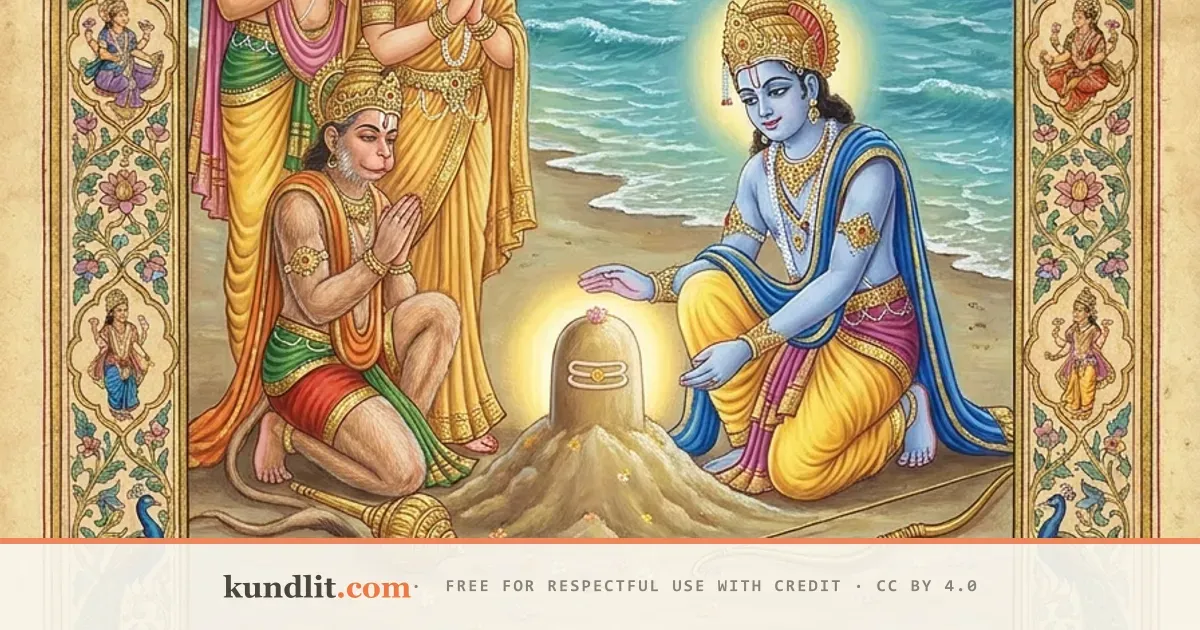
Rameshwaram, on its island between India and Sri Lanka, is the eleventh of the twelve jyotirlingas — and the only one established through the worship of Vishnu's own avatara. Its name can be read two ways, and the tradition cherishes both: Rama-ishwara, "the lord of Rama," or "the lord who is Rama's." Either way, Shaivas and Vaishnavas share this shrine without a seam.
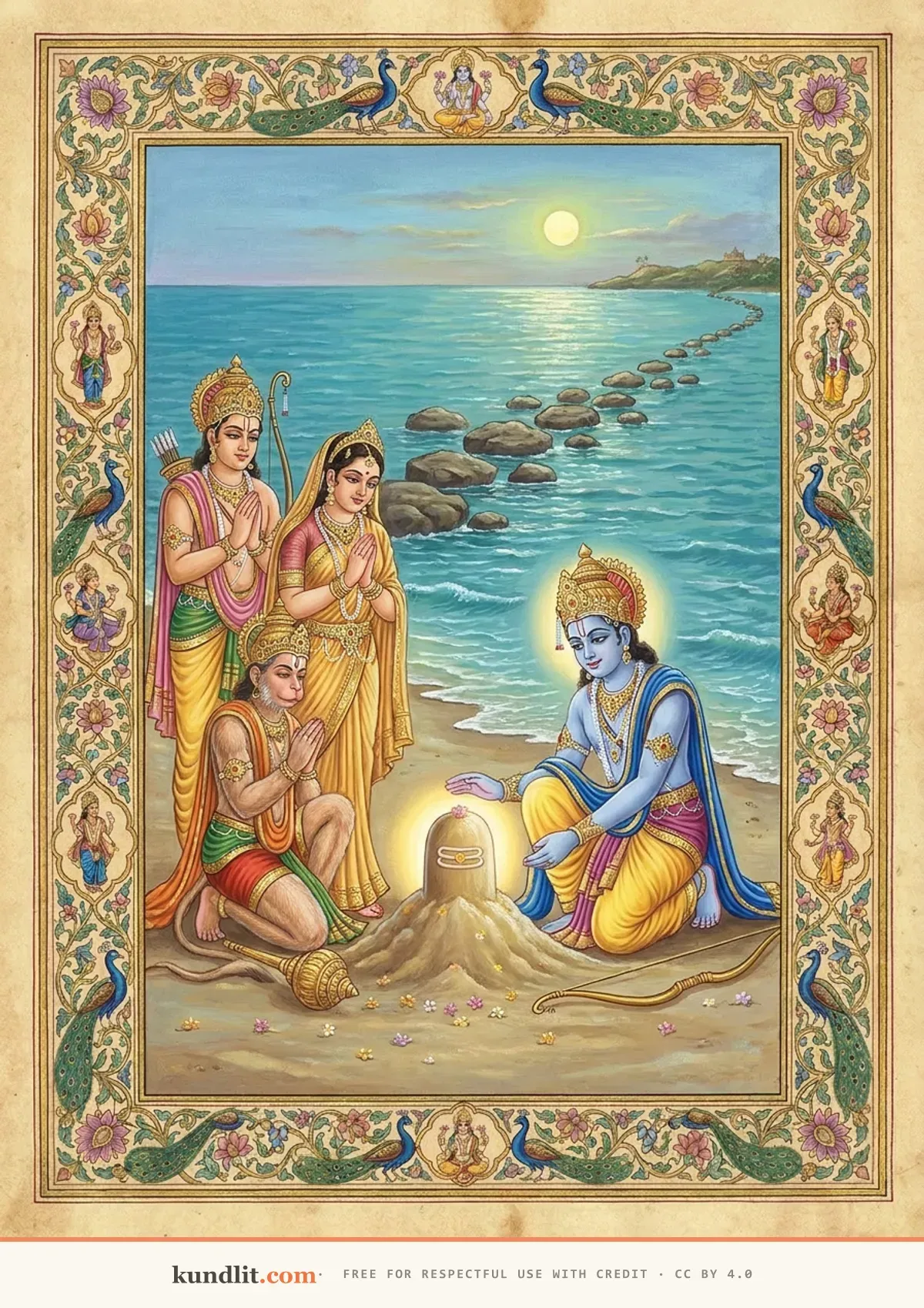
Rama worships Shiva at Setubandha before the crossing — Shiva Purana, Koti Rudra Samhita, Adhyaya 31. Image by kundlit.com, CC BY 4.0 — free to reuse with credit.
The story: the anxious king on the shore
The Shiva Purana sets the scene with unusual psychological honesty. Rama has reached the shore of the southern ocean with the vanara army. Sita is in Lanka. And the text lets the prince of Ayodhya worry like a man: the sea is unfathomable; the army cannot cross it; Ravana lifted Kailasa itself; Lanka is impregnable; his son Meghnad defeated Indra (Koti Rudra Samhita 31.11–13). It is there — thirsty, anxious, at the edge of the greatest gamble of his life — that Rama, "beloved of Shiva" as the chapter calls him, worships Shiva in a linga on the shore.
Shiva appears, grants the boon of victory — and then Rama asks for the thing that turns a battlefield rite into a permanent shrine:
त्वया स्थेयमिह स्वामिँल्लोकानां पावनाय च । परेषामुपकारार्थं यदि तुष्टोऽसि शंकर ॥ इत्युक्तस्तु शिवस्तत्र लिङ्गरूपोऽभवत्तदा । रामेश्वरश्च नाम्ना वै प्रसिद्धो जगतीतले ॥
"Rama said: 'If you are pleased, O Shankara — remain here, lord, for the purification of the worlds and the benefit of all who come after.' Thus addressed, Shiva became a linga there, famed on earth by the name Rameshwara." — Shiva Purana, Koti Rudra Samhita 31.39–40
Note what Rama asks for: not victory (already granted), but that others benefit. Then he crossed the sea on the bridge — Setubandha, which gives the smaranam verse its place-name — and "swiftly slaying Ravana and the rakshasas, regained his beloved" (KRS 31.41).
What the texts promise here
The Purana attaches a specific practice to this shrine, and it is the one pilgrims still perform:
दिव्यगंगाजलेनैव स्नापयिष्यति यः शिवम् । रामेश्वरं च सद्भक्त्या स जीवन्मुक्त एव हि ॥
"He who, with true devotion, bathes Shiva Rameshwara with the divine water of Ganga — he is liberated even while living." — Shiva Purana, Koti Rudra Samhita 31.43
That is why, to this day, pilgrims carry Ganga water the length of India to pour on this linga — and carry sand or sea-water back; the two ends of the land are tied together by this single verse. The Skanda Purana devotes its Setu Mahatmya to the sanctity of the bridge-region, down to promising that a house holding the mahatmya's manuscript "is itself a Rama-setu tirtha" (Skanda Purana, Setu Mahatmya, Gita Press ed.).
The temple today
The Ramanathaswamy temple on Rameswaram island, Tamil Nadu — reached over the Pamban bridge — is among the architectural wonders of the south: its pillared corridors, at about 1.2 km in circuit, are the longest of any temple in India. Pilgrims bathe at the twenty-two tirtha wells inside the complex before darshan; the sanctum holds the linga of the katha alongside a smaller linga the sthala tradition says Hanuman brought from Kailasa, honoured first. Rameshwaram is also one of the four dhams of the all-India Char Dham, making this the only shrine that is both a jyotirlinga and a dham of the great circuit.
| Position in the twelve | 11th |
| State | Tamil Nadu (Rameswaram island, Ramanathapuram district) |
| Setting | Setubandha — the shore of Rama's bridge |
| Primary scripture | Shiva Purana, Koti Rudra Samhita, Adhyaya 31 |
| Also in | Skanda Purana, Setu Mahatmya; Shatarudra Samhita 42.46–51 |
| Peak season | Shravan (Sawan), Mahashivratri, Rama Navami |
Continue the yatra
The yatra came from Nageshwar and ends at the smallest and tenderest of the twelve — Grishneshwar. For all twelve — the Sanskrit verse, the state-wise table, every story — see The 12 Jyotirlingas: names, places and stories.
The painting above was made for this article following the Purana's account, and is free to reuse with credit to kundlit.com under CC BY 4.0.