

Grishneshwar Jyotirlinga: a mother's hundred and one lingas
- grishneshwar
- ghushmeshwar
- jyotirlinga
- shiva
- ellora
- maharashtra
Read with context
- Sources and context stay close to the text
- Interpretations are presented as guidance

Grishneshwar — Ghushmeshwar in the Purana's own spelling — is the twelfth and last of the twelve jyotirlingas, a short walk from the Ellora caves in Maharashtra. The cycle that opened with a god's curse at Somnath closes with no god in the leading role at all: the final jyotirlinga exists because of the steadiness of one ordinary woman, and the shrine bears her name.
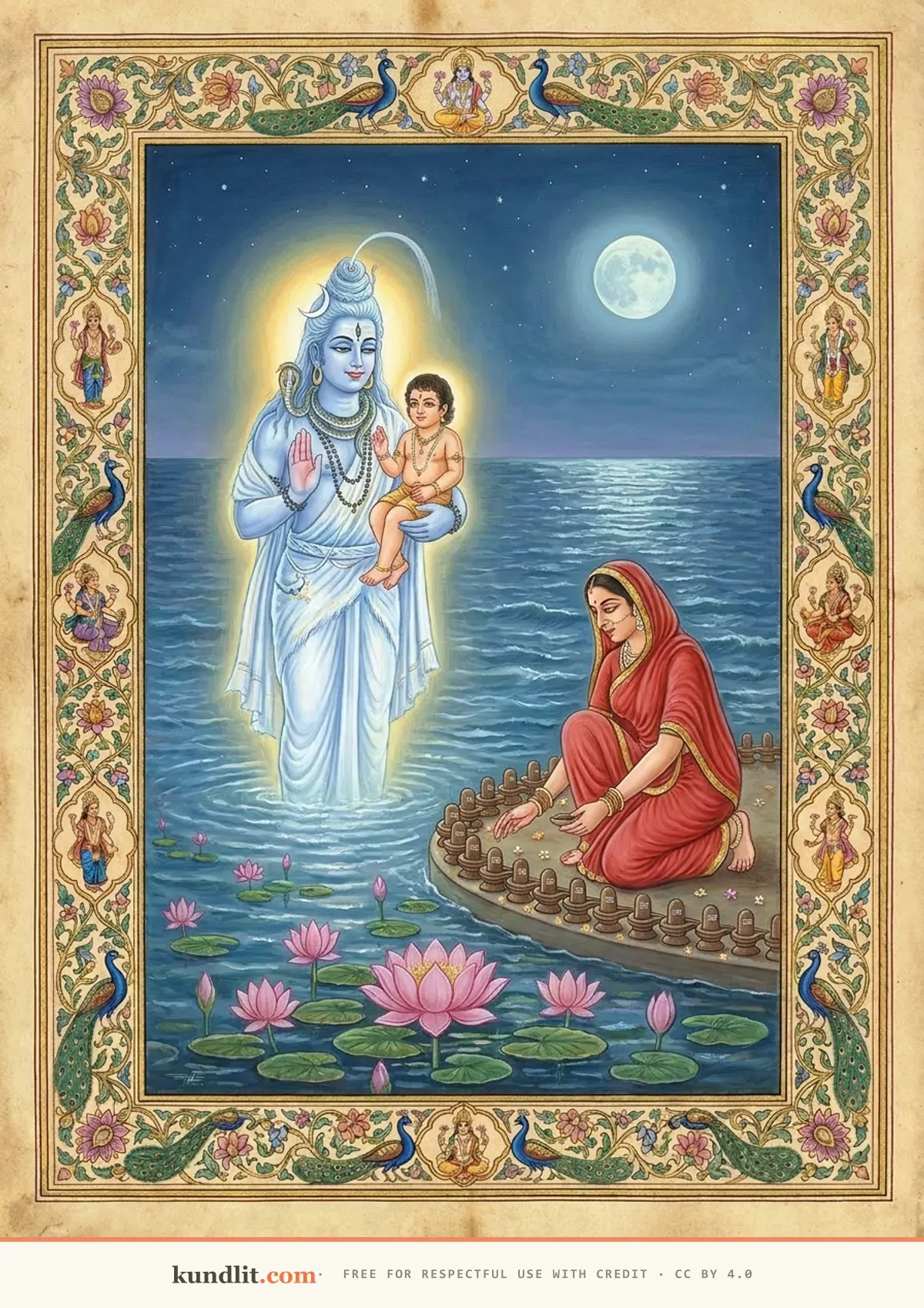
Ghushma's faith answered at the pond — Shiva Purana, Koti Rudra Samhita, Adhyayas 32–33. Image by kundlit.com, CC BY 4.0 — free to reuse with credit.
The story: the vrata that would not break
Near Devagiri in the south lived a brahmin, Sudharma, and his wife Sudeha, who was childless. At Sudeha's own urging, her younger sister Ghushma married Sudharma as his second wife. Ghushma's daily vrata was simple and immense: each day she shaped a hundred and one parthiva (clay) lingas, worshipped them, and immersed them in the nearby pond. By that worship a son was born to her — and the household's joy slowly curdled, in Sudeha, into the jealousy the Purana traces with terrible patience (Koti Rudra Samhita, Adhyaya 32).
One night Sudeha killed the young man — Ghushma's son, newly married — and threw his body into the very pond where the lingas were immersed. The text's pivot is what Ghushma did at dawn. She rose, saw the blood, heard her daughter-in-law's grief — and completed her full worship first, without rage and without despair: he who gave me this son is the one who protects him. Then she carried the day's lingas to the pond — and her son rose living from the water, and Shiva rose with him, blazing, trident drawn, ready to destroy Sudeha (KRS 32–33).
Ghushma's answer made the shrine. She asked Shiva to forgive her sister. Astonished — the text says pleased beyond measure by both her steadiness and her mercy — Shiva offered her a boon, and she asked him to remain by that pond:
सुदेहामारितं घुश्मापुत्रं साकल्यतो मुने । तुष्टस्तद्भक्तितः शम्भुर्योऽरक्षद्भक्तवत्सलः ॥ तत्रार्थितः स वै शम्भुस्तडागे तत्र कामदः । ज्योतिर्लिङ्गस्वरूपेण तस्थौ घुश्मेश्वराभिधः ॥
"Pleased by her devotion, Shambhu, affectionate to his devotees, restored Ghushma's son — slain by Sudeha — whole. Prayed to there, the wish-granting Shambhu remained at that pond in the form of a jyotirlinga, named Ghushmeshwara." — Shiva Purana, Shatarudra Samhita 42.54–55
The same summary places the manifestation "in the southern direction, near Devashaila" (42.53) — the Devagiri country, which is exactly where the temple stands.
What the texts promise here
"Seeing that shivalinga and worshipping it with devotion, one enjoys all happiness here and then attains liberation" (Shatarudra Samhita 42.56). And with Ghushmeshwara told, the Purana closes the cycle: these twelve, it says, are "the divine garland of jyotirlingas, giving enjoyment and liberation; one who reads or hears this account is freed from all sins" (42.57–58).
The temple today
Grishneshwar stands at Verul (Ellora), about 30 km from Chhatrapati Sambhajinagar (Aurangabad), Maharashtra — within walking distance of the Ellora caves and their colossal rock-cut Kailasa temple, so the smallest jyotirlinga shrine sits beside the largest sculpture of Kailasa on earth. The present red-stone temple is an 18th-century rebuilding by Ahilyabai Holkar — the queen who also rebuilt Somnath and Kashi Vishwanath; her name threads through three of the twelve. The pond of the katha is honoured as the Shivalaya teerth beside the temple.
| Position in the twelve | 12th (the last) |
| State | Maharashtra (Verul/Ellora, Chhatrapati Sambhajinagar district) |
| Setting | The Shivalaya pond near Devagiri — beside the Ellora caves |
| Primary scripture | Shiva Purana, Koti Rudra Samhita, Adhyayas 32–33 |
| Also in | Shatarudra Samhita 42.52–58 |
| Peak season | Shravan (Sawan), Mahashivratri |
The yatra completes
The traditional circuit that began at Somnath ends here. For all twelve in one place — the Sanskrit smaranam verse, the state-wise table, and every origin story — see the complete guide: The 12 Jyotirlingas: names, places and stories.
The painting above was made for this article following the Purana's account, and is free to reuse with credit to kundlit.com under CC BY 4.0.