

The forms of Maa Kali: Dakshina Kali, Bhadrakali, Shamshan Kali, Guhya Kali and Mahakali
- maa-kali
- dakshina-kali
- bhadrakali
- mahakali
- dus-mahavidya
- shakti
- devi
Read with context
- Sources and context stay close to the text
- Interpretations are presented as guidance
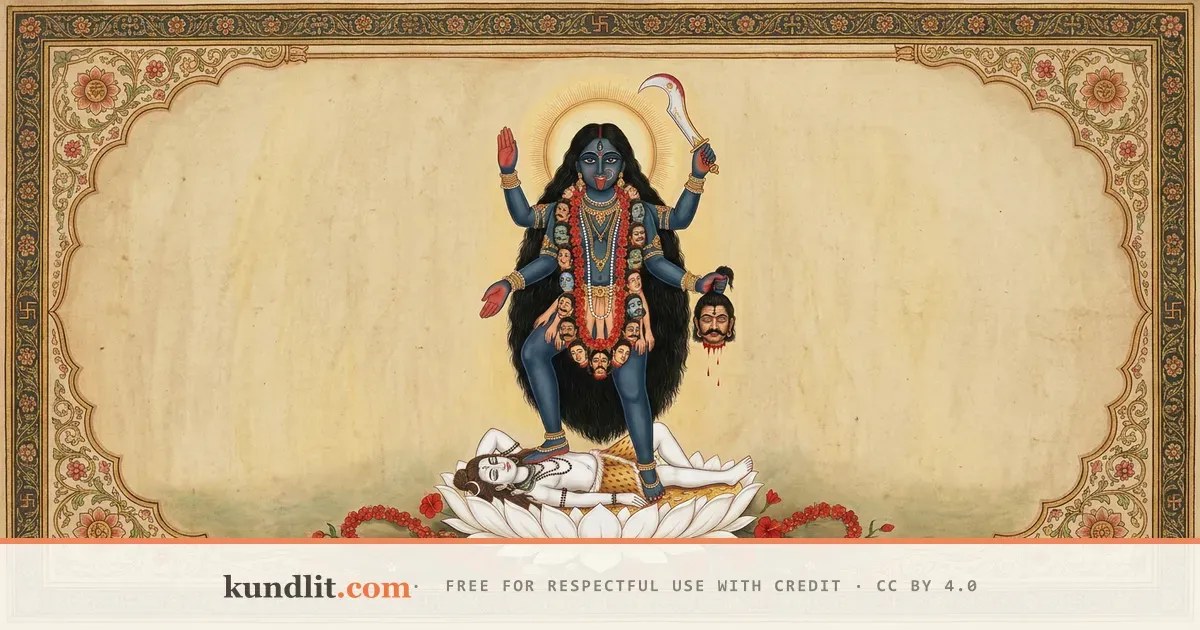
Ask ten people about Maa Kali and you will hear ten different stories — and most of them come from posters and serials, not from the texts. The scriptures themselves are far more precise. They tell you exactly where Kali came from, why she is dark, what each of her major forms looks like, and what each form is approached for.
This guide stays inside those texts. Every claim below is sourced to a named scripture — the Durga Saptashati, the Devi Bhagavata Purana, the Mahanirvana Tantra, the Todala Tantra and others — cited by book and chapter, so you can verify everything. Where the texts are silent and only popular tradition speaks, we say so plainly.
One note on what this article deliberately leaves out: the tantras attach specific mantras to each form of Kali, and every one of them is taught only through initiation from a qualified guru. Out of respect for that rule, no mantras appear here — only the forms, their stories, and their meaning.
What the name "Kali" actually means
The plain meaning first: kala means time — the force that eventually consumes everything. Shiva, as the devourer of all things at the great dissolution, is called Mahakala, "great time." Kali is the power beyond even that: the one who consumes time itself. She is not simply "the dark goddess"; she is what remains when everything else, including time, has ended — which is why the texts also call her Adya, the primordial one.
The Mahanirvana Tantra states this in two verses that are the clearest definition of Kali anywhere in the literature:
कलनात् सर्वभूतानां महाकालः प्रकीर्तितः । महाकालस्य कलनात् त्वमाद्या कालिका परा ॥ कालसंग्रसनात् काली सर्वेषामादिरूपिणी । कालत्वादादिभूतत्वादाद्या कालीति गीयते ॥
"Because he devours all beings, he is called Mahakala. And because you devour Mahakala himself, you are the supreme, primordial Kalika. Because she swallows time, she is Kali, the original form of all; being time itself and being the first of all beings, she is sung as Adya Kali." — Mahanirvana Tantra, Ullasa 4, verses 31–32
Her darkness carries the same idea. As night absorbs every colour, Kali absorbs every form. The texts present her dark complexion as a statement of ultimacy, not of menace.
Kali is also the first of the ten Mahavidyas — the ten "great wisdoms," the tantric map of the Devi's principal aspects. The Todala Tantra (Patala 1) lists them in order: Kali, Tara, Sundari (Shodashi), Bhuvaneshvari, Chinnamasta, Bhairavi, Dhumavati, Bagala, Matangi and Kamala. The same text closes (Patala 10) by pairing each Mahavidya with an avatar of Vishnu — and pairs Bhagavati Kali with Krishna, both dark, both supreme in their own streams.
Where Kali comes from: the Durga Saptashati account
The most famous origin of Kali is a battlefield scene, told in the Durga Saptashati (the 700-verse hymn inside the Markandeya Purana, also called the Devi Mahatmya or Chandi Path).
The demon kings Shumbha and Nishumbha send the generals Chanda and Munda to seize Devi Ambika. As the demon army closes in, Ambika's face darkens with anger — and from her knitted brow, Kali bursts forth:
भ्रुकुटीकुटिलात्तस्या ललाटफलकाद्द्रुतम् । काली करालवदना विनिष्क्रान्तासिपाशिनी ॥
"From the surface of her forehead, fierce with frown, Kali of the terrible face sprang forth instantly, armed with sword and noose." — Durga Saptashati, Chapter 7, verses 5–6
The verses that follow (7.6–8) give her first iconography: she carries the skull-topped staff (khatvanga), wears a garland of human heads and a tiger skin, her flesh is gaunt, her mouth vast, her tongue lolling, her eyes deep and red, and her roar fills the directions. She destroys the demon army, severs the heads of Chanda and Munda, and brings them to Ambika — who grants her the name Chamunda for the deed.
The Devi Bhagavata Purana tells the same episode at greater length (Skandha 5, Chapters 25–26), down to the same image — "then Kali sprang swiftly forth from the surface of her forehead" (5.26.39) — and the same naming: "Since you have slain Chanda and Munda, you will be famed in the world as Chamunda" (5.26.64–65).
One chapter later comes the episode that explains Kali's most misunderstood image. The demon Raktabija had a boon: every drop of his blood that touched the ground became another Raktabija. The Devi's blows only multiplied him. So Ambika instructs Kali to spread wide her mouth and drink the blood before it can fall — and as Chamunda drinks, Raktabija withers and falls (Durga Saptashati, Chapter 8; Devi Bhagavata, Skandha 5, Chapter 29). The outstretched tongue of Kali, in the primary texts, is an instrument of cosmic damage-control — the popular story that she bit her tongue in embarrassment upon stepping on Shiva appears in later folk tradition, not in any of the scriptures surveyed here.
The Saptashati also contains a quieter, earlier origin: in Chapter 5, when the radiant Kaushiki emerges from Parvati's body, Parvati's own remaining form turns dark — and that dark form too is called Kalika. So within one scripture, "Kali" names both the wrathful brow-born warrior and the dark residual form of the Mother herself. The tradition holds both without contradiction: the forms are masks of one Devi.
How many forms does Kali have?
The texts answer "countless," then name the important ones. The Todala Tantra (Patala 3) names her eight forms: Dakshina Kalika, Siddha Kalika, Guhya Kalika, Shri Kalika, Bhadra Kali, Chamunda Kalika and Shmashana Kalika, under the supreme Mahakali. The later tantric digests (such as the Dash Mahavidya Tantra Shastra, citing the Kali-krama-diksha) record a parallel eightfold set of her benign aspects: Chintamani Kali, Sparshamani Kali, Santatiprada Kali, Siddhi Kali, Dakshina Kali, Kamakala Kali, Hamsa Kali and Guhya Kali. The Mahakala Samhita goes further still, enumerating twenty-four divisions, including Srishti Kali (of creation), Sthiti Kali (of preservation) and Samhara Kali (of dissolution).
The lists differ at the edges, but five forms dominate actual worship across all of them. Those five are below.
Dakshina Kali — the form on most home altars
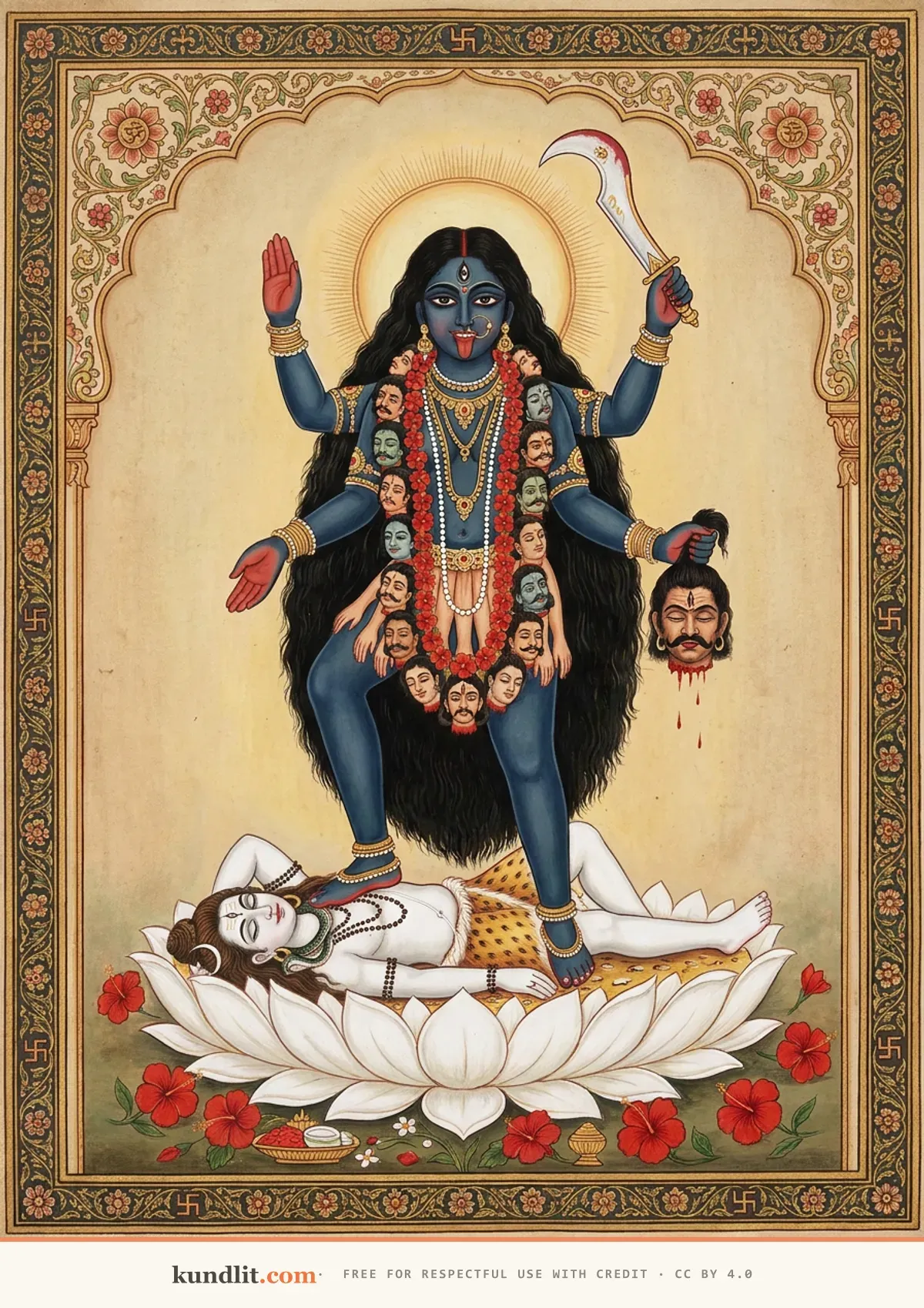
Dakshina Kali, painted to the Kali Tantra meditation-verse: sword and severed head in her left hands, fear-dispelling and boon-giving gestures in her right, her foot upon Shiva. Image by kundlit.com, CC BY 4.0 — free to reuse with credit.
If you have seen an image of Maa Kali in a Bengali home or a Kali temple, it is almost certainly Dakshina Kali. The digests call her sadyah phalaprada — the form that bears fruit quickly — and describe her as the most benevolent of Kali's aspects, the one a householder may approach directly.
Her classical meditation-image, repeated across the Kali Tantra and the tantric compendia, is precise: she is dark as the night, three-eyed, four-armed. Her two left hands hold the sword and a severed head; her two right hands are raised in abhaya (fear-not) and varada (boon-giving) gestures. She wears the garland of heads, her hair is unbound, and she stands upon the chest of Shiva — the Kalivilasa Tantra's meditation describes her "established upon Sadashiva." The image is a complete sentence: the left side destroys the ego and the demonic; the right side protects and grants. Destruction and grace are one act.
The Todala Tantra (Patala 1) adds her consort: "On Dakshina's right, worship Mahakala, with whom Dakshina is always in union." The digests also record a traditional reading of her name: dakshina is the southern direction, the realm of Yama, lord of death — and even Yama's authority does not run over her devotees.
Bhadrakali — the auspicious Kali
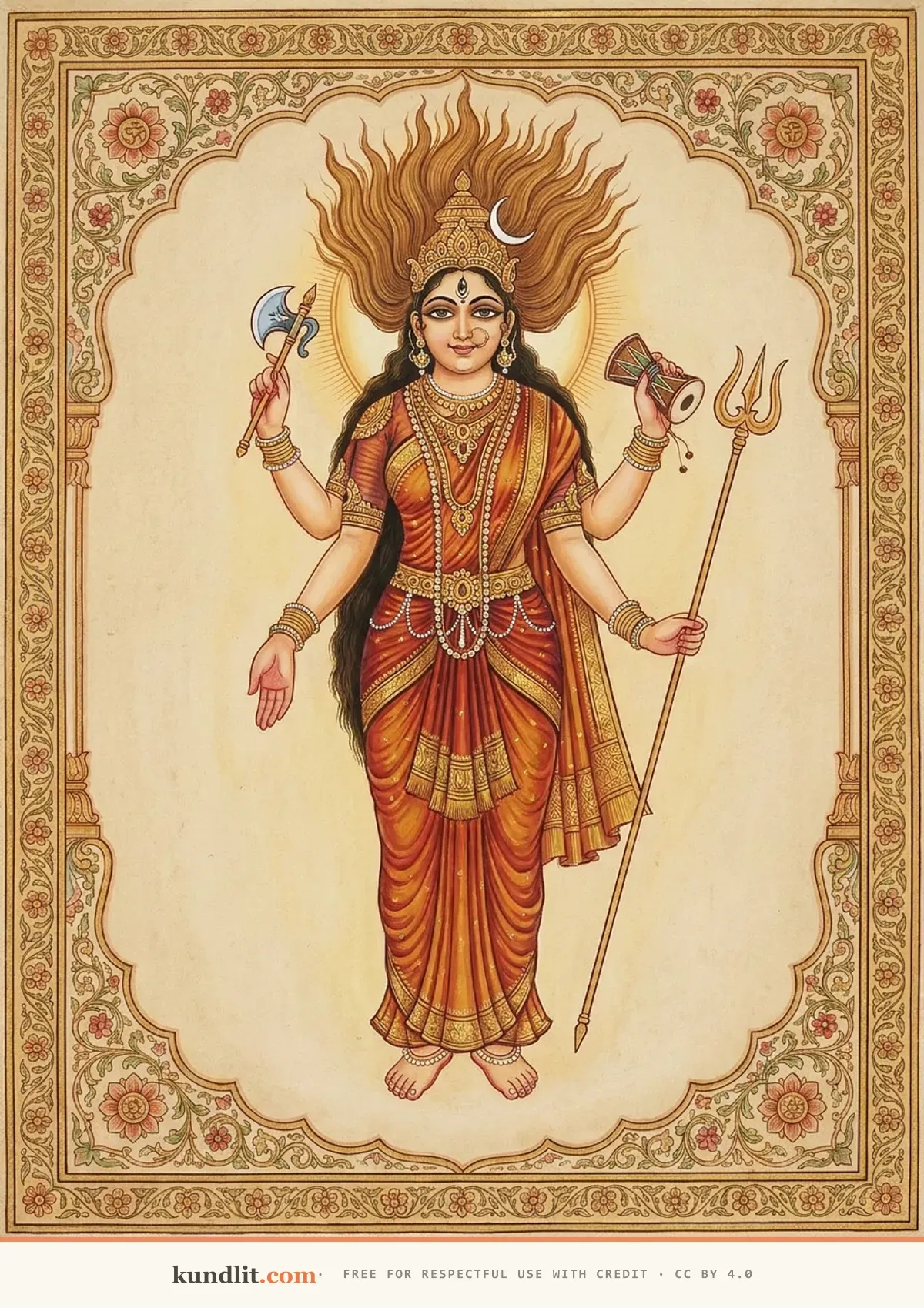
Bhadrakali, painted to the Phetkarini Tantra meditation-verse: tanka, skull-cup, damaru and trident in her four hands, the crescent moon her crest, her expression gracious. Image by kundlit.com, CC BY 4.0 — free to reuse with credit.
Bhadra means auspicious, gracious, good. Bhadrakali is the gentle paradox among the fierce forms — the digests note that when the Vedas praise Kali, it is by the name Bhadrakali. In the Saptashati frame, the sixteen-armed Mahamaya who is praised as Yoganidra is identified with Bhadrakali, linking her to the protective, world-sustaining face of the Devi rather than the battlefield one.
The Phetkarini Tantra preserves her meditation-verse, and it reads like a blessing:
टङ्कं कपालं डमरुं त्रिशूलं संबिभ्रती चन्द्रकलावतंसा । पिङ्गोर्ध्वकेशी असितधूमनेत्रा भूयाद् विभूत्यै मम भद्रकाली ॥
"Bearing the axe, the skull-cup, the damaru drum and the trident, crested with the crescent moon, her tawny hair streaming upward, her eyes the colour of dark smoke — may that Bhadrakali be for my prosperity." — Phetkarini Tantra (meditation of Bhadrakali, as preserved in the tantric compendia)
Note the last word of the Sanskrit: vibhutyai — "for prosperity." She is invoked for welfare and protection, especially of the household and community.
Shamshan Kali — the Kali of the cremation ground
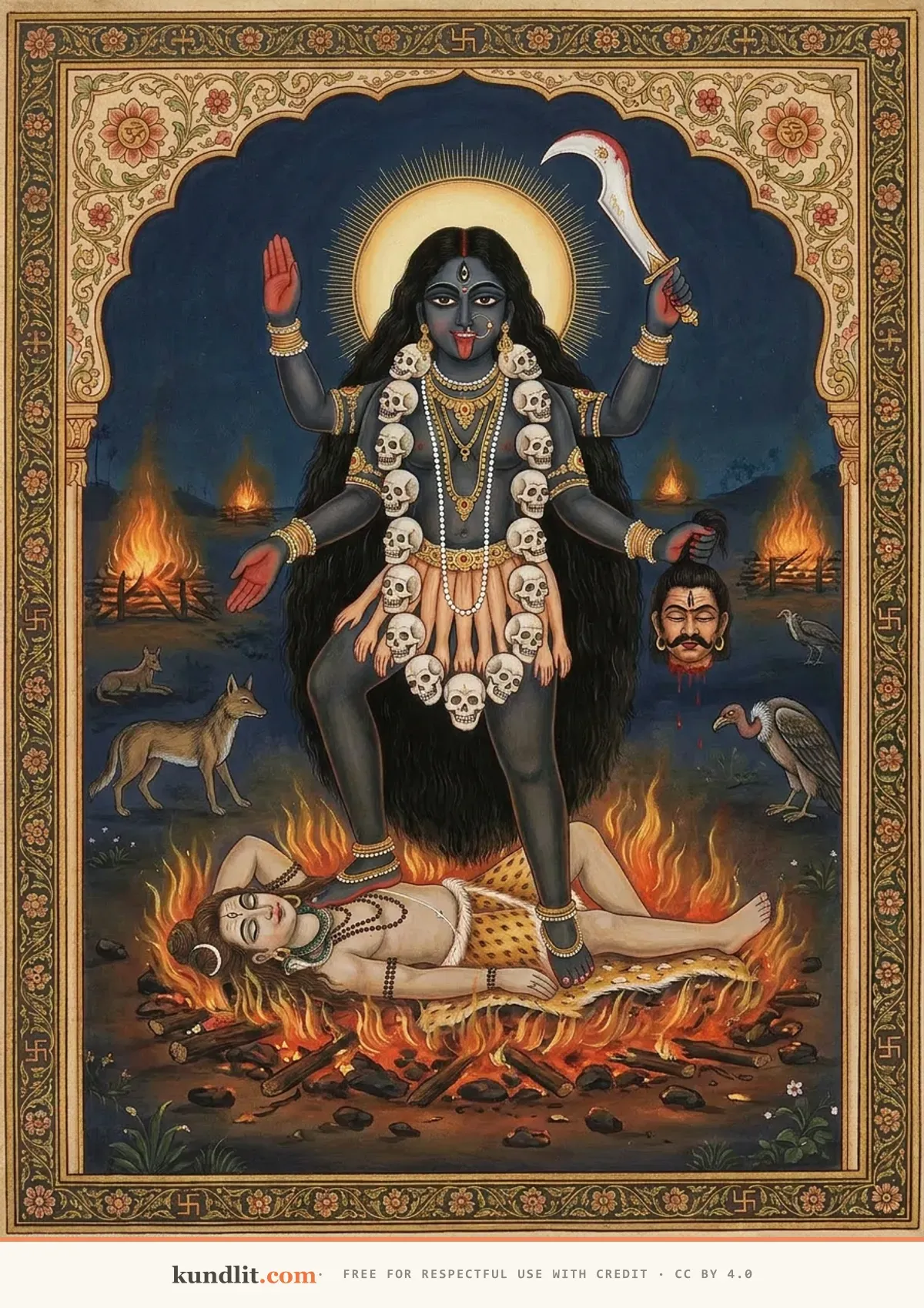
Shamshan Kali in her cremation ground at night, sword and severed head in hand — the bearer of the epithets "khadga-munda-dhara" and "shmashanalaya-vasini". Image by kundlit.com, CC BY 4.0 — free to reuse with credit.
Shmashana is the cremation ground, and Shamshan Kali (Shmashana Kali) is its presiding form. Her thousand-name hymn opens with her — "Shmashana-Kalika, Kali, Bhadrakali, Kapalini..." — and gives her the epithet shmashanalaya-vasini, "she whose dwelling is the cremation ground."
Why locate the Mother there, of all places? The tantric texts answer directly: the cremation ground is the one place where the world's permanence cannot be pretended. The digests quote the old observation that the detachment a person feels while attending a cremation — shmashana-vairagya — would, if it became permanent, be liberation itself. Shamshan Kali stands where every ego ends, teaching the lesson the rest of life lets us avoid.
She is counted among the most fierce (ugra) forms, and her worship traditionally belongs to renunciate and initiated tantric streams — the compendia place her in the uttaramnaya, the northern transmission of Kali worship — not to household practice. Householders honouring Kali are consistently directed to Dakshina Kali instead. That division of labour is itself scriptural, not squeamishness.
Guhya Kali — the hidden Kali
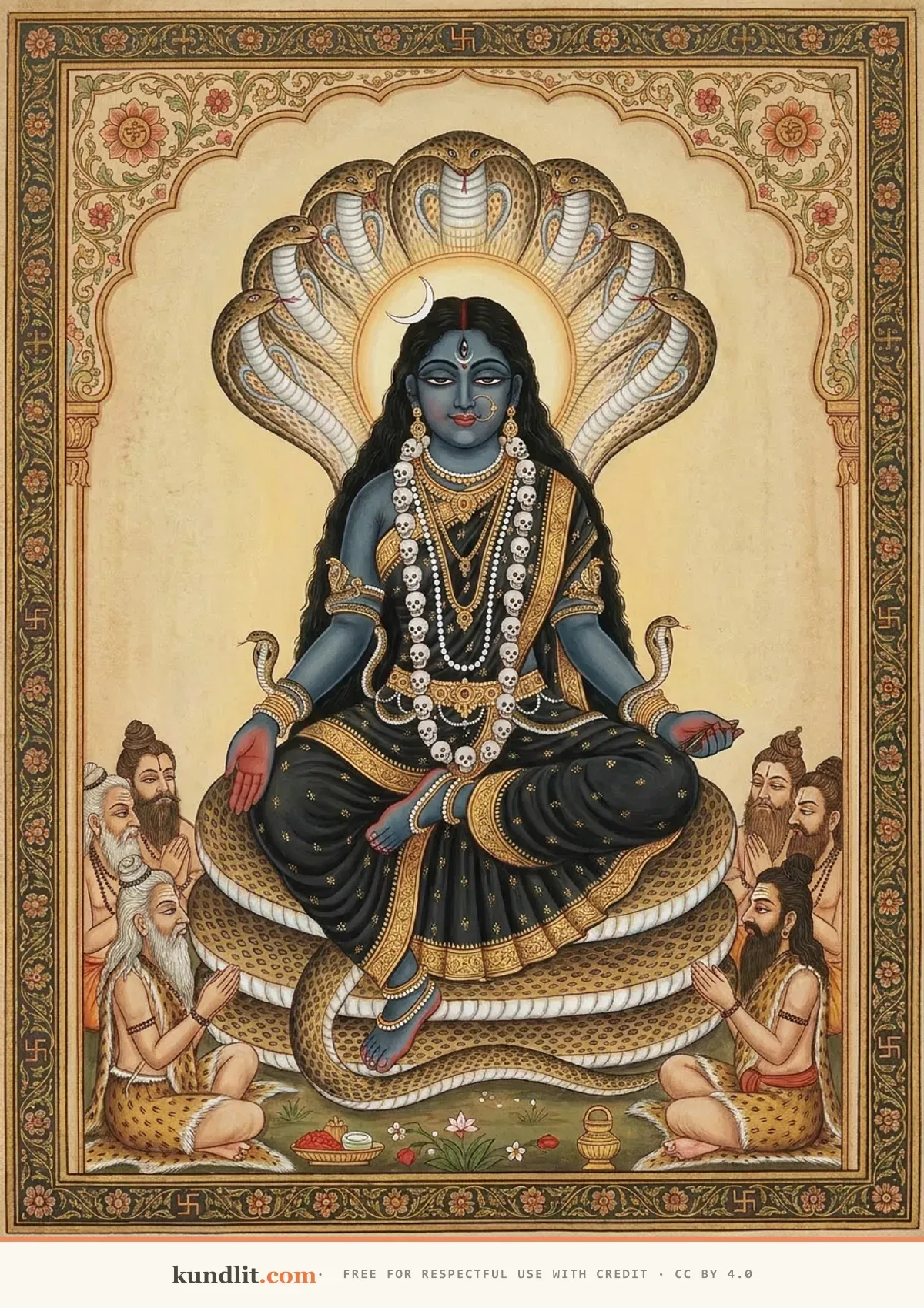
Guhya Kali, painted to the Mahakala Samhita's description: cloud-dark and clothed in black (krishna-vastra), crescent-crowned, serpents as her ornaments and her seat, sages in attendance. Image by kundlit.com, CC BY 4.0 — free to reuse with credit.
Guhya means secret or hidden, and Guhya Kali is the most esoteric of the major forms. She has an entire scripture largely to herself: the Guhyakali Khanda of the Mahakala Samhita, one of the most extensive Kali texts in existence. Her worship remains especially prominent in Nepal.
Her iconography is unlike any other Kali: serpents everywhere. The meditation-images describe her as dark as the great cloud, crescent-crowned, wearing serpents as her sacred thread and bracelets, resting upon a bed of serpents with a great hood spread above her, a fifty-skull garland at her chest — and, despite all that, a serene, smiling face. The Mahakala Samhita describes her forms with one face, three, five, ten, and onward to a hundred faces, and names among her ancient worshippers Brahma, Vasishtha, Rama, Kubera and Ravana.
The digests are unanimous on her character: despite the fearsome imagery, Guhya Kali is counted among the most benign (saumya) forms — the destroyer of great sins and a giver of liberation.
Mahakali — the great Kali of the first cosmic act
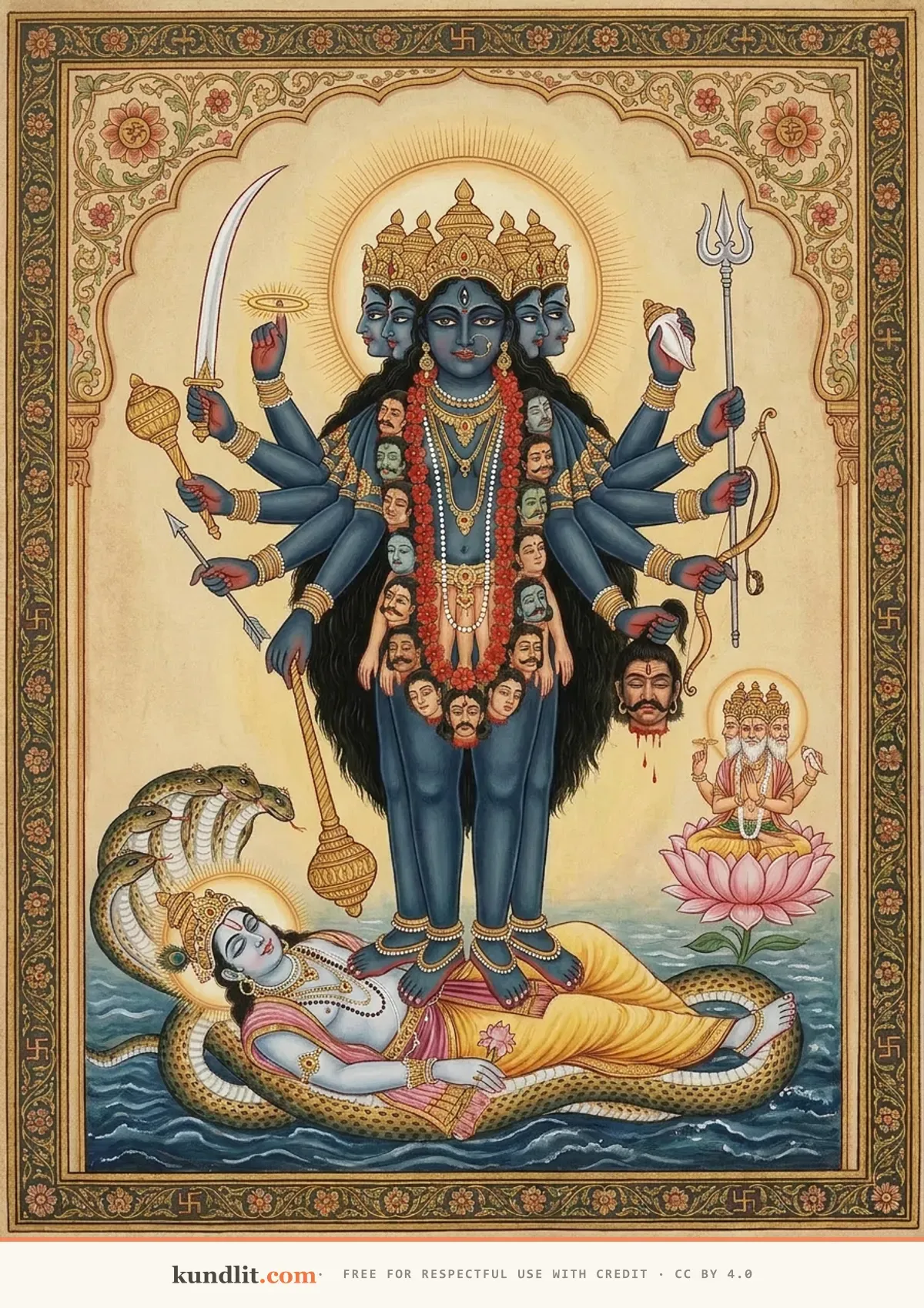
Mahakali, painted to the dhyana of the Saptashati's first chapter: ten faces, ten arms with the ten named implements, Vishnu asleep on Shesha below and Brahma praising her from the lotus. Image by kundlit.com, CC BY 4.0 — free to reuse with credit.
Mahakali is the form behind all forms — the Saptashati's own opening. In its first chapter, the demons Madhu and Kaitabha rise to destroy Brahma while Vishnu sleeps the cosmic sleep. Brahma's hymn rouses the Devi as Yoganidra to withdraw from Vishnu so he can wake and fight (Durga Saptashati, Chapter 1).
The meditation-verse attached to that first episode gives Mahakali her cosmic dimensions: ten faces, ten arms and ten feet, lustrous like blue gem, her hands bearing the sword, discus, mace, bow, arrow, iron club, trident, sling, a human head and the conch. This is not a goddess in a landscape; she is the landscape — the digests read the ten faces and limbs as her presence in all ten directions.
Where Dakshina Kali is approached for immediate grace and protection, Mahakali is the form contemplated for the largest things: the dissolution of obstacles at their root, and ultimately liberation itself.
Kali and Durga — same Devi, different work
The relationship is stated by the texts themselves: in the Saptashati, Kali emerges from Durga (Ambika) as her concentrated wrath — a weaponised aspect, born for a task. The Kalika Purana (as quoted in the compendia) even identifies the ten-armed Katyayani Durga with "Ugrakali," the fierce Kali. So Durga and Kali are not rivals or sisters; Kali is what Durga becomes when the situation is past negotiation.
The tantric digests add one refinement: the Adya (primordial) Kali of tantra — the first Mahavidya, the consumer of time from the Mahanirvana verse above — is prior even to the battlefield Kali of the Saptashati, which they treat as her avatar for that war. First the principle, then the episode.
The forms at a glance
- Dakshina Kali — the household form: four arms, sword and severed head on the left, fear-not and boon-giving on the right, standing on Shiva. Approached for protection and swift grace. (Kali Tantra; Todala Tantra, Patala 1)
- Bhadrakali — the auspicious form: axe, skull-cup, damaru and trident, crescent moon in her hair. Invoked for welfare and prosperity. (Phetkarini Tantra)
- Shamshan Kali — the cremation-ground form: fierce, reserved for initiated and renunciate practice; the teacher of impermanence. (Kali sahasranama tradition; tantric compendia)
- Guhya Kali — the hidden form: serpent-adorned, many-faced, serene; benign and liberation-giving despite the imagery. (Mahakala Samhita, Guhyakali Khanda)
- Mahakali — the cosmic form: ten faces, ten arms, ten feet, present in all directions; the Devi of the first chapter of the Saptashati. (Durga Saptashati, Chapter 1 and its dhyana)
About the images on this page
Each painting above was composed strictly to the meditation-verse (dhyana) of its form as cited in this article — the arms, implements, gestures, garments and setting come from the texts, not from imagination. They are released under the Creative Commons BY 4.0 license: you are free to use them on your website, publication or presentation, including commercially, on two conditions — credit "kundlit.com" with a link to this page, and use them respectfully, as devotional images of the Devi deserve.
Sources
- Durga Saptashati / Devi Mahatmya (Markandeya Purana) — Chapter 1 (Madhu-Kaitabha and Mahakali), Chapter 5 (Kaushiki and the dark Kalika), Chapter 7 (Kali's emergence, verses 5–8; the naming of Chamunda), Chapter 8 (Raktabija).
- Devi Bhagavata Purana — Skandha 5, Chapters 25–26 (Chanda-Munda; Chamunda naming), Chapters 27–29 (Raktabija).
- Mahanirvana Tantra — Ullasa 4, verses 30–32 (the meaning of the name Kali).
- Todala Tantra — Patala 1 (the ten Mahavidyas; Dakshina and Mahakala), Patala 3 (the eight forms of Kali), Patala 10 (Mahavidyas and the avatars of Vishnu).
- Mahakala Samhita — Guhyakali Khanda (Guhya Kali; the twenty-four divisions of Kali).
- Phetkarini Tantra — meditation-verse of Bhadrakali (as preserved in the tantric compendia).
- Kalivilasa Tantra; Kali Tantra; and the tantric compendia (Dash Mahavidya Tantra Shastra and related digests) for the standard meditation-images and form-lists.
The forms of Kali are a map of how one power meets different needs — protection, prosperity, detachment, secrecy, dissolution. If you want to see how the Devi's other map — the nine planets — was arranged at your own birth, generate your free Kundali Analysis, or go deeper with a Deep Kundali reading prepared by our astrologer.